Unitree Technology, China's most prominent humanoid robot maker, has filed its first earnings report since going public, and the numbers tell two stories at once. The company listed on Shanghai's STAR Market under the ticker 688836 on August 19, and its report for the first nine months of 2026, disclosed October 28, shows revenue of RMB 1.82 billion, up 55.71 percent year over year, with attributable net profit of RMB 387 million, up 270.54 percent. About 255 million US dollars of revenue in nine months makes Unitree one of the few quadruped and humanoid robot companies anywhere with a genuinely profitable business.
The 270 percent profit growth deserves a careful read. Unitree's own disclosure notes that the jump comes from revenue growth plus a base effect: the prior-year period absorbed roughly RMB 349 million in one-time share-based payment expenses that depressed the 2025 comparison. Strip out non-recurring items and adjusted net profit for the nine months actually fell 18.78 percent to RMB 349 million. The third quarter shows the trend without the base effect: revenue of RMB 665 million, up 69.93 percent and accelerating from 48.54 percent in the first half, but attributable net profit of RMB 113 million, down 17.37 percent year over year and down about 49 percent from the second quarter.
The reason is deliberate. Third-quarter R&D spending reached RMB 127 million, up 249.58 percent and equal to 19.10 percent of quarterly revenue, while nine-month R&D of RMB 263 million, up 191.48 percent, has already exceeded the company's full-year 2025 total. Unitree's filing attributes the increase to embodied intelligence research, specifically the development of embodied foundation models and a sharp rise in compute procurement, along with team expansion. Sales expenses grew even faster, up 202.4 percent to RMB 230 million for the nine months, lifting the expense ratio from 6.51 to 12.65 percent, helped by brand campaigns including the CCTV Spring Festival Gala.
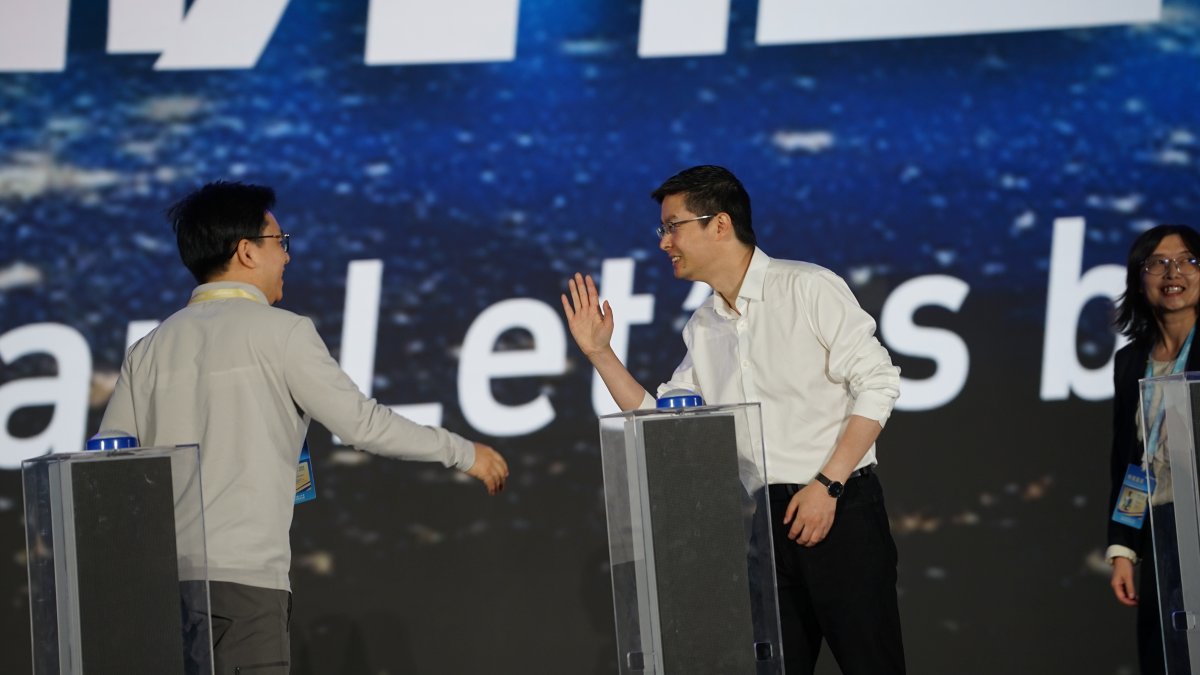
The strategy was on display days before the filing. Founder and CEO Wang Xingxing told the World Physical AI Conference on October 22 that physical AI already shows signs of a breakthrough moment, and the company's own research direction, the UnifoLM embodied model family, is where most of the new RMB is going. The bet is that whoever owns the robot brain owns the category, and hardware profits are the fuel rather than the finish line.
The market had been pricing in momentum. JPMorgan upgraded the stock to overweight on October 25 and lifted its December 2027 target price from RMB 300 to RMB 995, and the shares had run up despite two risk-warning announcements in a single week. After the filing, the stock opened down 6.13 percent on October 29 and closed at RMB 662.39, still a multiple of the IPO-era valuation, and still well below the investment bank's new target.
The fundamentals underneath are real. Counterpoint estimates Unitree held about 37 percent of global quadruped robot shipments in 2025, ranking first, and its humanoid line, the industrial H1 and the lighter G1, is moving from pilots in car factories and substations toward volume delivery. China's humanoid robot market is forecast at RMB 8.24 billion for 2025, and Unitree is its reference asset: the first quarterly report from the sector's flagship listing.
What the report really settles is a question about the whole category, not one company. Skeptics have long argued humanoid robots are a story stock that cannot turn a profit, and Unitree's nine-month statement answers that in the affirmative. The more interesting tension is the one the company chose: it is spending its hard-won hardware margin on models and compute at a pace that guarantees several quarters of shrinking reported profit, because in its judgment the window to own physical AI is open now and will not stay open long.
Comments (0)
Log in to join the discussion
Log InNo comments yet