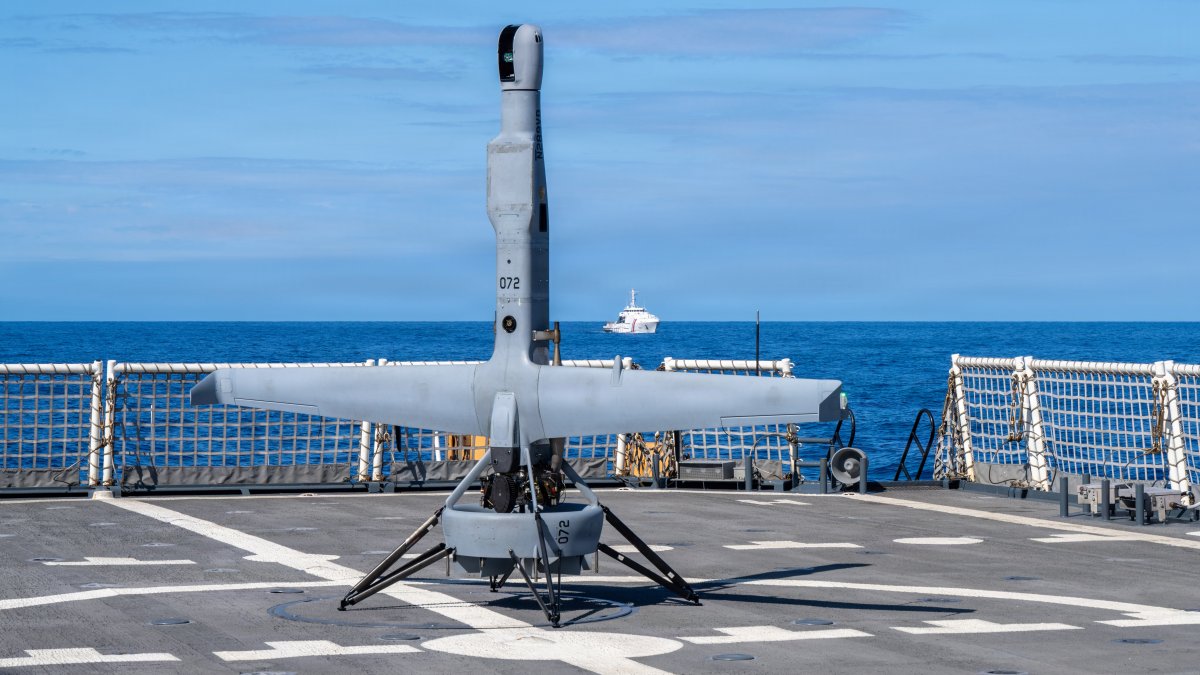
Shield AI, the defense technology company behind the Hivemind autonomy software and the V-BAT and X-BAT aircraft, said it has signed a definitive agreement to acquire radar maker Echodyne Corp. in a transaction valued at $5.3 billion, and is raising $2.5 billion in fresh capital to pay for it. Of the deal value, $4.8 billion will be paid or issued at closing, with up to an additional $500 million contingent on Echodyne hitting agreed performance targets.
The financing package that accompanies the deal is unusually large for a private defense startup. It includes a $1 billion Series H at a $28.8 billion post-money valuation, co-led by Disruptive and Innovation X Capital with participation from Advent, the Strategic Investment Group of JPMorganChase's Security and Resiliency Initiative, Snowpoint Ventures, Apandion and Center15 Capital. On top of that come $1 billion in structured equity from funds managed by Blackstone and $500 million in debt financing led by JPMorgan Chase Bank as sole arranger.
The valuation marks a steep climb for the company. In March it raised $2 billion at a $12.7 billion valuation, so the new round more than doubles that figure in roughly eight months. Both companies said they expect triple-digit revenue growth this fiscal year, a company projection that has not been independently verified.
Echodyne, based in Kirkland, Washington, builds compact solid-state radars using its patented Metamaterials Electronically Scanned Array technology. Its radars are built into hundreds of counter-drone and security systems used by defense, government and commercial customers in more than 40 countries, and in September it won a contract with a $250 million ceiling from Joint Interagency Task Force 401 to supply counter-drone radar to US and allied forces. The company recently opened an 86,350-square-foot manufacturing facility, a $40 million investment capable of producing about 30,000 radars per year.
For Shield AI, the acquisition extends its Mission Systems business into the fast-growing counter-drone sector and adds a hardware layer to an offering that until now has leaned on software and aircraft. "We are building a new-generation defense technology company consisting of three fast-growing, high-margin, mutually supporting business units: autonomy software, autonomous systems, and mission systems," CEO Gary Steele said in the announcement.
Echodyne CEO Eben Frankenberg, who will report directly to Steele and keep running the radar business as a standalone product line, framed the logic simply: autonomous systems can only act on what they can sense, and better sensors lead to better autonomous behavior. His company's radars detect and track drones for everything from stadium and airport protection to police and fire departments flying in shared airspace.
The deal is expected to close in early 2027, subject to regulatory approvals and customary conditions. J.P. Morgan Securities advised Shield AI, while Morgan Stanley and Robert W. Baird advised Echodyne.
The transaction is the latest sign that private capital is rotating deeper into defense AI. Investors have spent months worrying publicly about how autonomous systems firms will convert hype into revenue, and Shield AI's answer is to buy the sensing layer that makes its autonomy stack useful, before it has to test that thesis in the public markets.
Comments (0)
Log in to join the discussion
Log InNo comments yet