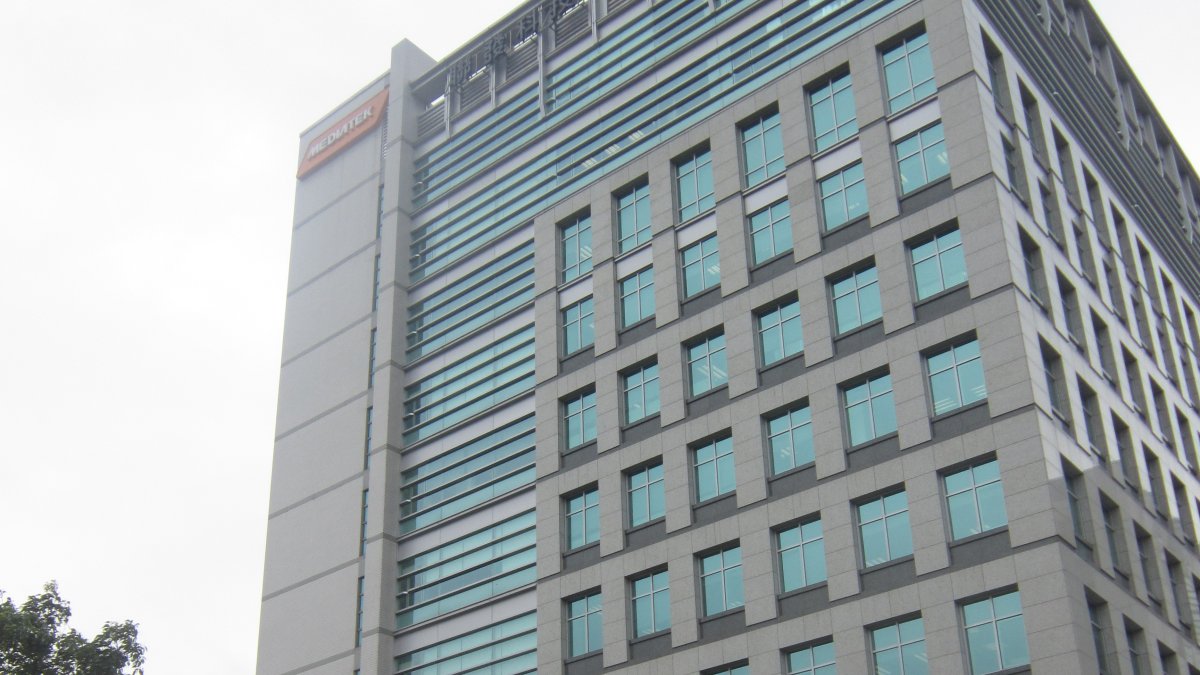
The smartphone chip business that made MediaTek Taiwan's second-most-valuable company now has a second engine, and it just started turning. On its third-quarter earnings call Friday, the company said its first data center AI accelerator began initial shipments in September and is expected to generate $2.5 billion of revenue in the fourth quarter alone. All forward figures on the call are company guidance, not independently audited results.
The quarterly numbers themselves were solid if unspectacular: revenue of NT$168.1 billion, up 18.3 percent year over year, gross margin of 46.3 percent and net income of NT$28.2 billion, up 10.8 percent. The AI program is what moved the story. MediaTek said demand for the first accelerator remains strong enough that it now expects the project to reach the high end of its 2027 revenue target range of approximately $16 billion, which it pegs at around 20 percent of the total AI accelerator ASIC market. That is a company estimate, and the market-share math depends on how the rest of the custom-silicon field performs.
Just as notable was what MediaTek said about its customer roster. It confirmed a second AI ASIC customer has signed on, with the new project expected to enter mass production and contribute revenue in 2028 - and it explicitly pushed back on market speculation, saying the second customer is not a Chinese company. That comment appeared aimed at persistent rumors linking the slot to ByteDance. MediaTek did not name the customer or the chip specifications.
The second-generation accelerator is progressing on schedule for high-volume production in the first quarter of 2028, Tsai said, with several dies already taped out; the larger, more complex dies are running two to three weeks behind the smaller ones but remain within the original timeline. On packaging, MediaTek is working with a US integrated device maker widely believed to be Intel on the EMIB-T process, while stressing that TSMC remains its most important partner across the supply chain.
Funding the ramp required an unusual structure. During the quarter MediaTek completed a $3.9 billion overseas convertible bond offering - a record for the company - with participation from Nvidia, which took $3.5 billion according to Reuters, and Alphabet. The bond does double duty: it deepens ties with the two companies whose ecosystems MediaTek is plugging into, and it secures capital and capacity for the components the expansion needs. Through its NVLink Fusion partnership, MediaTek connects customer XPUs to Nvidia's NVLink ecosystem, and it also supports UALink for Ethernet-based rack architectures.
The momentum showed up in guidance. MediaTek forecast fourth-quarter revenue of NT$210.1 billion to NT$221.8 billion, up 25 to 32 percent sequentially, with gross margin between 43.5 and 46.5 percent, and said full-year 2026 revenue growth in US dollar terms will beat its previous high-single-digit target. The stock has climbed 174 percent this year, far outpacing the Taiwan benchmark's 56 percent gain, and closed down 3.2 percent ahead of the results.
The strategic readout is that the custom ASIC market has matured into a genuine second pillar of AI silicon. Broadcom and Marvell have owned the merchant ASIC lane for years; MediaTek's entry at $16 billion-a-year scale, backed by Nvidia's own balance sheet and shipping into the same TSMC advanced packaging ecosystem, makes custom accelerators a three-horse race - one whose customers are, increasingly, the same hyperscalers funding the rest of the AI buildout.
Comments (0)
Log in to join the discussion
Log InNo comments yet