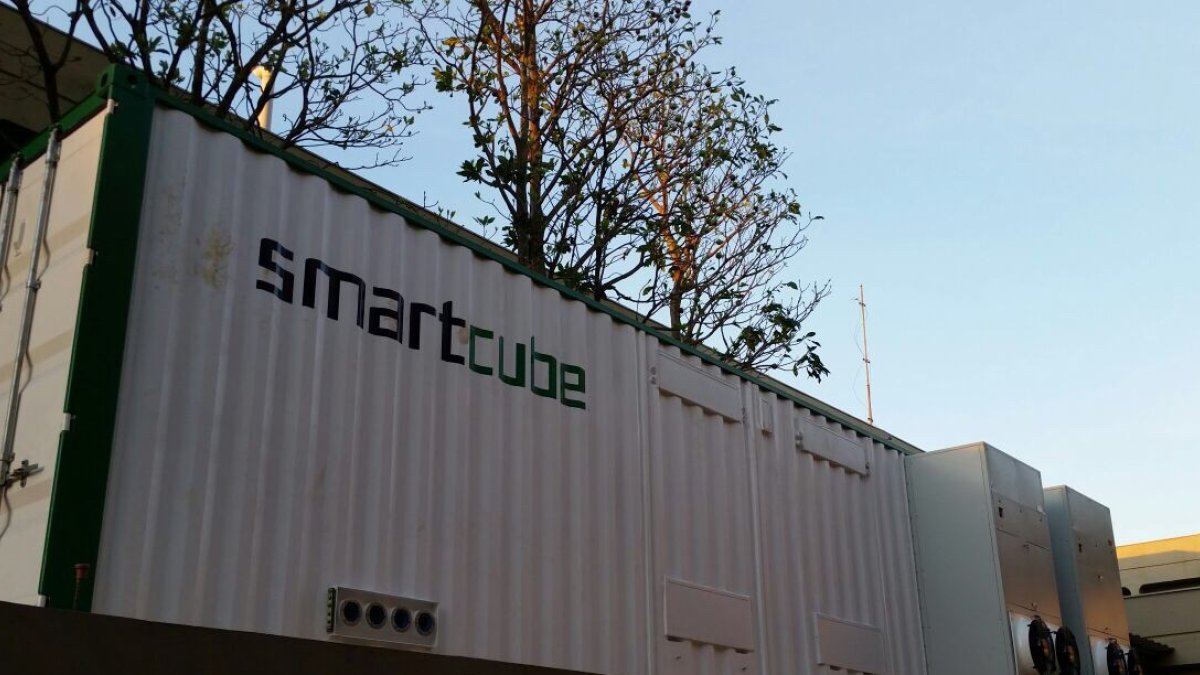
Runware, the AI infrastructure company that showed off a factory-built inference pod in August, now says it wants to manufacture those pods the way automakers build cars: on a moving production line, at volume, with a fixed bill of materials.
Chief executive and co-founder Flaviu Fadulescu told TechCrunch that Runware plans to scale output at its Romanian factory to 30 megawatts of data center capacity per day by 2028. That works out to nearly a gigawatt a month. For scale, the entire United States was expected to add about 10 gigawatts of data center power this year, according to Goldman Sachs research, so Runware is describing an annual output roughly equal to a year of national buildout.
The pitch is speed rather than novelty. Prefabricated and modular data centers are already sold by Crusoe, Schneider Electric, and, in effect, by Nvidia, whose Vera Rubin AI factory designs and DSX Pod reference architectures let customers assemble their own. Runware's distinction, according to Fadulescu, is that it has actually built a factory rather than a blueprint. The company operates one plant it has used for several years and is finishing a second that should come online early next year.
The operational numbers are the interesting part. A pod that once took three weeks to build will soon take a single day, the company says, and once a pod reaches a customer site, Runware aims to have it running within 48 hours. That figure covers installation and commissioning, not manufacturing. Customers can supply their own land or ask Runware to find a site, bring their own GPUs or rent compute from Runware, and pay a monthly fee for the hardware and operations, with power and connectivity billed separately.
Runware says it has received $1 billion in committed interest for its Sonic pods since opening them to outside customers a month ago, representing more than 20 megawatts it is now working to deliver. It also says it is working with power providers on a site pipeline covering 397 megawatts, with the potential to expand to 1.2 gigawatts. The pods use closed-loop liquid cooling with air-cooled radiators, so they need a power connection and an internet link but no water supply, and the company says they run silently up to 86 degrees Fahrenheit.
Money is the constraint that matters. Runware has raised more than $60 million to date, including a $50 million Series A in December 2025 led by Dawn Capital and Comcast Ventures, and says it plans a Series B. Building a real production line out of that budget is a different order of difficulty from shipping custom pods, and the sector has a cautionary tale: the electric vehicle startup Arrival reached a valuation above $13 billion on the promise of microfactory manufacturing and ended up selling its assets in bankruptcy. Fadulescu argues the cost structure differs because factory labor is cheap relative to the value of deployed AI compute, and says Runware has hired a plant manager from the automotive industry.
Supply chain risk is real as well. Runware designs its own cooling and pod systems around standard components, but pumps and fans come from Germany and networking still depends on Nvidia, whose GPU lead times have historically run longer than pod delivery times, a mismatch the company treats as an advantage because it can adapt a pod to whichever chip generation arrives.
What this means: the bottleneck in AI infrastructure has moved from chips to the physical envelope around them, and the companies that win the next phase may be the ones that can deliver powered, cooled, connected capacity in weeks instead of years. Runware has the clearest public thesis on that idea, and, as of now, one factory and a plan. Whether pods can be mass-produced like cars will be decided by the boring middle of the problem: inventory, staffing, quality control, and whether power utilities can move as fast as the production line.
Comments (0)
Log in to join the discussion
Log InNo comments yet