AMD said Microsoft has powered up its first Helios rackscale solution at a Microsoft research lab, a qualification step that puts AMD's full-rack AI platform inside the validation process of one of the two largest cloud providers. According to AMD's announcement, Microsoft accepted delivery of the system this fall, and engineers from both companies have it successfully performing early workloads as they collaborate on the next Azure rack-scale AI system.
Azure plans to deploy Helios at scale to support frontier models and customer applications, and AMD says Microsoft's cloud is expected to be among the first service providers putting a Helios system to work delivering AI inference - generating responses and executing tasks with trained models. What AMD did not publish is a date. There is no commercial timetable, no pricing, and no third-party benchmark.
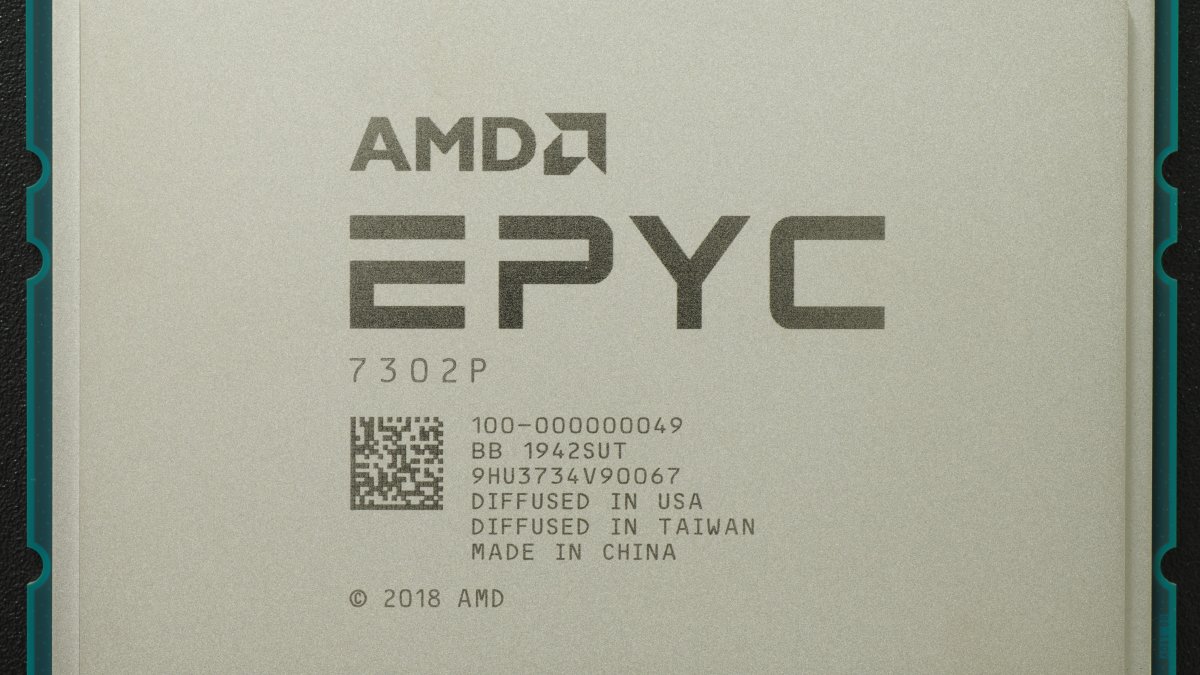
The rack itself is the product. One Helios pairs 72 Instinct MI455X GPUs - each carrying 432GB of HBM4 with 23.3 TB/s of bandwidth - with 18 sixth-generation EPYC Venice server CPUs, for roughly one host processor per four accelerators. Aggregate memory is 31TB of HBM4 with about 1.7 PB/s of memory bandwidth, scale-up bandwidth reaches 260 TB/s, and scale-out bandwidth 43 TB/s. AMD rates peak compute at up to 2.9 exaFLOPS in FP4 and 1.4 exaFLOPS in FP8 per rack, with Pensando Salina DPUs and Vulcano NICs handling networking on an OCP-style design cooled entirely by liquid.
The competitive claims are all AMD's own. The company has published comparisons against Nvidia's Vera Rubin NVL72 - up to 15% more peak FP4 performance, 50% more HBM capacity, 6% more HBM bandwidth, 50% more scale-out bandwidth, and up to 30% more tokens per dollar. These are vendor figures, not independently verified results, and the honest caveat applies to every one of them: peak theoretical throughput does not establish real-world economics.
The shape of the announcement - hardware counts with no performance numbers - is what a platform qualification looks like before it becomes a product. A research-lab rack and a region full of production racks are separated by qualification, supply, power contracts and customer agreements. AMD has spent the past weeks stacking the commercial case around Helios: a six-gigawatt multi-year agreement with OpenAI, Oracle's OCI supercluster built on 50,000 MI450 GPUs, and Helios racks already live for Meta. Microsoft is the kind of anchor customer that turns a challenger architecture into a procurement option.
Inference is the market that makes this matter. Training contracts are few and planned months ahead; inference happens on every request and is priced per token. A vendor that can only sell training capacity competes for a handful of deals a year. A vendor that can serve inference competes on every query, which is why AMD's disclosure leads with a rack rather than a chip, and why the missing number - sustained tokens per dollar under real load - is the one that will eventually decide whether Azure's Helios deployment is a press release or a business.
Comments (0)
Log in to join the discussion
Log InNo comments yet