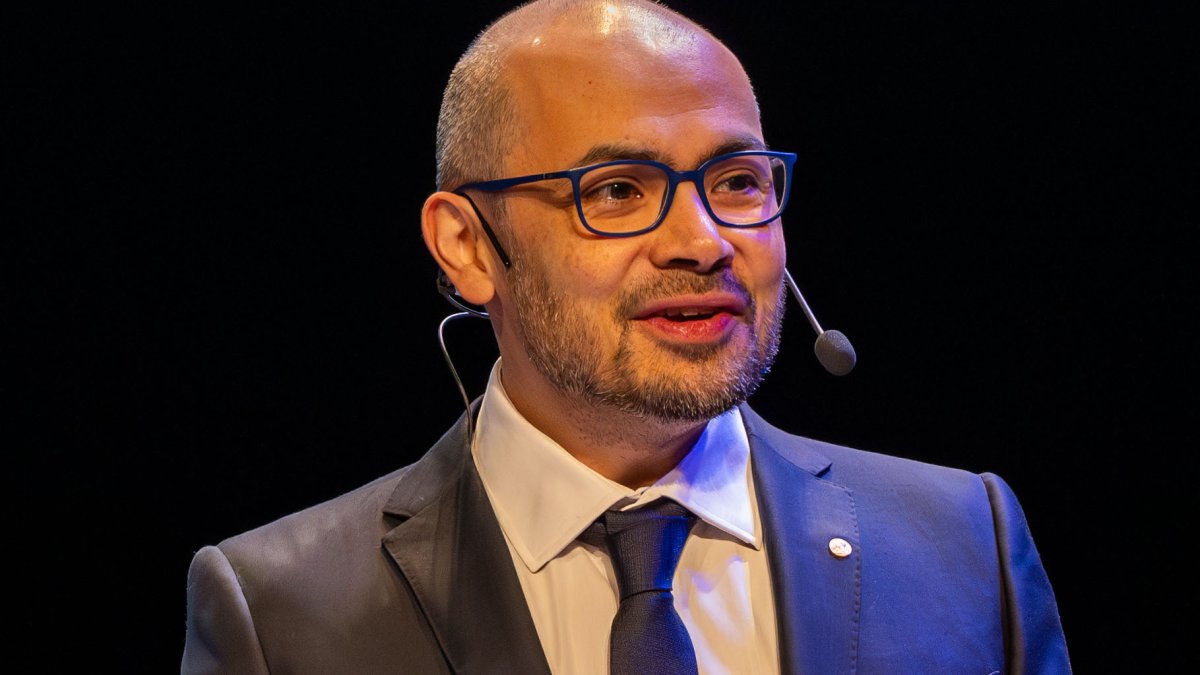
Demis Hassabis has shortened his own countdown. The Google DeepMind founder and Nobel laureate told the Wall Street Journal that artificial general intelligence could arrive within two to three years, pulling forward the three-to-five-year estimate he held earlier this year. "It's going to happen soon. My estimate keeps moving closer to the present," he said in the interview.
Hassabis uses a deliberately strict definition: AGI is a system that matches the full cognitive range of the human brain, not one that clears a basket of economic or task-based benchmarks. His practical litmus is what he calls the Einstein test — could a system trained only on knowledge available before 1901 independently reproduce Einstein's 1905 papers? It is a thought experiment rather than a measurable metric; no evaluation protocol or model has been published against it, which is precisely what makes it a bar that cannot be gamed by benchmark tuning.
The direction of the revision matters more than the number. Hassabis has moved his estimate inward by one to two years in a matter of months, and he is among the most prominent researchers who hold AGI to a brain-level standard rather than a product-level one. When the person applying the strictest definition is also the one compressing the timeline fastest, that is a signal about what frontier-lab leadership thinks it is seeing in internal progress — though it remains a forecast, not a disclosure, and there is no benchmark result attached to it.
Hassabis paired the timeline with his usual sense of scale, comparing AGI's expected impact to ten times the industrial revolution at ten times the speed. That characterization is his own; no economic modeling accompanied it in the interview.
On governance, he renewed a proposal that has been gestating for months: an industry-funded oversight board operating under government control that would vet frontier models before release. He also warned that bad regulation is worse than none. The proposal remains a position statement — the funding mechanism, legal authority, scope of covered models and pass/fail standards are all undisclosed.
Skeptics will note the unfalsifiable structure of the claim: a two-to-three-year window cannot be wrong until it expires, and the definitional rigor that makes the Einstein test admirable also guarantees that any claimed arrival will be argued over for years. Forecast revisions from lab leaders have historically tracked funding cycles as often as capability curves.
Still, the combination is coherent and worth tracking as a package: a shortened timeline, a definition that resists benchmark inflation, and a push to stand up pre-release vetting before the capabilities arrive. Hassabis is effectively arguing that governance has a deadline too — and that it is the same one on his clock.
Comments (0)
Log in to join the discussion
Log InNo comments yet