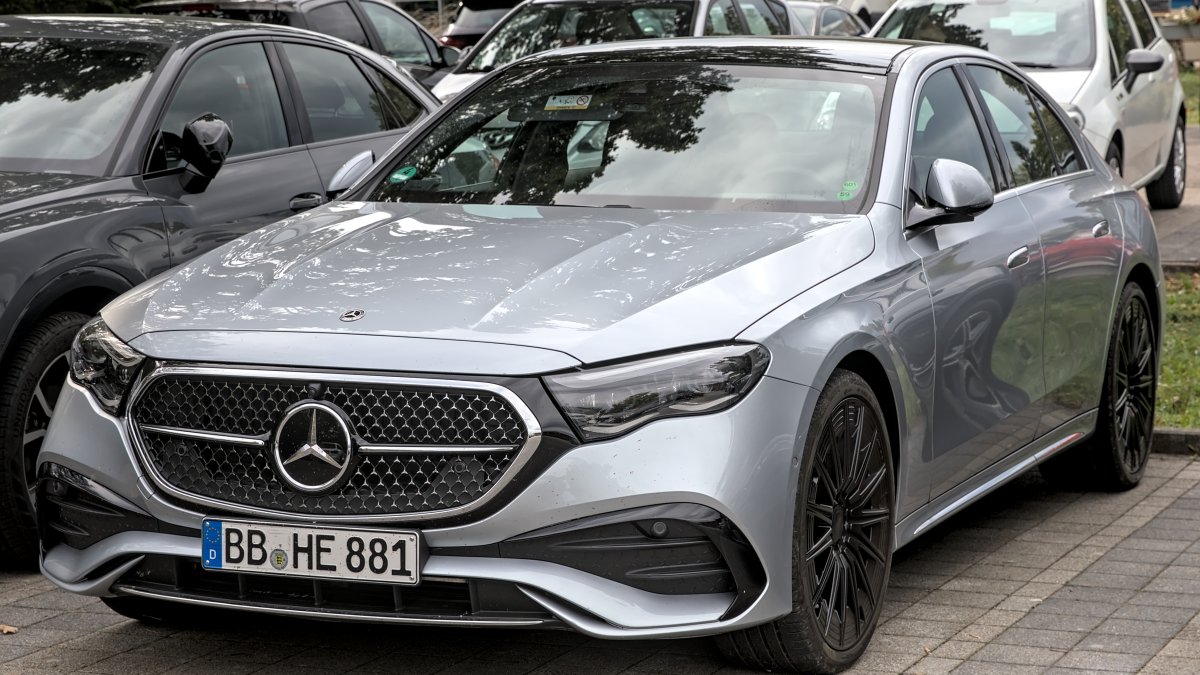
The next time a Mercedes-Benz driver asks the car to warm the seats or navigate home, the answer may never leave the vehicle. Mercedes-Benz has begun rolling out a conversational AI system built on models from Liquid AI, an MIT spinout, that processes supported voice commands directly on the car instead of routing every request to a data center, The Wall Street Journal reported on November 5.
The deployment started in October through over-the-air software updates in North America. The first vehicles to receive it are the 2027 E-Class and CLE, along with selected older models whose hardware qualifies. The feature runs on the third- and fourth-generation versions of the MBUX infotainment system, using the MB.OS software architecture Mercedes has been building as the software backbone of its cars.
The division of labor is deliberate. Everyday vehicle interactions such as adjusting climate and seat settings, entering navigation, playing music and making phone calls are handled by the onboard models, a scope Mercedes-Benz North America CEO Jason Hoff has described in the companies' messaging. More open-ended requests, such as recommendations for restaurants nearby, still fall back to larger cloud-based models. Mercedes says the embedded system complements rather than replaces its cloud AI, and that benefits include lower latency, more privacy for locally processed requests and fewer dead zones when connectivity is weak. Those advantages are company-stated rather than independently measured.
Liquid AI is a roughly three-year-old MIT spinout based in Cambridge, Massachusetts, led by CEO Ramin Hasani, that builds compact foundation models designed to run efficiently on hardware that already exists rather than requiring new chips. Mercedes-Benz announced the multiyear partnership in April 2026, covering speech recognition, language understanding and reasoning for MBUX-equipped vehicles in North America, with a first production deployment originally targeted for the second half of 2026. The October rollout meets that target. Neither company has published the size of the onboard models or detailed performance figures.
Mercedes-Benz chief technology officer Joerg Burzer has framed on-device speech, language understanding and reasoning as foundational technologies for more intuitive multimodal in-car experiences. Hasani has called software-defined vehicles one of the most consequential real-world applications of AI, pointing out that the models are built to deliver fast, private responses on the processors and memory already installed in production cars. Drivers will not pay extra: the feature ships without an additional subscription.
The roadmap widens quickly. Mercedes plans to extend the capability to the 2027 S-Class, the electric GLC and the GLE in the second quarter of 2027, and the companies say they will explore additional product development opportunities as the partnership expands. The feature is aimed at the cabin experience rather than autonomous driving.
The significance goes beyond one badge. Cars are the most visible example of a broader shift in consumer AI: local models handling narrow, well-defined tasks like understanding a spoken command, while cloud systems keep the open-ended work. Automakers get lower latency and a privacy story, and the approach scales across vehicles already on the road because no new hardware is required. Watchboards should note what is still unverified: how large the onboard models are, how often requests fall back to the cloud in practice, and whether the latency and privacy benefits show up in independent testing.
Comments (0)
Log in to join the discussion
Log InNo comments yet