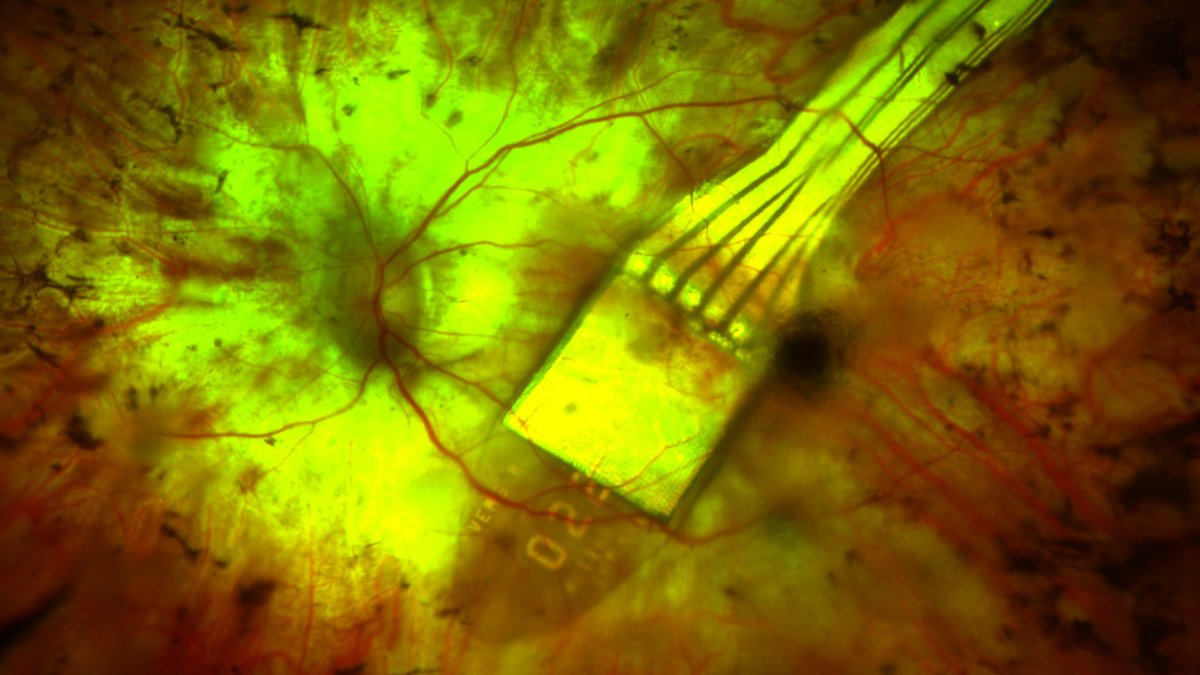
Science Corporation, the neurotechnology company founded by former Neuralink president Max Hodak, has implanted its PRIMA vision-restoring chip in its first patient with Stargardt disease, an inherited condition that progressively destroys central vision. Hodak announced the milestone on stage at TechCrunch Disrupt, positioning it as an early step in a broader bid to turn retinal prostheses — and eventually brain interfaces — into routine medicine.
The first Stargardt patient received the implant in May as part of an ongoing trial at Sydney Eye Hospital in Australia. The progress was fast by the standards of sensory prostheses: during the first rehabilitation session the patient saw a single letter, and during the second he was able to read a word.
The procedure takes about an hour. Surgeons place a chip measuring two millimeters by two millimeters at the back of the eye, where the light-sensing cells have degenerated. The patient then wears camera-equipped glasses that transmit what they see to the implant, which effectively works as a set of artificial photoreceptors.
The resulting vision is deliberately modest. Hodak compared it to looking through a straw: a patch of central vision that is black-and-white rather than color, but sharp and high-contrast, enough to make out a few letters at a time. The goal now, he said, is a bigger field of view — which means dealing with the curvature of the eye and shrinking the electrodes to approach the resolution of native vision.
PRIMA is not experimental everywhere. The device is already commercially available in Europe for patients who have lost sight to geographic atrophy, an advanced form of age-related macular degeneration. Stargardt is a different target: it attacks the outer retina and kills off light-sensing cells while often sparing the inner retina that carries signals to the brain, and roughly 150,000 people worldwide have lost vision to it.
Hodak said the company has a clear path forward, with a next-generation device expected to reach humans within the year and performance approaching native visual acuity within five years. He framed the technology in broader terms: "The retina is part of the central nervous system. We consider cochlear implants, retinal prostheses, motor prostheses, these are all different types of BCIs."
That framing is central to how Science differs from Neuralink, which Hodak left in 2021. Rather than threading electrodes into brain tissue, the company's neural interface sensor is designed to sit inside the skull and rest on the surface of the brain. Its first clinical indication — not yet announced publicly, Hodak said — is a neurodegenerative disease, and the company is also looking at stroke, including the possibility of adding new cortical connections to areas the brain has lost.
What it means: vision restoration is the revenue-generating bridge while the harder brain-interface work matures, and the Stargardt trial is a test of whether one implant platform can stretch across multiple diagnoses. If the five-year acuity target is even roughly right, retinal prostheses stop being a last-resort device and start competing with the biology they replace.
Comments (0)
Log in to join the discussion
Log InNo comments yet