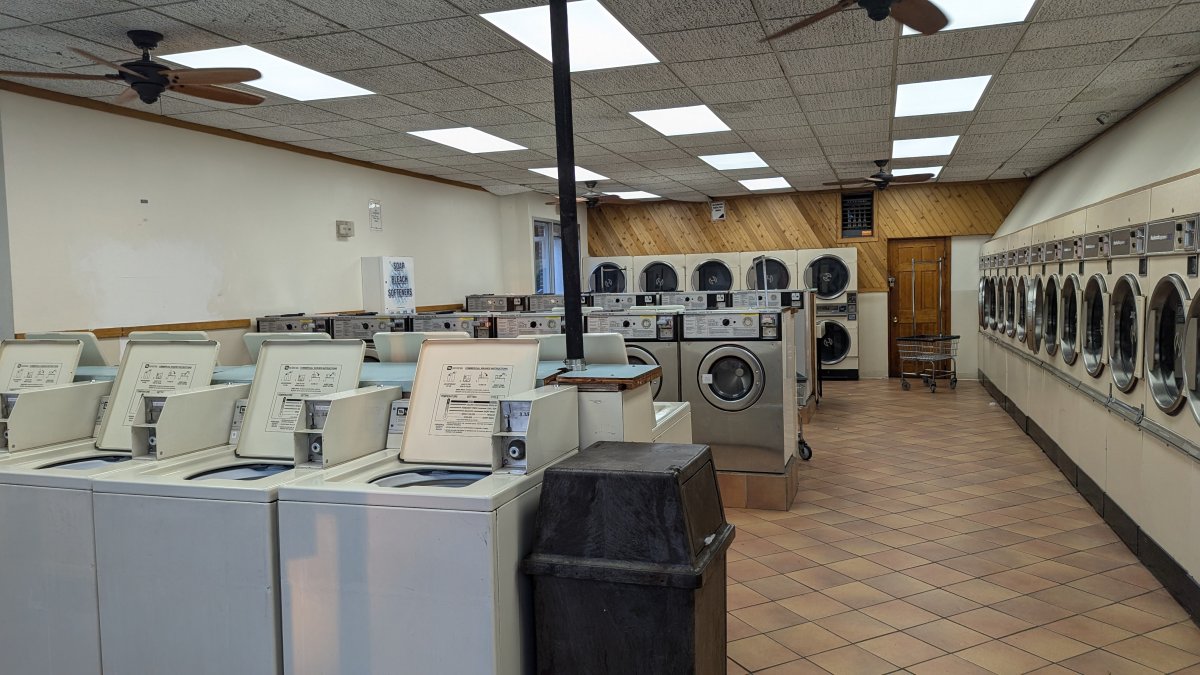
A robot that folds a towel is no longer impressive. A robot that keeps a commercial laundry room running for an hour without a person stepping in is the claim Dyna Robotics made this week, unveiling Dyna 2.1 and a new wheeled semi-humanoid called Taku.
The hardware reflects a deliberate bet against bipedal designs. Taku has a human-shaped upper body, two arms with seven degrees of freedom each, a lower body that folds to reach low shelves and washing machine drums, and four steerable wheels. Dyna's reasoning is that the commercial environments it targets - hotel laundry rooms, laundromats, restaurant back-of-house - have floors built for carts and workers, so balance is not the hard problem. Reach and manipulation are. The company sized Taku like an average person so that human motion-capture data - recorded wrists, elbows and chest positions - maps naturally onto its reachable poses. End effectors are interchangeable between parallel-jaw grippers and dexterous hands.
The workflow argument is the interesting part. Dyna says a commercial laundry cycle chains roughly 79 steps, and that at 95% reliability per step a cycle almost never finishes unattended, because small failures compound and some mistakes undo earlier work - a dropped towel has to go back in the wash. The process is also non-linear: machines finish on their own schedules, folding has to be interruptible, and a finished machine left idle is lost capacity. The system breaks a cycle into 13 decision points, several of which depend on information observed minutes or hours earlier, such as when a washer started or which shelf has room.
Under the hood, Dyna 2.1 splits responsibility by timescale across three layers. A whole-body controller trained with reinforcement learning in simulation converts task-space target trajectories into joint commands and wheel velocities at 100 Hz. The Dyna-2 policy, an improved version of the company's world-action model, turns the current step into whole-body target trajectories. Above both, a vision-language orchestrator tracks the workflow, maintains a compressed text-based memory of progress - which machine is running, whether doors are open, how many towels have been folded - and decides what should happen next. A shared data interface, which Dyna calls the Unified Robot Representation, lets human recordings and robot data describe a body the same way in a locally consistent frame, so both can feed the same training pipeline.
That data strategy is where the numbers come from. Dyna says it pretrained its action model on one million hours of human video mixed with robot fleet data, using whole-body poses tracked from the footage as targets. The earlier Dyna-2 model, pretrained on human video alone, passed 87% of customer acceptance tests zero-shot on a stationary robot at sites it had never seen, against 46% for the previous generation. Earlier stationary deployments reportedly reached a new site's production bar in as little as three days. All of these figures are company-reported.
The team has a track record in this space. Founders Lindon Gao and York Yang previously sold Caper AI, a self-checkout startup, for \$350 million, and co-founder Jason Ma is a former DeepMind research scientist. Backers include CRV and First Round.
The caveats matter as much as the demo. Dyna says Dyna 2.1 is being deployed at hotels, laundromats and restaurants, but it has not named customers, fleet size, shift reliability, pricing or service terms - and its pitch to buyers, that customers want "a robot that can become a whole employee," is a promise rather than a contract. By comparison, Figure's 03 and Agility's Digit are bipeds with named industrial pilots; Dyna's public evidence for 2026 is a company-run demonstration.
What it means: the shift in benchmark is the real story. Mean Time Between Interventions is closer to how a hotel operator or a laundry chain would actually judge a return on a robot, because it measures productive minutes rather than isolated successes. Per-task success rates were always a proxy. Selling a role instead of a task is the harder test - and the one Dyna has now set for itself.
Comments (0)
Log in to join the discussion
Log InNo comments yet