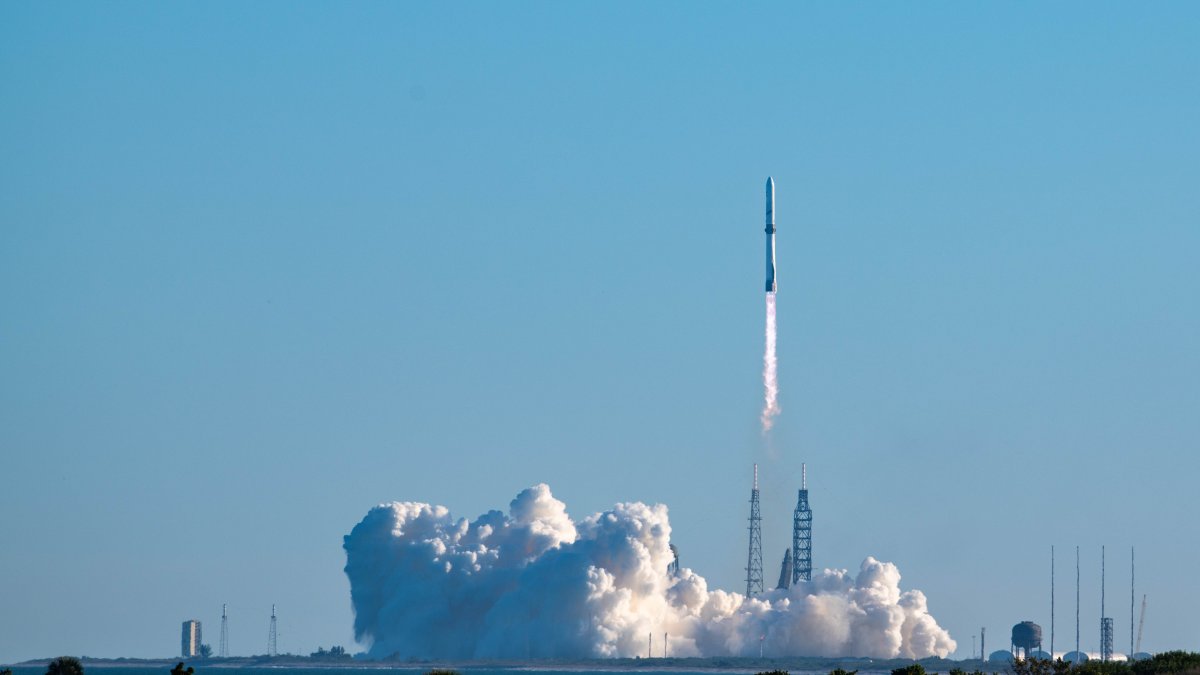
Google has signed a launch services agreement with Blue Origin to send the next phase of Project Suncatcher to orbit: multiple solar-powered satellites carrying the company's Tensor Processing Units, deployed on a New Glenn rocket targeted for the first quarter of 2029. Blue Origin announced the deal on Thursday. It will be the first dedicated heavy-lift flight for Suncatcher, the research program exploring whether machine learning compute can be scaled in space.
The mission is designed to place the satellites in sun-synchronous orbit, where they receive near-continuous sunlight. Google says each satellite is designed to provide computing capacity roughly comparable to one rack of servers in a conventional data center. The companies have not disclosed how many satellites the flight will carry or the value of the agreement.
The contract moves Suncatcher past its prototype stage. Google and Planet Labs launched the first prototype aboard a SpaceX Falcon 9 on October 1, and by the end of October the spacecraft had powered up its host and TPU trays in orbit, with an onboard Gemma 4 model generating a haiku that Google described as the first AI response from a data-center-class TPU in space. The disclosed roadmap also includes a 2027 milestone involving two interconnected satellites, which engineers will use to test the harder problems: radiation tolerance, cooling without airflow, and laser links between spacecraft flying in close formation.
The energy logic is the core of the pitch. Satellites in low Earth orbit can generate up to eight times more solar power than panels on the ground, and orbital compute avoids the land, grid and cooling constraints that are increasingly bottling up AI data centers on Earth. SpaceX and the startup Starcloud are pursuing similar visions, and the field has moved from papers to hardware in barely a year.
The engineering case remains unproven. Radiation can damage electronics and corrupt data, chips must shed heat through pipes and radiators rather than airflow, and the proposed clusters depend on high-bandwidth laser links that require each satellite to know its position relative to its neighbors with precision. Experts Reuters cited also point to launch costs, limited satellite production and reliability as reasons orbital data centers remain years away from commercial viability, whatever the roadmaps say.
For Blue Origin, the agreement is a flagship future mission for New Glenn, which can lift 45 metric tons to low Earth orbit and more than 13 metric tons to geostationary transfer orbit with a seven-meter payload fairing and a reusable first stage rated for a minimum of 25 flights. The company has been rebuilding momentum after delays and a launchpad explosion in May. "New Glenn's heavy-lift capacity and large payload volume give customers the flexibility to bring new capabilities to orbit," said Jordan Charles, Blue Origin's senior vice president of New Glenn. Google's Travis Beals, senior director of Project Suncatcher, called the dedicated launch a milestone for the program.
The 2029 flight will not decide whether space data centers make business sense, but it sets the first concrete date on which a networked, multi-satellite AI compute system is scheduled to fly. If the 2027 twin-satellite tests clear their hurdles, the Q1 2029 mission becomes the first real demonstration of orbital machine learning at rack scale; if they do not, Suncatcher joins a long line of infrastructure visions that looked better in orbit than on a balance sheet.
Comments (0)
Log in to join the discussion
Log InNo comments yet