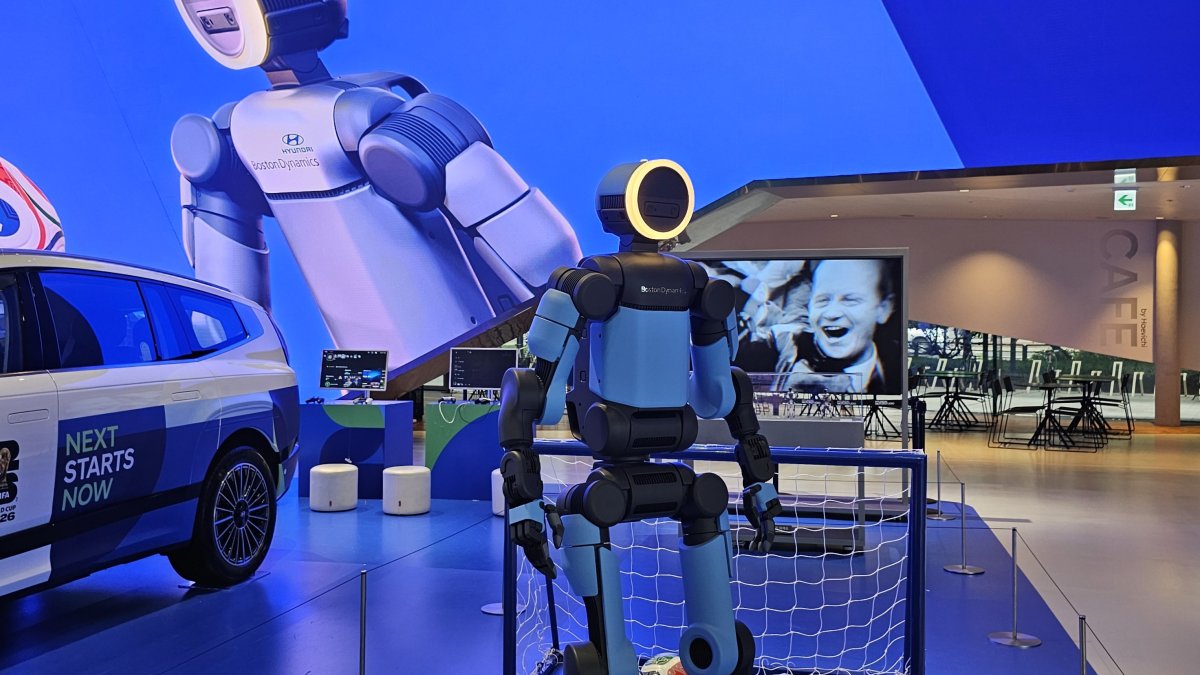
Boston Dynamics and GlobalFoundries said on November 17 that they are widening a four-year robotics relationship from a single site to a global programme, and adding a humanoid to the mix. Spot quadruped robots will be deployed across GlobalFoundries fabs in Malta, New York; Burlington, Vermont; Dresden, Germany; and Singapore. GlobalFoundries will also become the first semiconductor manufacturer to test Boston Dynamics' Atlas humanoid under the company's early adopter programme, and the first Atlas customer outside the automotive industry.
The existing deployment supplies the numbers behind the announcement. GlobalFoundries has run Spot at its Burlington site for more than four years. In Singapore, where the programme was extended more recently, two Spot robots have travelled nearly 900 kilometres and completed more than 90,000 inspections in sub-fab areas since April, with a 99% mission success rate, according to the companies. GlobalFoundries also redeployed 875 routine inspections onto the robots in two weeks and says it has a roadmap to more than double that count using Spot's visual inspection capabilities.
"Spot has helped us shift from reactive to predictive maintenance, collecting data across thousands of inspection points to prevent downtime and keep our fabs running more efficiently," said Pradip Singh, chief manufacturing officer at GlobalFoundries. He described scaling Spot and testing Atlas as the next steps in what the company calls AI-enabled manufacturing.
The humanoid work begins in early 2027, when the two companies will start testing Atlas on site. The stated goals are to evaluate potential humanoid use cases, assess customer readiness and integration needs, and begin early testing and training for specific task execution. Neither company said which tasks Atlas would take on, how many robots would be involved, or what payload or reach requirements a cleanroom environment would impose. A skills development workshop tied to the programme is meant to feed GlobalFoundries' broader effort to upskill employees in AI.
"GlobalFoundries was one of our earliest customers to adopt Spot, and we are excited to see the program continue scaling across the globe," said Zack Jackowski, chief product and technology officer at Boston Dynamics. He framed the value as operational today plus data collection that will be useful for manufacturing innovation in the next few years.
The semiconductor fab is an unusual first stop for a general-purpose humanoid. Cleanrooms impose strict particle, vibration and chemical constraints, and much of the work is already automated by fixed handling equipment. The tasks that remain for people tend to be irregular: moving cassettes and parts between tool sets, inspecting equipment, and assisting in areas where fixed automation is too rigid to justify the retrofit.
GlobalFoundries is one of the largest contract chipmakers outside Asia and has been expanding capacity in the United States and Europe under industrial policy incentives. Boston Dynamics has been owned by Hyundai Motor Group since 2021, and Hyundai has been pushing the robot maker toward factory deployments of its own. The Atlas early adopter programme is designed to put the humanoid into customer facilities before general commercial availability, with the customer paying for the integration work rather than the robot alone.
For the wider humanoid sector, the significance is less about Atlas than about the buyer. Semiconductor manufacturing is a high-margin, capital-intensive industry that tolerates expensive equipment if it protects uptime, which makes it a plausible early market for machines that still cost far more than the labour they replace. The test will be whether Atlas can hold a repeatable task in a classified cleanroom for months, not whether it can do a backflip on stage.
Comments (0)
Log in to join the discussion
Log InNo comments yet