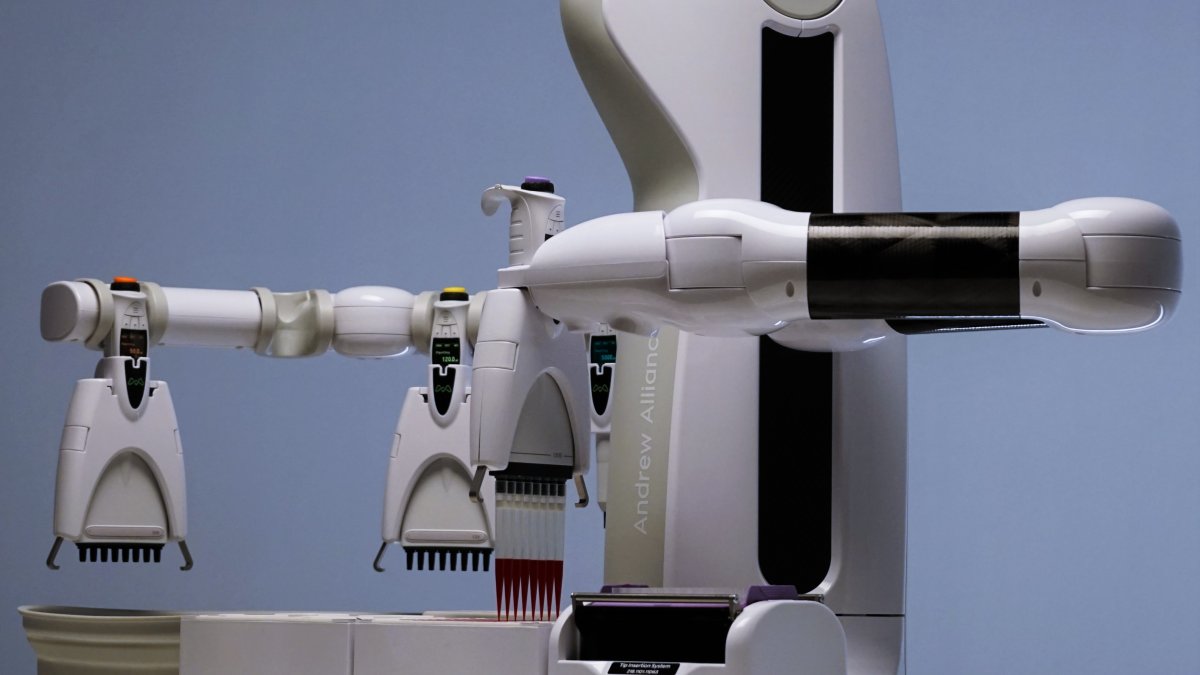
MegaRobo Technologies, a Beijing company that builds robots and software for laboratory work, said on Thursday that it had raised nearly $200 million. Oman Investment Authority, the Gulf state's sovereign wealth fund, participated alongside CMB International, with existing backers Asia Investment Capital, Granite Asia and Sinovation Ventures returning. The company did not disclose a valuation.
Founded in 2016, MegaRobo positions itself in what the industry calls AI for Science: automating the physical bench work of drug discovery, from sample handling and reagent dispensing to high-throughput screening, then layering machine learning on top of the data those robots generate. A second line applies high-precision sensing and robotics to production yields in semiconductors, optical interconnects and displays. The company says it serves more than 1,200 pharmaceutical, biotech and academic customers.
This is not a first-time unicorn round. MegaRobo has raised roughly $600 million across its history, including a near-$300 million Series C in June 2022 co-led by Goldman Sachs Alternatives, Asia Investment Capital and Granite Asia that pushed its valuation past $1 billion. It filed for a Hong Kong listing in mid-2025 and, according to chief executive Daniel Huang, remains in the queue.
Huang told Bloomberg that about 80% of revenue still comes from China and that overseas markets represent a great deal of untapped demand, particularly along Belt and Road routes. The new money is earmarked for core technology, infrastructure for AI operating in complex physical environments, and expansion into Europe, North America, the Middle East and Asia.
The customer mix is shifting in a way that explains the timing. AI developers that need large volumes of high-quality scientific training data are now buying MegaRobo's automated laboratory systems, Huang said, without naming them. He put revenue growth at roughly 30% a year with improving margins, and said about two-thirds of sales now come from modular, AI-native configurations that customers assemble to fit a specific workflow rather than from fixed production lines.
The competitive field is crowded on both sides. Domestically, XtalPi and DP Technology pursue similar AI-plus-automation theses; abroad, Agilent and Twist Bioscience are far larger and better capitalised. The sector also carries an uncomfortable track record: despite years of investment and several high-profile claims, no AI-designed therapy has yet reached approval, and many AI-for-Science companies remain loss-making while the cost of drug development stays concentrated in clinical trials rather than in discovery.
For Oman, the cheque is part of a broader pattern of Gulf sovereign capital diversifying away from United States technology assets and into Chinese hardware and automation. For MegaRobo, the more instructive signal is the customer list: automation sold as a data engine for foundation models is a different business from automation sold as lab equipment, and it is the one being funded right now.
What remains unproven is whether that data advantage converts into a listing. The Hong Kong filing has been pending for more than a year, and the company is now raising private capital at a moment when public investors have been rewarding AI infrastructure and punishing AI drug discovery. MegaRobo is effectively both.
Comments (0)
Log in to join the discussion
Log InNo comments yet