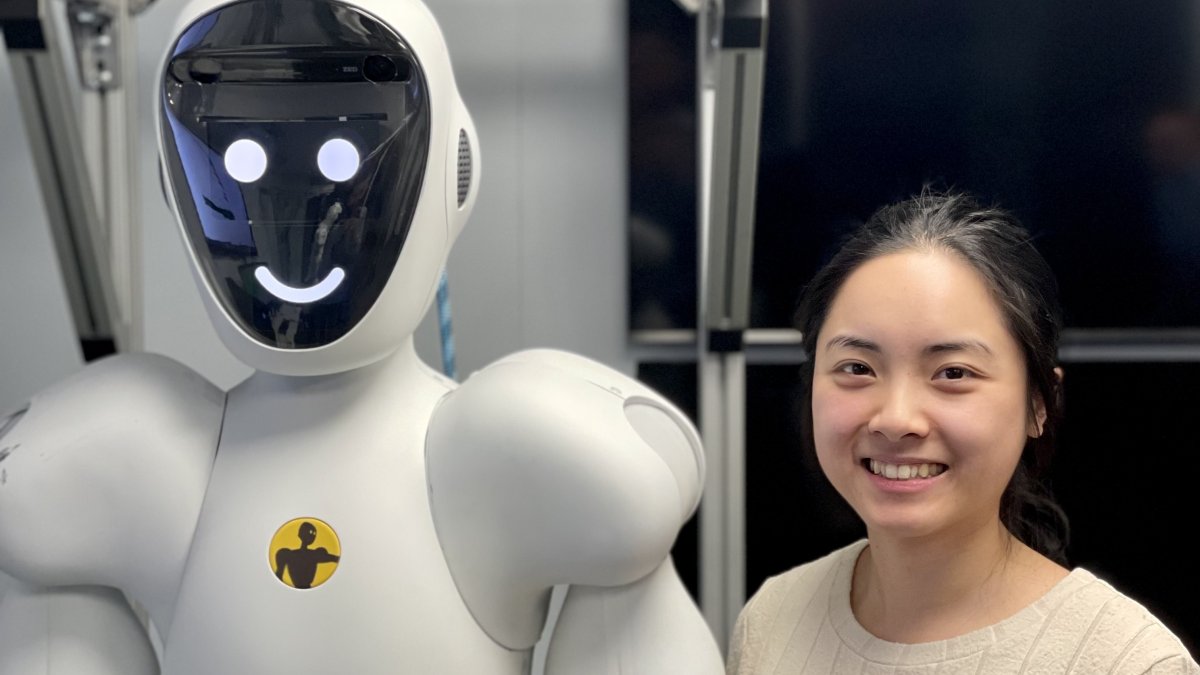
Embo, a San Francisco robotics AI startup, came out of stealth on November 23 with a $110 million seed round led by Andreessen Horowitz. Khosla Ventures, DST Global and Nvidia's venture arm NVentures participated alongside Striker VP and other strategic investors, according to the company and to a16z's investment note, which describes the target as "the brain for the humanoid workforce". The company has not disclosed a valuation.
The founders are Danijar Hafner, whose Dreamer series of world-model agents is among the most-cited lines of work in model-based reinforcement learning, and Wilson Yan, a co-author of VideoGPT and Diffusion Forcing. Hafner's doctoral thesis was titled Embodied Intelligence Through World Models, and the most recent Dreamer system learned to collect diamonds in Minecraft by training entirely on imagined experience. The wider team has worked at Google DeepMind, Meta Superintelligence Labs, Nvidia's Cosmos group, UC Berkeley and MIT, and Embo says it has previously built infrastructure to train multimodal models across 70,000 GPUs.
The technical bet is that the bottleneck in humanoid robotics is not hardware but the distribution shift between the room a robot was trained in and the room it has to work in. Rather than collecting demonstrations task by task, Embo pretrains one unified model from scratch on large amounts of internet video and text so that it absorbs how objects fall, slide and stack. The same model then doubles as a practice environment: skills are rehearsed across millions of imagined scenarios and improved through reinforcement learning, including from simulated failures, before a policy is fine-tuned on data from the company's own humanoid fleet.
Embo frames the payoff as two properties, generalisation and resilience. Generalisation means a robot trained in one kitchen can work in another it has never entered. Resilience means it recovers when an object slips out of its gripper or a drawer jams, rather than stalling on a plan that no longer matches the world. Andreessen Horowitz's note argues that this is how robot learning scales with compute, because an agent can accumulate far more practice inside a learned model than any physical fleet can generate, and rare mistakes that human demonstrators never make can be simulated cheaply.
What the company has not shown is equally notable. There is no public product, no named customer, no deployment timeline, no disclosed fleet size and no published benchmark, so the claim that video pretraining plus imagined practice transfers to reliable manipulation outside a demo remains untested in public. The founders' track record is the main evidence offered, and it is a strong one in research terms; the gap between a world model that plays Minecraft and a humanoid that unloads a pallet is precisely where the money is being spent.
The round is also a signal about where physical-AI capital is pooling. Nvidia backing a rival to its own Cosmos video models through NVentures looks like a hedge rather than a contradiction, and a $110 million seed implies that investors expect the value in the humanoid supply chain to sit in the learned policy rather than in frames and actuators, which are commoditising. For a company with no shipped product, that is a lot of runway and a correspondingly short patience window.
Comments (0)
Log in to join the discussion
Log InNo comments yet