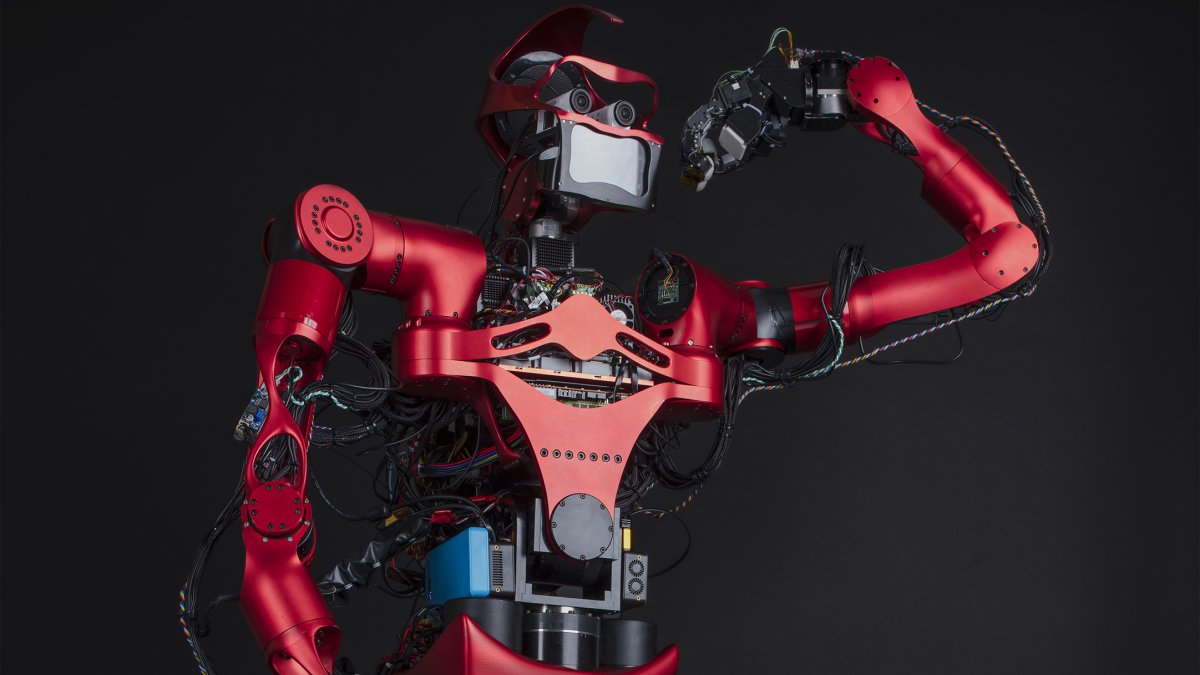
Hangzhou-based embodied-AI startup Simplexity Robotics has closed a $100 million pre-Series A round led by Ant Group, at a valuation of $1.6 billion, according to chairman and co-founder Wang Kai in an interview with Bloomberg. Existing backers Alibaba, Tencent, HongShan Capital and Lanchi Ventures all re-upped in the round, which was announced alongside the launch of the company's second humanoid robot on Monday.
The company is barely 16 months old. It was founded in July 2025 in Hangzhou by three former Li Auto executives: Wang Kai, the EV maker's former chief technology officer; chief executive Jia Peng, who ran Li Auto's intelligent-driving R&D and earlier worked as an IBM high-performance computing engineer and a senior architect at NVIDIA; and COO Wang Jiajia, who led intelligent-driving mass production there. A funding tracker lists an undisclosed seed round in October 2025 and an undisclosed Series A in March 2026, which makes the jump to a $1.6 billion pre-Series A valuation — a nine-figure check on a company that has not passed its second birthday — one of the steeper repricings in China's robotics scene this year.
The new product, iX, is a wheeled humanoid aimed at service scenarios rather than factory lines. Simplexity says it can mix and serve drinks, fetch and deliver items, and lead visitors on guided tours, combining voice interaction with whole-body control. It joins the i7 Pro, a public-service robot with modular force-controlled arms. Early customers named by the company include the Korean robotics startup Rlwrld, Tsinghua University and the forklift manufacturer Hangcha Group, with which Simplexity has already deployed a warehouse sorting line.
For Ant Group, the deal is its twelfth investment in China's humanoid sector since the start of 2025, according to a CNBC report citing PitchBook data. The Jack Ma-backed financial group has spread its capital across finished-robot makers such as Unitree and Galaxea, component and software startups, and its own Robbyant subsidiary. Ant is betting that Simplexity can take on far larger incumbents in China's crowded robotics field.
Technically, Simplexity sells a full stack — robot hardware, software and autonomous-driving systems — and describes its approach as combining a world model with a vision-language-action model in a single Transformer that jointly handles language, vision, 3D space and robot state. The company has open-sourced SimpleWAM, a multimodal world-action model whose 6B-parameter version it says can run on NVIDIA's ThorX edge chip with latency as low as 42 milliseconds, and it operates Simple Claw, a developer platform that bundles agent frameworks, skill libraries, simulation and deployment tools. Those performance figures are company-reported and have not been independently verified.
The round lands in a market where Chinese makers dominate volume: Chinese companies shipped roughly 97 percent of the humanoid robots delivered worldwide in the first three quarters of 2026, according to figures cited in Bloomberg's reporting. Startups have captured 82 percent of tracked global humanoid deals this year, with at least $7.7 billion in disclosed funding and 38 rounds of $100 million or more — versus 11 at this point last year.
What the money has not yet shown is deployment at scale. Outside the Hangcha sorting line and a short customer list, neither the company nor its investors have disclosed revenue or fleet numbers, and the Pre-Series A label on a $100 million round suggests investors are pricing trajectory rather than traction. In a field where well-funded peers such as Unitree, Fourier and Agibot are also racing from demo to deployment, the question for Simplexity is whether a 16-month-old company can turn Li Auto's manufacturing playbook into repeatable, revenue-generating robot work.
Comments (0)
Log in to join the discussion
Log InNo comments yet