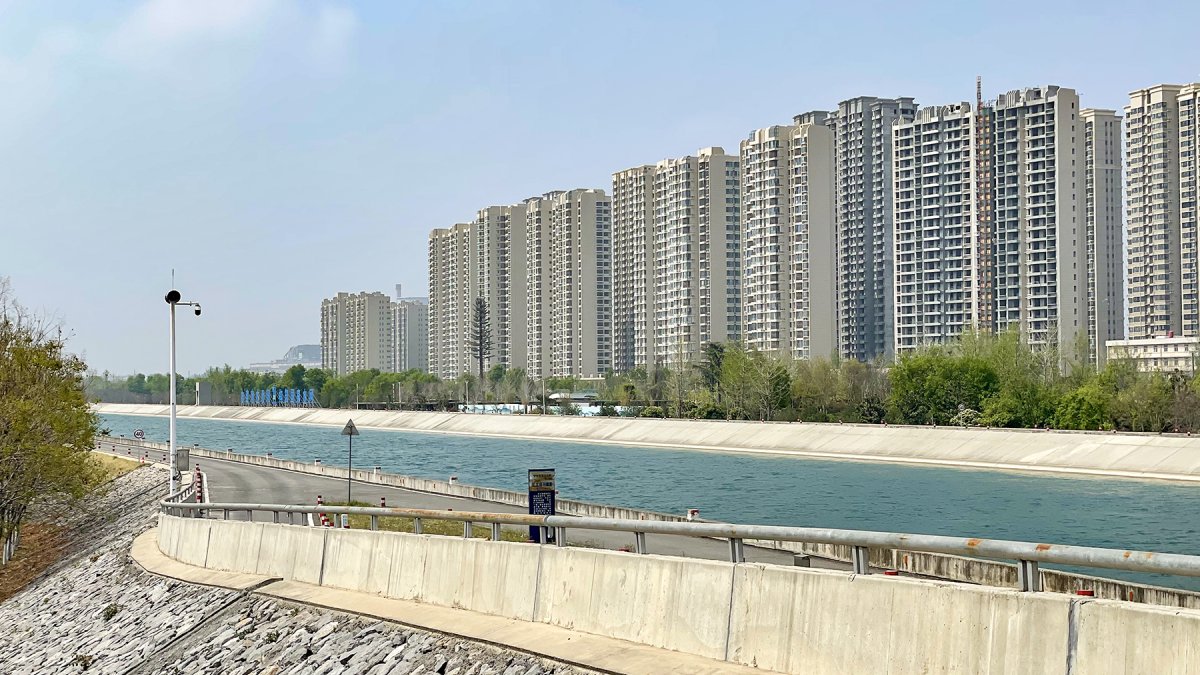
China's South-to-North Water Diversion Project — the largest water-transfer scheme on the planet — has upgraded the AI system that helps run it. On November 21, at the third National Water Network and South-to-North Water Diversion High-Quality Development Forum, the China South-to-North Water Diversion Group released Tianhe V2, the second generation of its namesake large model, shifting water-network decisions from purely data-driven operation toward a stack driven jointly by data, physical mechanisms and intelligence.
In flood control, the upgraded model now ingests feeds from 27 remote-sensing satellites and 237 weather radars, fusing rainfall, water-level and infrastructure condition data. The practical effect: flood-situation analysis that used to take hours is compressed to minutes. In water quality, the model draws on a monitoring network covering the source, conveyance and receiving zones, with 50 million monitoring records integrated into its databases.
The water-quality side also gains an agent. A one-click rehearsal agent can invoke specialized hydrological models, simulate how pollutants and algae spread through the channel network, and generate gate-scheduling recommendations and emergency-response plans — moving contamination response from experience and guesswork toward model-driven calculation. Officials frame V2 as moving the system out of its "zero to one" build phase and into a "one to use" deployment phase across the project's core operations: engineering safety, supply security, water quality and business management.
The scale behind the model explains the ambition. Since the east and central routes opened, the project has moved more than 92 billion cubic meters of water north, providing stable supply to nearly 200 million people and supporting more than 19 trillion yuan, roughly 2.7 trillion US dollars, of GDP growth in northern regions.
The group says the V2 framework is replicable, its models are portable and its assistant applications are configurable, so the stack can be copied to other water-network projects, and it plans to push industrial adoption in 2027 by building an ecosystem with upstream and downstream partners.
Tianhe is a useful counterpoint to the frontier-model arms race. Nothing about it pushes parameter counts; its value comes from wiring satellites, radars and 50 million monitoring records into a decision loop where the hard part is domain knowledge and physical mechanism, not raw capability. It is the same lesson Chinese smart-factory programs keep producing: in applied AI, the moat is not the model — it is the data and the mechanism wrapped around it.
Comments (0)
Log in to join the discussion
Log InNo comments yet