Shanghai-based AI virtual cell startup Yuanshi Technology has raised nearly RMB 300 million, roughly $42 million, in a Pre-A round led by Legend Capital, the company said, a sum Chinese investment trackers describe as the largest single round reported to date in China's fast-crowding AI virtual cell field, a record set only two weeks earlier by a competitor.
The round included participation from Huaxia Ling Investment, a China Merchants-affiliated China fund, a JD-affiliated fund, CDH VGC and CMC Capital, with existing backers Monolith, Sinovation Ventures, Daotong Investment and Yanyuan Venture Capital re-upping. Guangyuan Capital acted as sole financial adviser. Yuanshi previously raised an angel round and an angel-plus round together worth close to RMB 100 million.
The funding lands in a niche that has just proved it can produce headline rounds in consecutive weeks. On November 16, INFevo, an AIVC company backed by drug-design firm XtalPi, announced a Pre-A round of over RMB 100 million with Sequoia China and Shunwei Capital among the returning investors. Yuanshi's nearly RMB 300 million now tops that as the biggest single check reported in the domestic AIVC space.
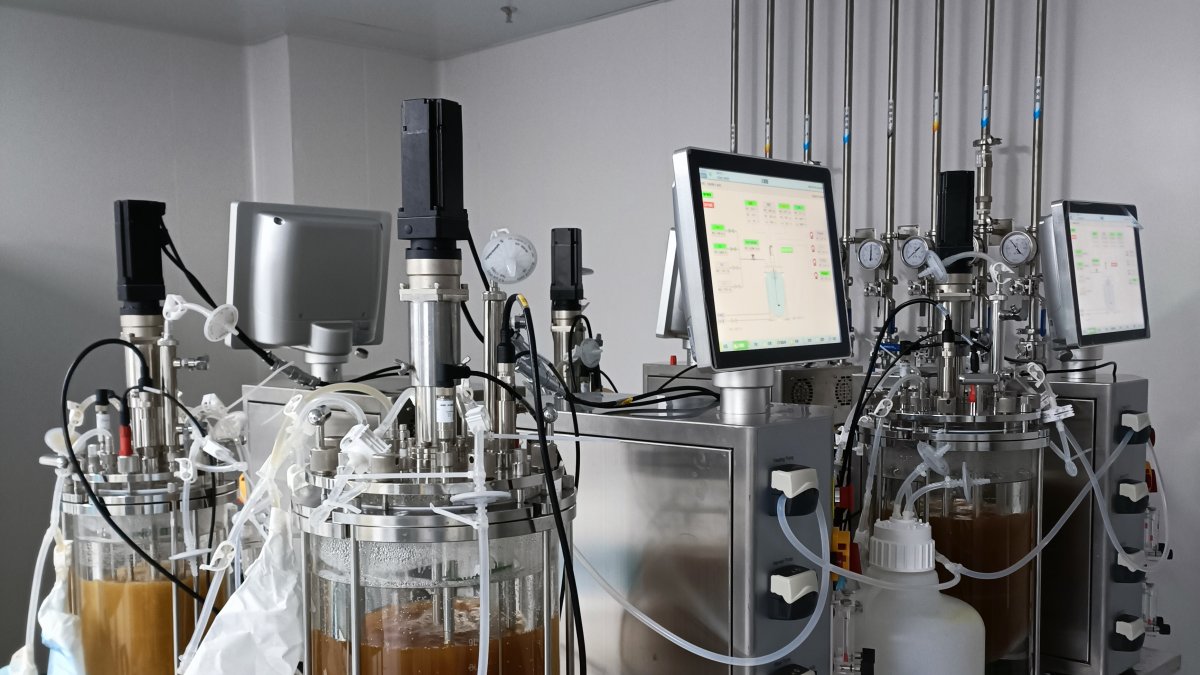
Yuanshi, which entered the Zhangjiang Pharma Valley incubator in June 2026, is building what it calls a dual-foundation approach: a raw biological data engine paired with a general-purpose cell model intended to learn the dynamic causal logic of living systems, predicting how cells respond across disease states, experimental conditions and interventions rather than merely fitting expression levels. The company runs a wet-lab-dry-loop cycle in which model predictions are tested experimentally and the results feed back into training.
The founding team is unusually pedigreed for a Pre-A company. CEO Wu Jiaqi holds a PhD in systems biology from Peking University and did her postdoctoral work at Rockefeller University, specializing in single-cell sequencing technology. CTO Dong Mingze studied in Peking University's Yuanpei program, earned a computational biology PhD at Yale, and completed a Stanford postdoc during which he participated in STATE, the Arc Institute's virtual cell model reported as the first to comprehensively beat baselines, and led STACK, described as the first zero-shot generalization SOTA model in the field. Both are now full-time at Yuanshi.
The company says the new capital will go to four lines: filling data gaps around rare cell states and key interventions, building automation to raise wet-lab throughput and consistency, iterating the general cell foundation model for cross-context generalization, and hiring across computational biology, single-cell experimentation and engineering. All figures and model claims are company-reported and have not been independently verified.
Virtual cell models, simulations that predict cellular behavior computationally before any experiment is run, have become one of the most active AI-for-science bets globally, with the US Biohub program pulling in Google DeepMind and Meta behind a $1.8 billion federal commitment. China's AIVC wave is following the same playbook with local capital. What two record-setting rounds in two weeks really test is whether the models, not just the fundraising, can keep pace.
Comments (0)
Log in to join the discussion
Log InNo comments yet