Tesla began rolling out version 15 of its Full Self-Driving (Supervised) software on Saturday, November 21, starting with members of its Early Access Program. Chief executive Elon Musk said the build goes to wide release next month, and confirmed to an owner on X that it would ship with this year's holiday update. The company has not given a date, a market list, or a vehicle count for the first wave. Tesla has previously told investors that its AI4 computer, also known as Hardware 4, is sufficient to run v15; owners on the older HW3 platform are not receiving it and were moved onto a separate v14 Lite release instead.
The headline claim is a multiplier with no denominator. Tesla's release notes credit an upgraded vision encoder, shared between FSD, Robotaxi and the Optimus robot and trained on millions of internet videos, with improving the "critical intervention rate by 25x." That figure describes how often a driver has to take over to prevent a safety-critical event compared with the previous version. Tesla has not published the underlying rate on either side of the comparison, so the multiplier cannot be checked from outside, and it is not a claim that crashes fall by 25 times. Musk went further on X, calling the release "super intelligence" because its driving "has already surpassed human intelligence" - an assessment with no third-party test behind it.
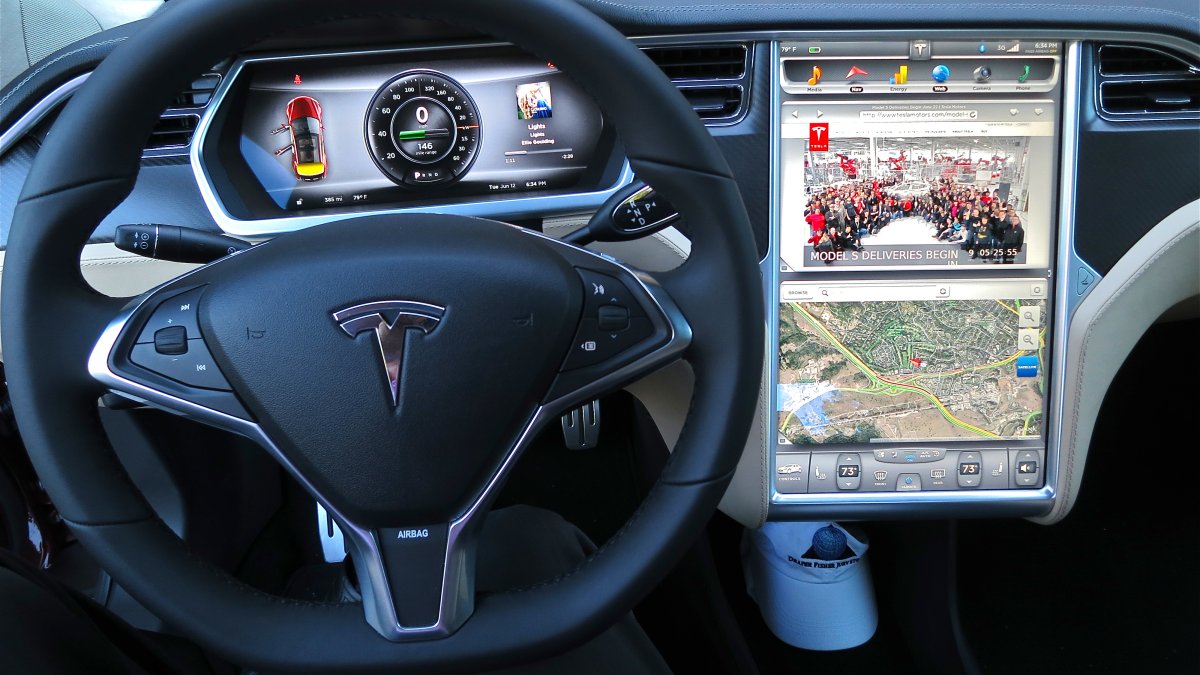
The part owners will notice first is on the screen. Tesla calls it Reality View in its announcement and "Tesla Augmented Reality" in the release notes: a real-time generative render from a virtual camera above the car, showing the street around the vehicle and the path the system intends to take. It replaces the previous visualization, which drew separate signals from separate parts of the stack, with one end-to-end render that Tesla says uses less total compute. Drivers get full-screen, map, split and quiet layouts, upcoming turns appear inside the scene, and a tap on the visualization can send the car to that point. Musk said the view is generated by the car's own computer rather than a game engine and consumes about half of one AI4 TRIP accelerator. He also said the driving model grew from roughly one billion parameters in v14 to about ten billion in v15.
Because the encoder is shared, the same weights now sit behind the consumer car, the Robotaxi fleet and the humanoid robot. Tesla says v15 runs the same software stack as its Robotaxi service; on the company's second-quarter earnings call, AI chief Ashok Elluswamy said early v15 builds had driven more than 380,000 unsupervised miles across six cities in two states without a major incident. Those figures are the company's own and have not been audited by a regulator.
Most of the release notes read as an admission of where the system was weak. Tesla lists improved detection of road signs, small animals, road debris, chains and potholes, and avoidance of deep standing water; better speed handling for school zones, speed limits, weather and each driver profile; a navigation model trained on fleet route preferences, currently applied only at the start and end of trips; parking suggestions drawn from the owner's own history; and two new behaviours - slowing for speed cameras and a Bike Rack Mode that disables reversing, Autopark and Summon. The targets are specific. A September test by the Brussels nonprofit Johanna.be found FSD exceeding the limit in 55% of the 30 km/h zones it drove through, averaging 44 km/h, with the screen showing a 50 km/h limit in most of them. Pothole avoidance had sat in the "upcoming improvements" list since at least v14.3, after Musk first promised it in 2019. The National Highway Traffic Safety Administration is reviewing a petition alleging that Tesla Robotaxis speed through active school zones, on top of an investigation opened in October 2025 into FSD traffic-law violations.
One change runs the other way. Tesla says driver monitoring becomes less strict in higher-speed driver profiles while becoming available to more drivers wearing hats or sunglasses - at a moment when reports of drivers asleep behind FSD keep surfacing and European regulators have pressed the company to tighten monitoring. Teaching the car to slow specifically for speed cameras carries its own signal: it implies tolerance for exceeding the limit where no camera is watching.
The strategic question for Tesla is no longer whether the system can drive, but whether anyone outside Tesla can verify that it can. A 25x improvement in a metric the company defines, measures and declines to publish is a marketing asset rather than an engineering result, and it lands in front of a regulator that is already examining the fleet. For competitors, the more interesting detail is architectural: one vision encoder, one set of weights, three embodiments, and a visualization generated by the same onboard model that plans the drive. That is a cheaper path to a general driving model than separate perception, prediction and planning stacks - and it makes the safety case harder to audit, because there is no longer an intermediate representation to inspect.
Comments (0)
Log in to join the discussion
Log InNo comments yet