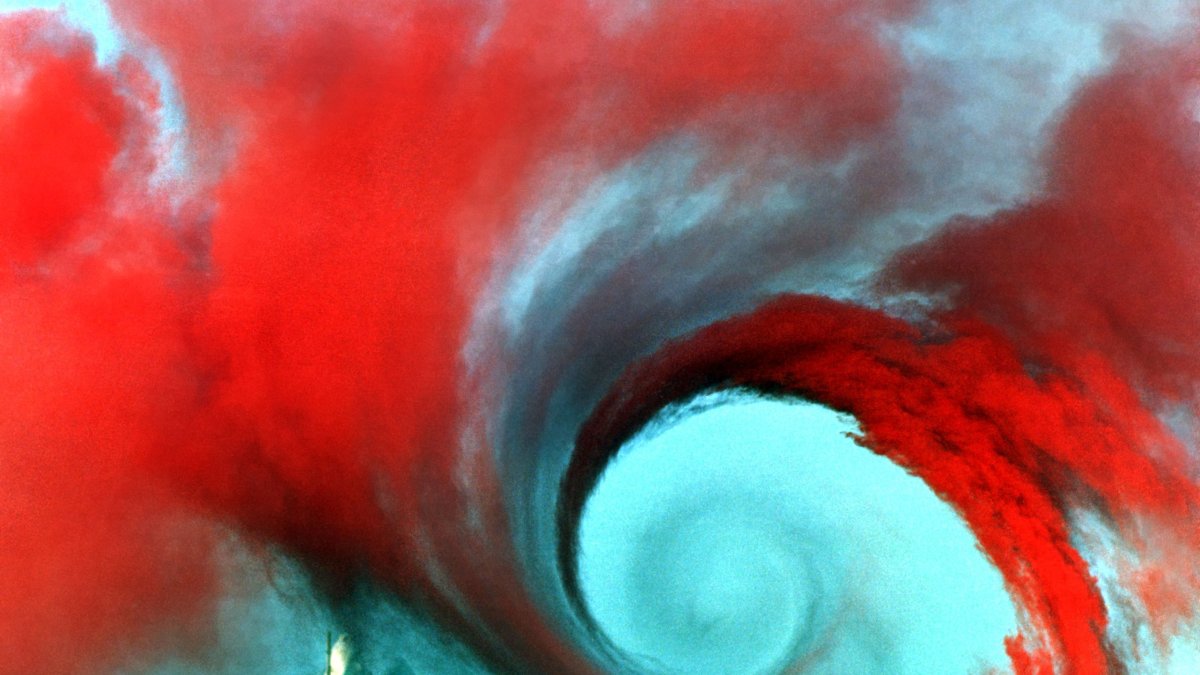
Two months after OpenAI announced a disputed proof of the Navier-Stokes Millennium Prize problem, the two mathematicians who accused the company of scooping them are back with a bigger claim of their own. On November 20, NYU professor Tristan Buckmaster and Anthropic researcher Levent Alpöge posted a 79-page paper asserting that the three-dimensional Navier-Stokes equations can blow up in finite time with no external force acting on the fluid — the version of the problem most mathematicians consider the real one. The post landed on Mastodon at 8:37 a.m. EST, hours before Alpöge separately announced a claimed proof of the Riemann hypothesis. "After last time, we couldn't risk waiting, so the Navier-Stokes write-up is unpolished and heavily LLM-assisted," Buckmaster wrote.
The distinction is the whole story. OpenAI's September 8 result, produced by a swarm of roughly 10,000 AI agents, satisfied the letter of the Clay Mathematics Institute's wording but relied on a smooth, finely tuned external force that keeps stirring the fluid toward the singularity. University of Chicago mathematician Luis Silvestre said at the time that the most important version of the problem remained unsolved, and on September 17 Peter Constantin, Mihaela Ignatova and Vlad Vicol posted a paper showing the kind of force OpenAI's construction requires can neither vanish near the singular point nor be real analytic. The new paper removes the hand entirely: it claims blowup for smooth, divergence-free, compactly supported starting flows both in open space and in a periodic box, at a rate of (T − t)−1/4.
Structurally, the proof follows what Terence Tao has described as one of the expected paths: compute an approximate, discretely self-similar solution numerically, then use rigorous estimates to show a true solution sits nearby. Alongside the paper sits a Lean 4 formalization of roughly 2,270 files and about 600,000 lines built on Mathlib, so a computer can check every logical step that is actually encoded. Tao, who listed the result on his blog, called it technically human-readable with a broadly clear proof strategy, but noted that more work is needed to produce a proper, professionally written proof.
The load-bearing gap is what the authors did not publish. The approximate solution the paper calls its certificate exists only as a cryptographic hash, with a note that it "will be released soon." The separate 128-bit interval-arithmetic computation that verifies the certificate is not in the repository and is not part of the formalization, and the README states a November 20 patch meant "the patched package was not rebuilt" before release. No independent mathematician has yet vouched for the result, and Scientific American, which first reported it, quoted no outside expert confirming it.
The paper is unusually explicit about how it was made. Its AI statement reads: "We used Anthropic models (Claude) throughout this work, and no others." The authors say AI agents were given a curated dossier of potential leads built on their own unreleased drafts about forced versions of the equations, and that a first draft of the paper was generated from an early Lean proof, then rewritten with Claude under their direction. A companion paper, written with Matei Coiculescu, claims unforced blowup for the Euler equations and was produced with both Claude and OpenAI's Codex; its README says that Lean proof contains no unproved steps.
The release also reopens the September priority dispute. Buckmaster alleged that OpenAI raced to beat him and Alpöge after hearing a rumor about their work, and that its math lead proposed release plans that would have dropped Alpöge, an Anthropic employee, from authorship. OpenAI denied wrongdoing and said a review confirmed Buckmaster's prompts could not have influenced its model. In a follow-up post on Friday, Buckmaster warned that "there is a strong indication that OpenAI uses user data from customers' active research as source material for designing post-training tasks" — his allegation, not an established fact. OpenAI has not commented on the new papers.
Even if the proof holds up, no Millennium Prize is imminent: Clay's rules require publication in a qualifying venue and two years of community acceptance. The decisive artifact is the missing certificate. When it appears, the test is whether another team can replay the interval-arithmetic bounds — and whether the Lean package, once rebuilt, checks cleanly without its placeholder gaps.
Comments (0)
Log in to join the discussion
Log InNo comments yet