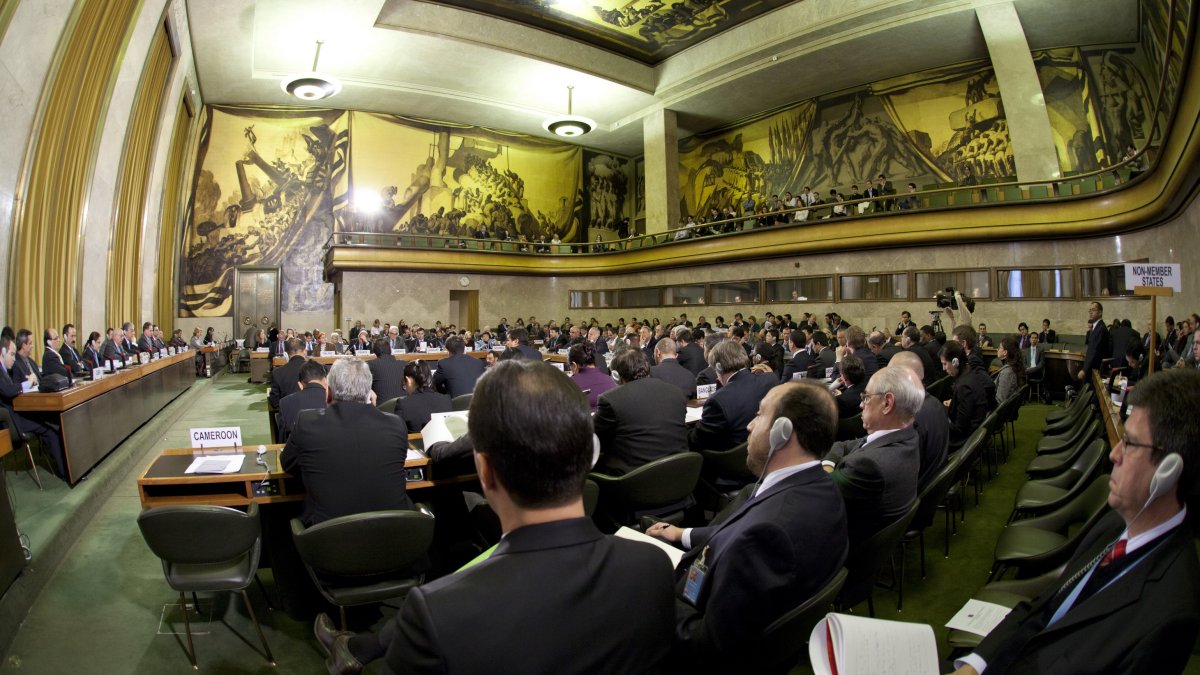
The United Nations' longest-running attempt to put legal limits on machines that select and attack targets on their own ended in the early hours of Saturday, Nov. 21, with an agreement to keep talking for two more years and no commitment that anything will ever bind. Delegates at the Seventh Review Conference of the Convention on Certain Conventional Weapons (CCW) in Geneva settled on language that asks states to "elaborate" a possible instrument on lethal autonomous weapons systems by 2028. The text is silent on the one question the week was convened to answer: whether that instrument would be a treaty, a set of voluntary guidelines, or nothing at all.
The arithmetic behind that silence was visible all week. Around 100 of the CCW's 128 states parties wanted negotiations aimed at legally binding rules, according to reporting from Geneva. The Stop Killer Robots coalition, which tracks national positions, counted 98 states explicitly supporting or accepting talks toward a binding instrument as of Nov. 18, rising to 139 if the Non-Aligned Movement's collective statement is included. The United States, Russia and Israel argued against binding rules now, and because the CCW decides by consensus, that was enough.
Russia also slowed the machinery itself, objecting to rules of procedure in a way that forced the cancellation of some formal sessions. The coalition's position map identified Russia, Belarus, Israel, Poland and Japan as the only five states backing continued discussion without a preset negotiating objective. Seven countries, including Brazil, Austria, Belgium, Ireland, Mexico, New Zealand and Panama, proposed launching formal negotiations on a rulebook that would prevent machines from killing without human control or accountability. That effort fell short.
Swiss ambassador Julien Thoeni, who chaired the meeting, called the outcome a significant achievement for humanitarian disarmament after more than a decade of work, telling reporters as the session closed shortly before dawn that "even in today's deeply divided world, multilateral diplomacy can still deliver concrete results." Izumi Nakamitsu, the UN high representative for disarmament affairs, described a glass half full and half empty, and urged governments to start work as early as Monday on the strongest instrument they could get. Brazil's ambassador Frederico Meyer was blunter: "Technology is moving faster than diplomacy. Diplomats are very slow."
Rights groups treated the compromise as a defeat. "Delaying the creation of a legally binding instrument puts civilians and humanity at risk," said Nicole van Rooijen, executive director of Stop Killer Robots. Beatrice Fihn, founder of the advocacy group Lex International, called the decision "pushing the can down the road for two more years." Max Tegmark of MIT said states had now agreed it was sufficient to talk about the issue "for the 14th year, while these weapons enable atrocities."
The pressure for faster action came from outside the room. The International Committee of the Red Cross had asked for binding rules within a year, arguing that autonomous weapons behave unpredictably in ways a bullet does not, and that life-and-death decisions should never be handed to machines. UN Secretary-General Antonio Guterres, who leaves office at the end of the year, had set 2026 as the deadline for opening negotiations, and Pope Leo XIV backed strong limits. Semi-autonomous drones and loitering munitions are already killing in Ukraine, Sudan and Gaza, even if fully autonomous target selection remains rare.
The structural problem is the forum itself. Every future measure must clear a process requiring agreement from all 128 states parties, which hands any single holdout a veto; negotiators spent hours this week on what Reuters described as a handful of words. Some observers and former military officials now argue that a coalition of willing states should negotiate outside the CCW entirely, the route taken by the Ottawa landmine treaty, which produced a binding ban among signatories while the major producers stayed out.
What the week produced, then, is a calendar rather than a constraint. Two years is a long runway for autonomy on the battlefield and a short one for treaty text, and the definitional work that has stalled for a decade, over what counts as meaningful human control and how it could be verified, has not advanced. The practical read for anyone watching the technology: the gap between what autonomous systems can do and what international law requires of them is now set to widen, by agreement, until at least 2028.
Comments (0)
Log in to join the discussion
Log InNo comments yet