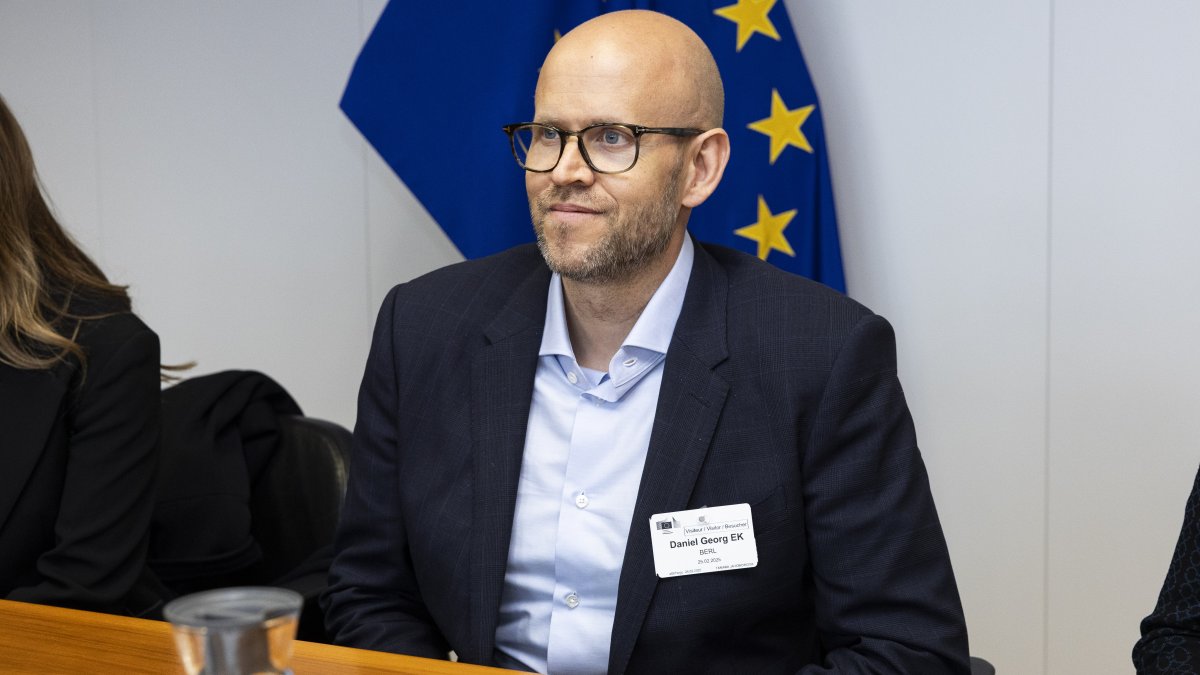
Daniel Ek, the Spotify founder who spent two decades building streaming infrastructure, is now backing a company that wants to build the power plants for the compute era. Europa Fusion, a stealth UK startup founded by AI researcher Nantas Nardelli, has secured backing from Ek, according to reporting first by Bloomberg and then detailed by TechCrunch on Nov. 20. Neither the size of his commitment nor his exact role has been disclosed, and it is not clear whether his investment firm Prima Materia is involved.
Nardelli's resume runs through the parts of the industry that spend the most on compute: Google DeepMind, Facebook AI Research and Microsoft Research Cambridge, followed by a stint as head of machine learning at Pacific Fusion, the Fremont, California company that recently broke ground on a demonstration facility in New Mexico. Companies House records list Europa Fusion Industries Ltd as incorporated in London on Feb. 9, 2026, with Nardelli as sole director. People familiar with his thinking said he had been working on the idea for longer than the corporate filing suggests.
The technical bet is pulsed power, the same approach Pacific Fusion pursues. Pulsed-power reactors deliver enormous, precisely timed surges of electrical current to compress a fuel target until the atoms inside fuse and release energy. The physics is well understood in the laboratory; turning it into a plant that feeds a grid steadily is the hard part, and it is a control-engineering problem as much as a plasma one.
Where Nardelli appears to differ from his former employer is in sequencing. Pacific Fusion leans heavily on physical devices to test theories and improve its simulations. Nardelli favors a data- and simulation-heavy route, refining physics models before committing capital to hardware, an approach that treats the reactor less as a series of expensive experiments and more as a system to be characterized in software first. "My original background is in electronics and control engineering. I used to build robots for a living," Nardelli wrote on his website. "One day I'll be back to that, but it's time to fix climate change for good."
No round size, valuation or construction timeline has been disclosed, and the company has not described a plant location or design in public. That is normal for fusion startups at this stage, most of which stay quiet until they have a prototype or a signed offtake agreement. It also means the investment cannot yet be read as a verdict on the technology, only on the founder and the thesis.
The thesis is not hard to reconstruct. Data center electricity demand is the constraint that AI companies now plan around; the International Energy Agency has projected that data center consumption could double to roughly 1,000 terawatt-hours by 2030, with AI the main driver. Fusion is the only supply-side answer with effectively unlimited fuel and no combustion emissions, and it is also the slowest and most capital-hungry one, decades from commercial delivery on most estimates.
That mismatch is why the money is arriving anyway. Founders who built the platforms now buying power have started moving down the value chain into generation, on the argument that whoever controls firm, carbon-free electricity controls the cost of intelligence. The counterargument is that fusion has absorbed decades of funding without a plant selling power to a grid, and that a simulation-first startup still has to build something physical eventually.
For Ek, the investment is a first step into energy infrastructure rather than a diversification. For the fusion sector, it is another data point that the buyers of electricity, not just the sellers, are now funding the supply. What remains undisclosed is the part that would settle the question: how much money, on what schedule, and what milestone would make the next check arrive.
Comments (0)
Log in to join the discussion
Log InNo comments yet