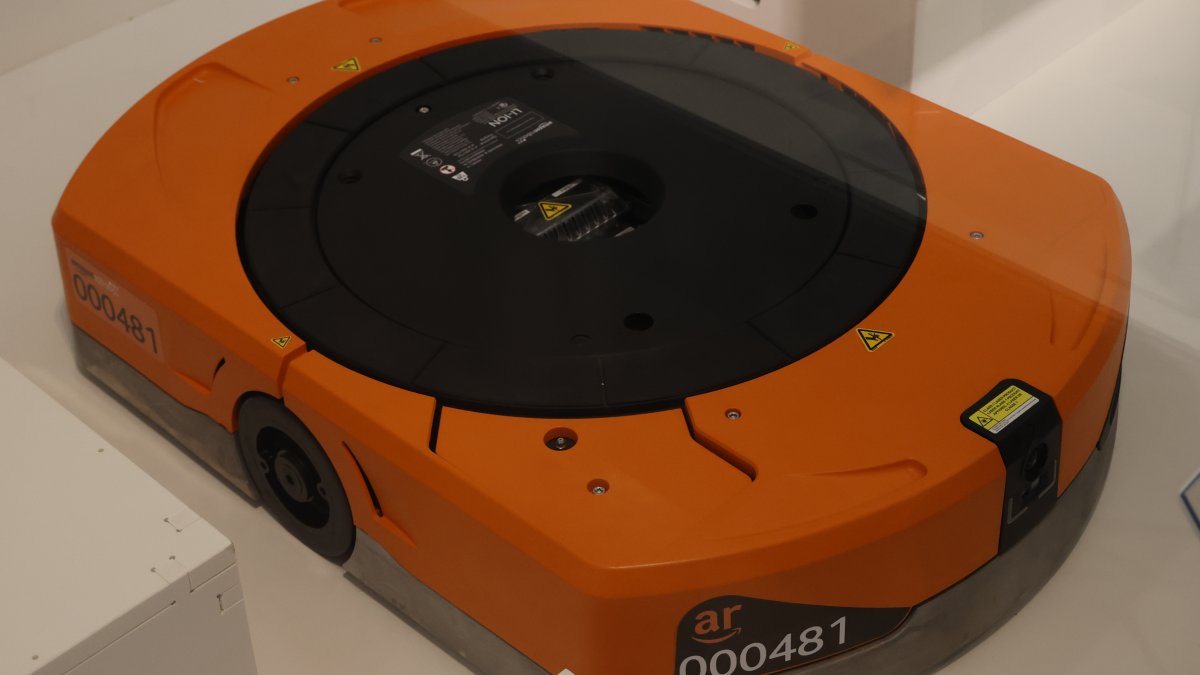
Amazon now operates more than 1 million robots across its warehouse network, the company confirmed in interviews published by Ars Technica this week — the world's largest robotic fleet, working alongside a human workforce of more than 1.5 million full- and part-time employees that makes Amazon the second-largest corporate employer on the planet.
The headline number undersells how lopsided the fleet still is. The mobile robots — descendants of the Kiva Systems business Amazon bought in 2012, including the newer Proteus units whose sensors let them work safely around people — dominate the count, ferrying shelving pods to workers while DeepFleet models predict and route around robot traffic jams. The robotic arms, by contrast, number only in the single-digit thousands. Amazon Robotics vice president Scott Dresser confirmed that figure, and CFO Brian Olsavsky said on the July earnings call that the company expects to more than double its arm fleet during 2026.
The arms are where the AI story actually lives. Robin, Amazon's first in-house arm, began sorting packages in Florida in 2022; an ML method for Robin reached a 93.73% pick success rate against 92.28% for the best traditional algorithm. Cardinal loads boxes weighing up to 50 pounds, and Sparrow consolidates items between storage totes using foundation models so that new products no longer need to be hand-coded one by one. The newest, Vulcan, adds force-feedback touch to vision, reaches awkward high and low storage positions, and has been running in Spokane, Washington and Hamburg, Germany since 2025 — with broader scaling expected in 2027.
Amazon frames the build-out as a safety win: robots absorb the tasks most associated with fatigue and injury, and the company points to improved injury rates since 2019. It is also building dedicated robot factories in Austin, Texas and Greenwood, Indiana to push out more capable machines at higher volume.
Labor researchers see a second effect that safety statistics do not capture. "The rise of collaborative robots really changes that dynamic for two reasons: one is that it is physically proximate, and two, the robot has the ability to dictate the pace of work," Brian Greenwood, a business professor at George Mason University, told Ars Technica. Earlier automation moved a dangerous task somewhere else; a cobot standing next to a worker sets the tempo of the shared job. That matters in a sector where the warehouse injury and illness rate has typically run at more than twice the all-industry average, according to OSHA figures cited in the report.
For anyone building around warehouse labor economics, the structure of Amazon's numbers is the real signal: a million mobile robots did not shrink the human workforce, but the fastest-growing category is the one where machines and people share a task in real time. If Vulcan-style touch-enabled arms scale the way Robin did, the bottleneck moves from what robots can lift to what pace humans can sustain beside them — a question regulators in the EU and US are only starting to look at.
Comments (0)
Log in to join the discussion
Log InNo comments yet