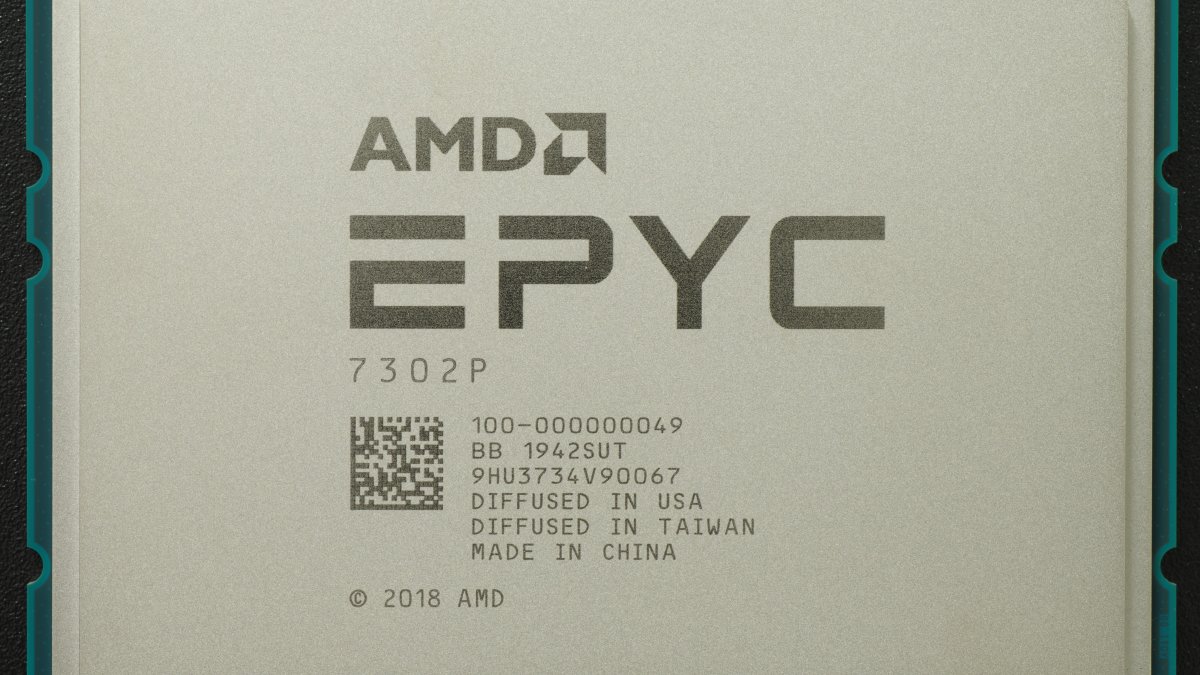
AMD is repositioning its sixth-generation EPYC 9006 server processors — code-named "Venice" — for agentic AI, arguing in a new white paper that the workload profile of autonomous agents is exactly where a general-purpose CPU earns its keep. The company says Venice is now in production, with major OEM platforms launching and cloud providers beginning deployments later this year.
The argument is about workload shape rather than raw model training. Agentic AI does not sit in the steady-state grind of large-batch training or high-volume inference; a single agent workflow can swing from information retrieval to tool calls to code execution within minutes, hammering different parts of the system in sequence. AMD's pitch is that data centers facing this stop-and-go pattern need flexible CPU capacity alongside their GPU fleets, not GPUs alone.
The headline numbers come from AMD's own testing and should be read accordingly. In SPECrate 2026 Integer, AMD reports the flagship EPYC 9996 delivering 1.2 times the per-core performance and 2.24 times the platform-level performance of an Nvidia Vera-based platform. Across selected enterprise and cloud-native workloads — the white paper cites Java, OpenSSL, MongoDB, Redis, NGINX, transaction processing, molecular dynamics, materials modeling and weather forecasting — AMD claims gains of 2.4 to 3.7 times, and against Intel's Xeon 6980P it reports 1.8 to 3.13 times on selected scientific computing workloads. None of these figures has been independently verified, and AMD itself notes results vary with configuration and workload.
The timing is not incidental. Days ago AMD announced an $8.2 billion all-stock acquisition of Fei-Fei Li's World Labs, explicitly to deepen its understanding of spatial intelligence, physical AI and robotics workloads so its future silicon roadmap follows where models are going. Venice's agentic positioning is the same logic pointed at today's infrastructure: if agents become the dominant consumer of data-center time, the vendor that defines the reference architecture around them — CPU, accelerator, network — captures pricing power across the stack.
For Nvidia, the comparison targets Vera, the CPU arm of its Vera Rubin platform that Jensen Huang has called the first CPU built for AI agents. For Intel, Venice's SPECrate claims land on the Xeon line's home turf of general-purpose server compute. AMD is effectively running a two-front argument: against Nvidia on platform economics, and against Intel on the workload mix that agents bring.
What happens next depends on customers, not benchmarks. OEM platform launches and cloud deployments later this year will put Venice's claims under independent load, and hyperscalers weighing CPU-to-GPU ratios for agent fleets will make the real verdict. But the white paper makes one thing clear: the agentic AI race has expanded from who builds the smartest model to who supplies the most flexible machinery underneath it — and AMD intends to contest every layer.
Comments (0)
Log in to join the discussion
Log InNo comments yet