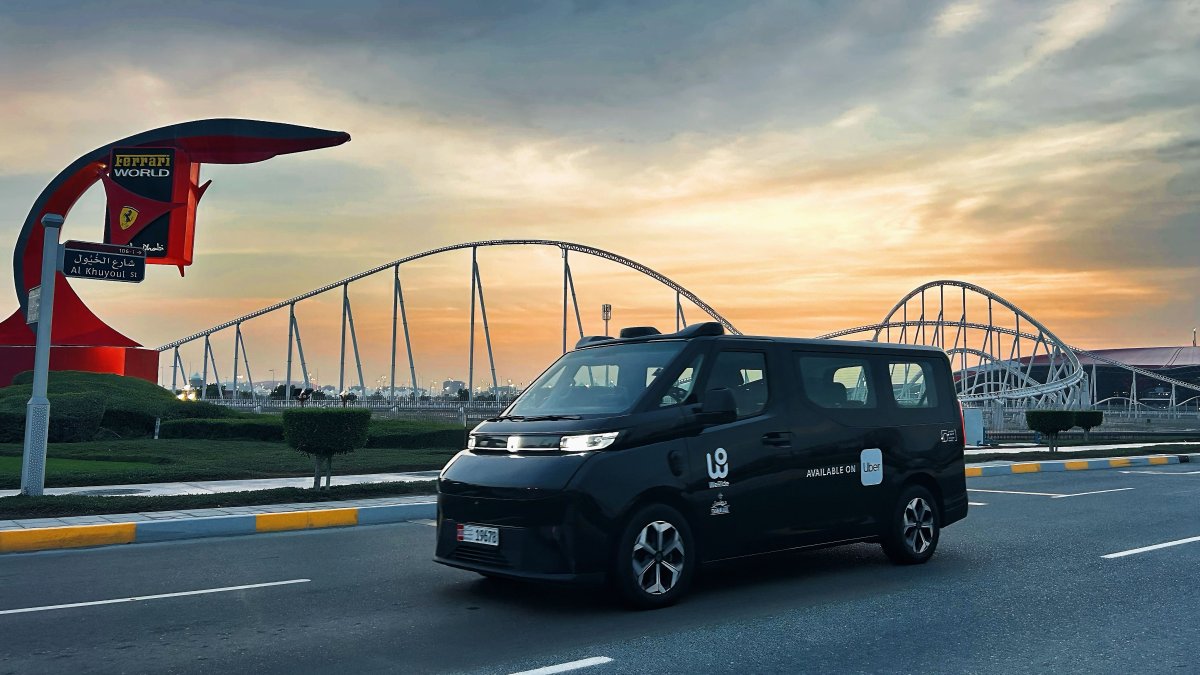
Chinese autonomous-driving company WeRide reported its strongest quarter to date on November 20, with third-quarter 2026 revenue of RMB 321.5 million, or about 48.0 million US dollars, up 88.0 percent year over year and 38.8 percent from the previous quarter. Gross margin expanded to 43.0 percent, a gain of 10.1 percentage points over the same quarter last year, and the company credited most of the improvement to its faster-growing overseas business.
Revenue from outside China reached RMB 146.9 million, up 171.5 percent year over year, and now accounts for 45.7 percent of total revenue. The overseas operations carry higher margins, which is what pushed the consolidated gross margin up. The company now operates in 13 countries across more than 60 cities.
The headline milestone was Robotaxi revenue crossing 100 million yuan in a single quarter for the first time, up 204.0 percent year over year, with more than 90 percent of that coming from markets outside China. WeRide also said its Robotaxi operations in Guangzhou have achieved positive unit economics, a milestone it framed as proof that shared autonomous mobility can be run sustainably at scale, at least in one city.
The physical fleet keeps growing. As of October 31, WeRide's global L4 fleet stood at roughly 4,100 vehicles, including more than 2,300 Robotaxis, an increase of 26 percent from the previous quarter. Its Middle East fleet reached about 600 vehicles, up from roughly 400 at the end of July, with Abu Dhabi and Dubai core urban areas targeted for full coverage by year-end. WeRide describes itself as Uber's largest autonomous-vehicle partner outside the United States, measured by fully driverless Robotaxis running on the platform.
Europe moved forward as well. WeRide received Spain's first national operating permit for L4 autonomous passenger vehicles from the Spanish traffic authority DGT, laying groundwork for commercial service in Madrid, and it has advanced operations in Switzerland, Belgium and France while starting road testing in Slovakia.
Another business line is quietly becoming material: AI infrastructure. WeRide's subsidiary Jingshuo Technology sells pre-training data, post-training environments and trusted verification to customers in embodied AI, robotics and foundation models. The company said this revenue nearly doubled year over year, driven by demand for high-quality physical-world data, and Chinese media reports following the earnings put its contracted backlog in the billions of yuan.
On the mass-production side, cumulative deliveries of WRD 3.0, WeRide's one-stage end-to-end L2++/L3 solution, exceeded 100,000 units by the end of the quarter, with the GAC AION i60, GAC Trumpchi Yue 7 and AION Ray7 all shipping with the system installed.
The quarter matters less for the growth rate itself than for what it validates: a Chinese robotaxi operator is making money outside China, where pricing is higher and margins are better, while its home-market operations in Guangzhou have stopped losing money per vehicle. The next test is whether the overseas-heavy model can keep scaling faster than competitors like Waymo and Baidu's Apollo Go, and whether the AI-infrastructure data business, which borrows the same closed-loop driving data, becomes a second durable revenue line rather than a side business.
Comments (0)
Log in to join the discussion
Log InNo comments yet