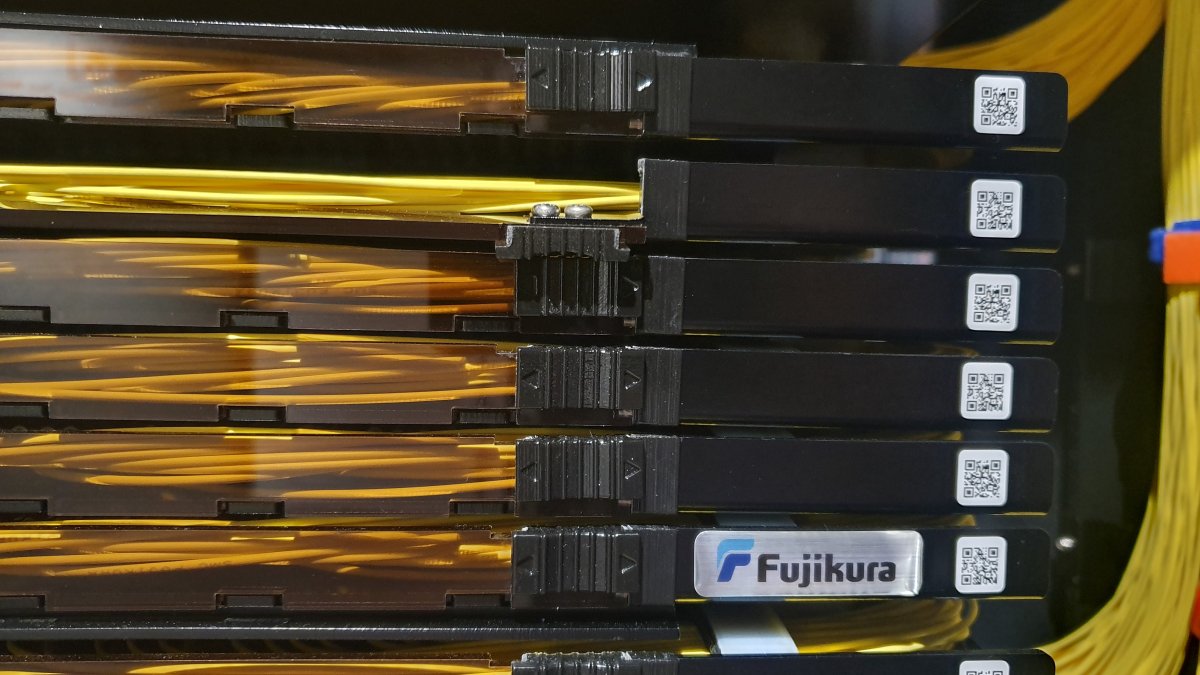
NVIDIA and Cisco put their names on the same piece of silicon plumbing on October 12, jointly announcing USFP, a new pluggable optics form factor built for AI data centers. The module is rated for 400 Gb/s per lane and up to 12.8 Tb/s of total capacity, and NVIDIA describes it as the industry's first module designed for 400 Gb/s-class networking fabrics. Both companies published the announcement through their own channels within minutes of each other.
The target is the wiring problem inside AI factories. As GPU clusters densify, the links between chips, servers and racks become the constraint: a training or inference job is only as fast as the fabric can move activations and gradients between accelerators. Pluggable optics that carry more data per lane reduce the module count, the fiber count and the power spent on serialization — which is why the form factor, not just the speed, is being standardized rather than kept proprietary.
The optics announcement landed inside a larger package of OCP contributions. NVIDIA said it is contributing key Vera Rubin rack and compute tray designs to the Open Compute Project through its open MGX architecture. The updated MGX 1.2 specification adds rack-scale blind-mate liquid cooling with new MQD and MQDB quick-disconnect connectors, a liquid-cooled 5,000-amp busbar for higher-power racks, native 19-inch equipment support and rack deployments up to 250 kW. NVIDIA's compute trays now ship with no cables, no hoses and no fans — everything liquid-cooled and modular, which the company says turns hours of tray assembly into minutes.
Software got the same treatment. NVIDIA expanded DSX OS, the operating layer of its DSX AI Factory platform, with open-source components for configuring network switches at scale, stress-testing GPU clusters with simulated workloads before training starts, and managing rack firmware as first-class units.
Partners used the same stage to stake out their pieces. Meta said it is adopting NVIDIA's Spectrum networking ASIC — the first 102.4 Tb/s Ethernet ASIC — in its next-generation AI factories, building Spectrum-X multi-plane networks where the SuperNIC detects a failed component and reroutes traffic in hardware in under 3 milliseconds. Google said Falcon Transport will be supported on future ConnectX-10 SuperNICs and BlueField DPUs. Visionbay introduced K-1, an 800-volt DC AI factory platform designed around Vera Rubin-era racks with power and thermal technology from Vertiv.
There were performance claims too, all from the vendors themselves: Meta measured 2x performance on DCPerf running Vera CPU systems, the Texas Advanced Computing Center reported a 2x uplift on the HPC GoldenSuite, and Red Panda reported 3.5x better streaming throughput on Apache Kafka. NVIDIA also published a Vera CPU rack design specification aimed at agentic AI — tool calling, orchestration and sandboxed execution — on the same third-generation MGX rack.
The open question is adoption. A form factor co-defined by the GPU vendor and the largest networking vendor carries weight, but USFP only becomes a standard if optics suppliers, switch makers and cloud operators outside the two companies build for it. The counterweight to lock-in fears is that NVIDIA spent the same week handing its rack designs to OCP — an implicit admission that in a market of gigawatt AI factories, no single vendor can dictate the physical layer alone.
Comments (0)
Log in to join the discussion
Log InNo comments yet