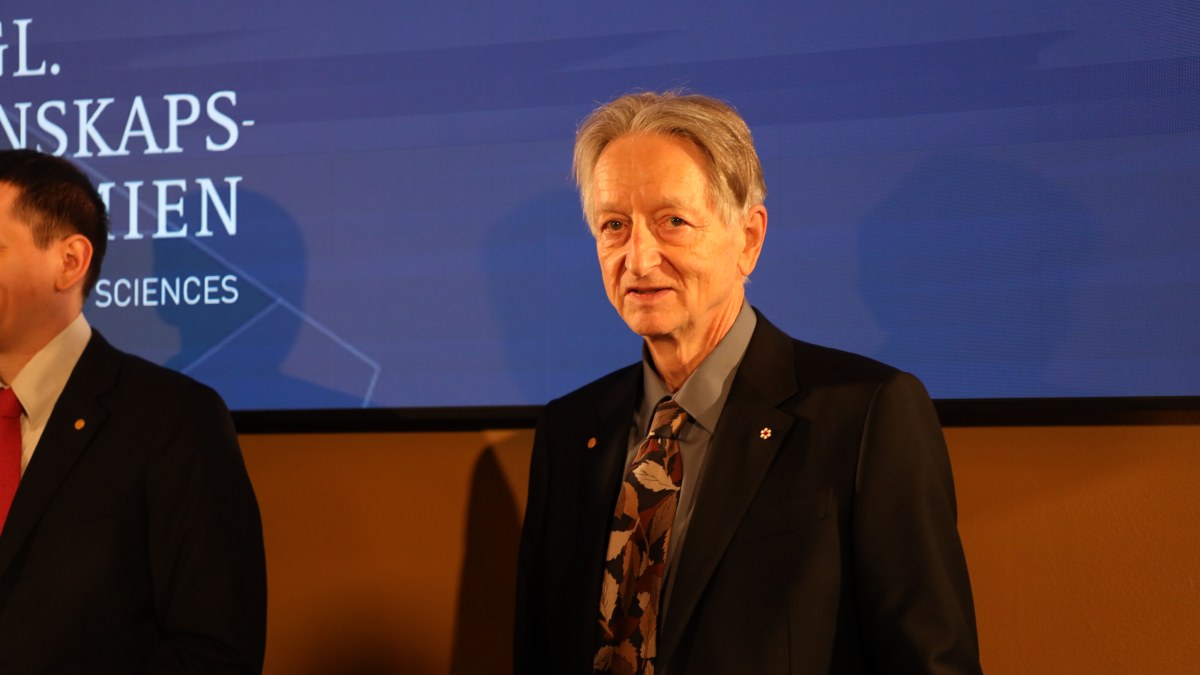
Geoffrey Hinton has published his first academic paper on recursive self-improvement — and he did not write it alone. "What if automating AI R&D triggers an intelligence explosion?" lists 22 authors, a lineup that includes fellow Turing laureate Yoshua Bengio, reinforcement-learning pioneer Andrew Barto, OpenAI chief scientist Jakub Pachocki, Microsoft chief scientist Eric Horvitz, Anthropic co-founder Jack Clark and UC Berkeley's Dawn Song. The paper was released by the Cambridge Programme on AI Science & Policy, and Hinton used X on October 3 to note that until recently, few frontier researchers believed an intelligence explosion could happen soon.
The core argument is deceptively simple. AI research is unusually easy to automate: the work happens in digital environments, code executes immediately, experiments return results in hours rather than months, and progress is measurable with benchmarks and loss curves. Once AI systems can carry out not just coding but the full research loop — proposing hypotheses, designing experiments, analyzing failures and redirecting — each better model helps build the next one. The paper calls this path a "software-driven intelligence explosion" and argues that, unlike faster chips, algorithmic improvements can be redeployed into the next training run within weeks.
The evidence section is what has made the paper travel. Citing internal data, it notes that the share of approved code written by AI rose from low single digits in January 2025 to more than 80% by May 2026. Claude autonomously completed about 1% of internal AI R&D tasks under high-level human oversight in March 2026; by August that figure was 26%, which the authors place near "AL4" on Epoch AI's automation scale. By September 2026, OpenAI has said its internal AI systems routinely finish research tasks that previously took human employees days. None of these companies claims fully unsupervised AI research is happening — Anthropic explicitly says Claude has not reached that level on any measured task.
The headline numbers come from an economic model. Meta-analyses of historical data from three AI R&D subfields put the "returns to research" parameter at roughly 1.2 to 1.9, meaning more research effort compounds into superlinear capability growth. If AI R&D became fully automated and that range held, the model produces an approximately 10-fold acceleration within roughly a year and a half — which is where the paper's most-quoted line comes from: a year of AI progress compressed to about five weeks. A second estimate holds that a leading lab's existing compute could, in principle, support the equivalent of millions of top-human-level AI researcher instances, up from research teams of a few thousand.
The authors are careful about what they are not claiming. They conclude there is no evidence an intelligence explosion has begun, and they identify four structural barriers that currently keep the loop from closing — led by compute scarcity, since a frontier training run consumes months of physical GPU time no matter how many AI agents are waiting with ideas, and by data exhaustion. The five-week figure is a model output under stated assumptions, not a timeline prediction.
The warnings, though, are unambiguous. Capability gains from automated AI research could outpace society's ability to adapt, eroding human oversight and upsetting the balance of power among states, companies and government agencies. The paper calls for far greater transparency about how much AI R&D automation labs are actually running, stronger monitoring and intervention mechanisms, and regulatory frameworks built "before the window closes."
What makes the paper notable is less its conclusion than its coalition: the labs' own chief scientists and co-founders signed alongside the field's two most prominent skeptics of unregulated scaling. Whatever one thinks of superintelligence, the people building these systems now agree the feedback loop is an engineering question with measurable inputs — not science fiction. That shift alone explains why policymakers are being handed a paper, not a manifesto.
Comments (0)
Log in to join the discussion
Log InNo comments yet