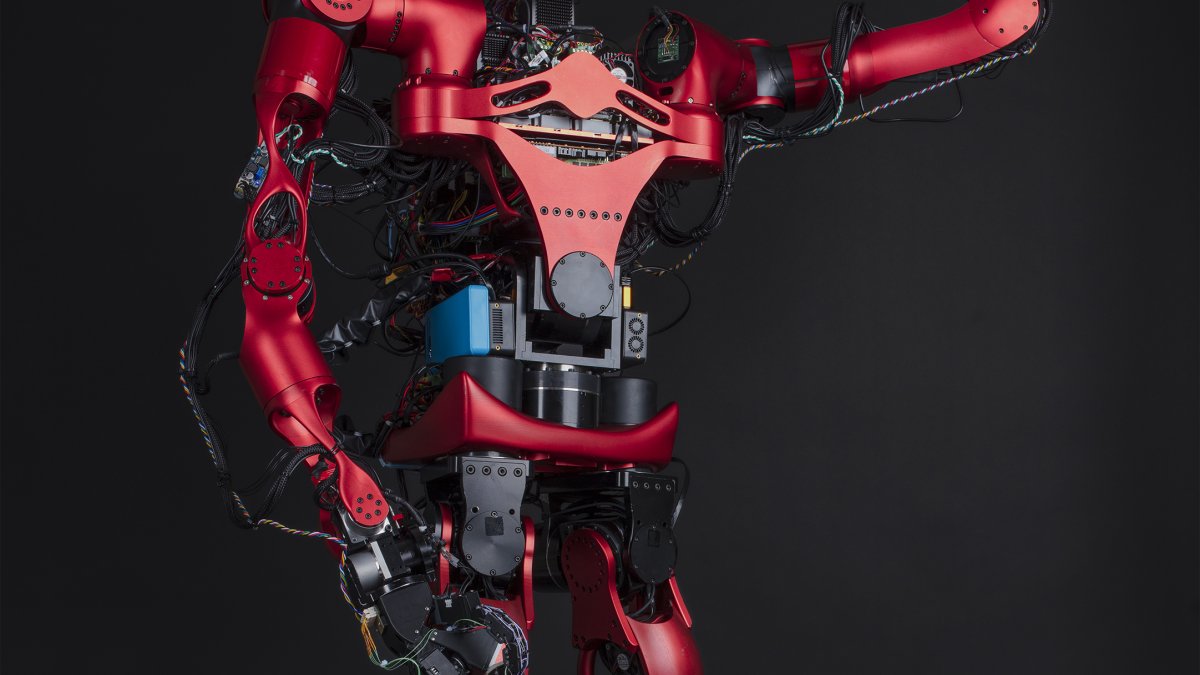
RoboScience, a Chinese embodied-AI startup founded less than two years ago, has completed an A2 round of several hundred million yuan, with Hupo Capital, Hongruida Investment and Shanghai Semiconductor Industry Investment as joint lead investors. 360's strategic investment arm, Guolian Tongbao, Jinding Capital and several listed-company vehicles also participated, with China Renaissance advising on the deal.
The company was founded in December 2024 by Tian Ye, formerly the technical lead of Apple's AI platform team and a Stanford AI Lab alumnus, and Shao Lin, an assistant professor at the National University of Singapore with a Stanford AI Lab doctorate. In roughly twelve months it has assembled a full stack: the RoboMirage differentiable physics simulation engine released in September 2025, the Visics embodied foundation model in June 2026, and REX G1, a wheeled humanoid robot, in August.
Its argument is that embodied AI's bottleneck is not parameters but data cost. The company says its combined simulation-plus-video pipeline produces training samples at about 0.05 yuan each — roughly one-twentieth to one-two-hundredth the cost of conventional collection — and that its video training corpus grew from about one million hours at the start of 2026 to four million hours by October, alongside more than ten billion simulated motion trajectories. These figures are company-reported and have not been independently audited.
Demonstrations at WAIC and WRC this year showed robots fitted with Visics switching between different brands of dexterous hands in about thirty seconds without retraining, and the company says multi-SKU grasping success rates have stayed above 99 percent in retail and logistics pilots — again, company-reported figures.
Commercialization runs on three tracks: turnkey solutions for end customers, an Embodied-AI-as-a-Service offering built with Tencent Cloud where Visics is callable via API, and edge controllers for third-party robot makers. The A2 round is the company's third financing of 2026, following a pre-A round in February and a Series A earlier in the year.
The raise lands in a cooling but still crowded Chinese embodied-AI market, where investors have shifted from demos to order books. RoboScience's wager is that whoever drives per-sample data costs toward zero first can afford the widest experimentation loop — and that a cloud-first model business, rather than robot sales, is how that gets monetized.
Comments (0)
Log in to join the discussion
Log InNo comments yet