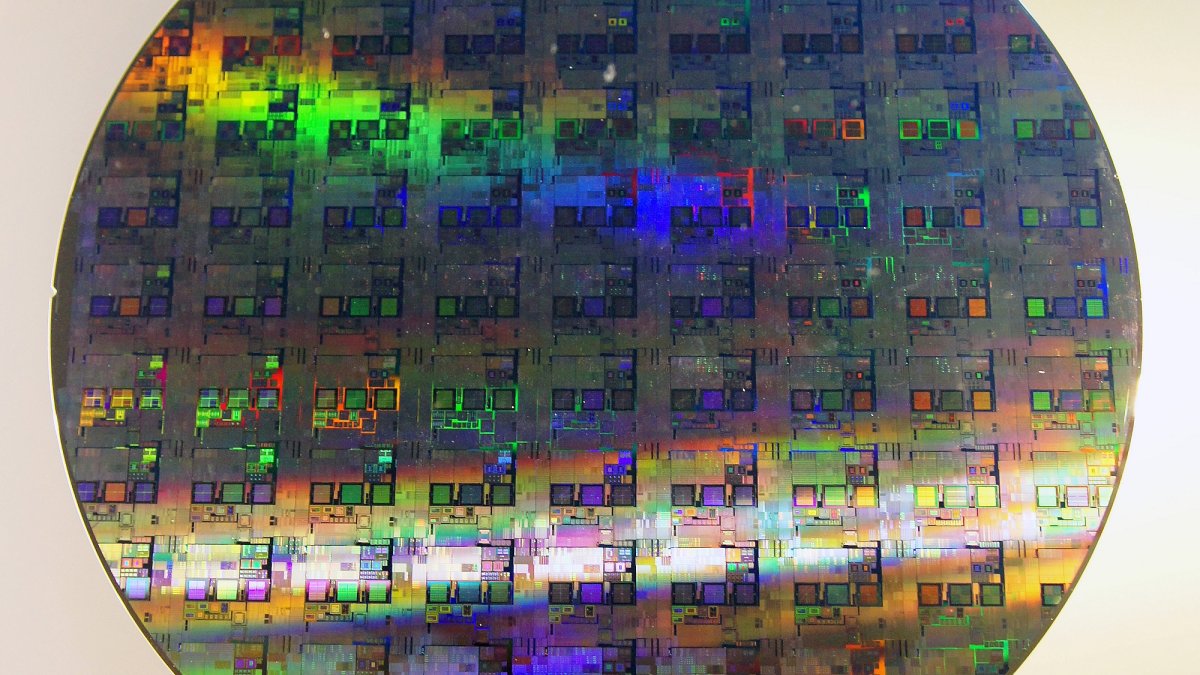
NVIDIA used SEMICON West 2026 to show a prototype of what it calls OOI — Optics-on-Interposer — a packaging approach that takes the organic substrate out of the optical path and places the optical engine directly on the silicon interposer that carries the GPU.
The distinction is geometric, and it is the entire point. In today's co-packaged optics, the optical engine sits on the organic package substrate beside the switch or compute die, so the electrical signal still crosses the silicon interposer and then the substrate before it is converted into light. OOI deletes that second hop. The engine talks to the die through high-density, fine-pitch wiring on the interposer itself — the same physical trick that lets a GPU reach HBM over a short distance at very high bandwidth.
Nikola Nedovic, a principal research scientist at NVIDIA Research, presented the work and said the company already has prototype samples in hand. The design replaces the organic substrate with a larger silicon interposer.
NVIDIA paired the demonstration with an 8-wavelength DWDM link running 32 Gb/s per wavelength, for 256 Gb/s across a single fibre — capacity added by multiplexing wavelengths rather than by pushing the speed of one lane. The two pieces address different halves of one problem: OOI shortens the electrical interface inside the package, DWDM raises the capacity of the fibre outside it.
The company is explicit that this is research. There is no commercialization timeline, and NVIDIA names the three obstacles itself: heat, manufacturing yield and serviceability.
Heat is the sharpest. OOI puts temperature-sensitive photonics on the same interposer as a compute die dissipating hundreds of watts. Silicon photonic components drift in wavelength and lose modulation efficiency as they warm, and an interposer leaves little room for thermal isolation. Serviceability is the quieter problem: a failed pluggable module is a port-level swap, while a failed engine fused to an interposer is a package-level loss.
The direction, though, is not seriously in dispute. Trade-press comparisons put the electrical loss of a conventional pluggable link at roughly 22 dB and of current co-packaged optics at about 4 dB; every decibel removed is power a cluster does not spend pushing bits between chips. As AI systems move from single racks to cross-rack fabrics, that power budget becomes the binding constraint.
For now OOI is a statement about where NVIDIA believes packaging is heading, not a product. The useful signal for the optical supply chain is that the company is willing to demonstrate a design which, if it ever ships, would shift value away from pluggable modules and organic substrates and toward silicon photonics and advanced interposer manufacturing.
Comments (0)
Log in to join the discussion
Log InNo comments yet