Huixi Intelligent, a Beijing chip designer founded in 2022, closed Pre-B+ and B rounds worth about 1.7 billion yuan, taking its 2026 equity fundraising past 2.5 billion yuan after an 800 million yuan Pre-B in February. The round was announced on October 17. The fresh confirmation came on Monday, when Hong Kong-listed Shoucheng Holdings disclosed that a fund it manages had invested in the company, adding a public filing to what had until then been company statements and trade press.
The investor list is mostly state money and strategic capital: the Beijing AI Industry Investment Fund, the Beijing Robotics Industry Development Fund, the National AI Industry Investment Fund, plus Yinshan Capital, Zhengxingu Capital, Jinyu Investment, Jiantou Investment, Huatai Baoli, Shunwei Capital, Yuansheng Capital, Cathay Capital, Guoxiang Capital and Guoshang Investment, with existing holders including 37 Interactive Entertainment adding. Chinese coverage is not consistent on who led. One financial data service named Shunxi Fund as lead investor, while the company's own announcement named the Beijing AI Industry Investment Fund. Huixi has not published a clarification.
What the money buys is a change of identity. Huixi started in self-driving chips and now positions itself as an embodied-AI compute platform, which in practice means selling a stack rather than a die: the RPU compute core, the RISE platform built on its own R1 SoC, and RhinoVLA, a pretrained model and development pipeline for robot builders.
The silicon comes in two tiers. R1 MAX is rated at 500 TOPS INT8 with 24 Cortex-A78AE cores. R1 PRO, aimed at robots, integrates CPU, NPU, GPU and real-time interfaces on one 7-nanometre automotive-grade SoC: 375 TOPS INT8, 16 A78AE cores, 204.8 GB/s of memory bandwidth, real-time control at 1 kHz and support for 22 cameras. Around the chips sit the RCM400 and RCM500 core modules, which bundle LPDDR5, UFS and power management behind a single 699-pin interface, with 16 to 64 GB of memory on the RCM400 and 32 to 128 GB on the RCM500. The pitch is that a robot maker can skip high-layer PCB, clock and high-speed signal design and reach a prototype faster.
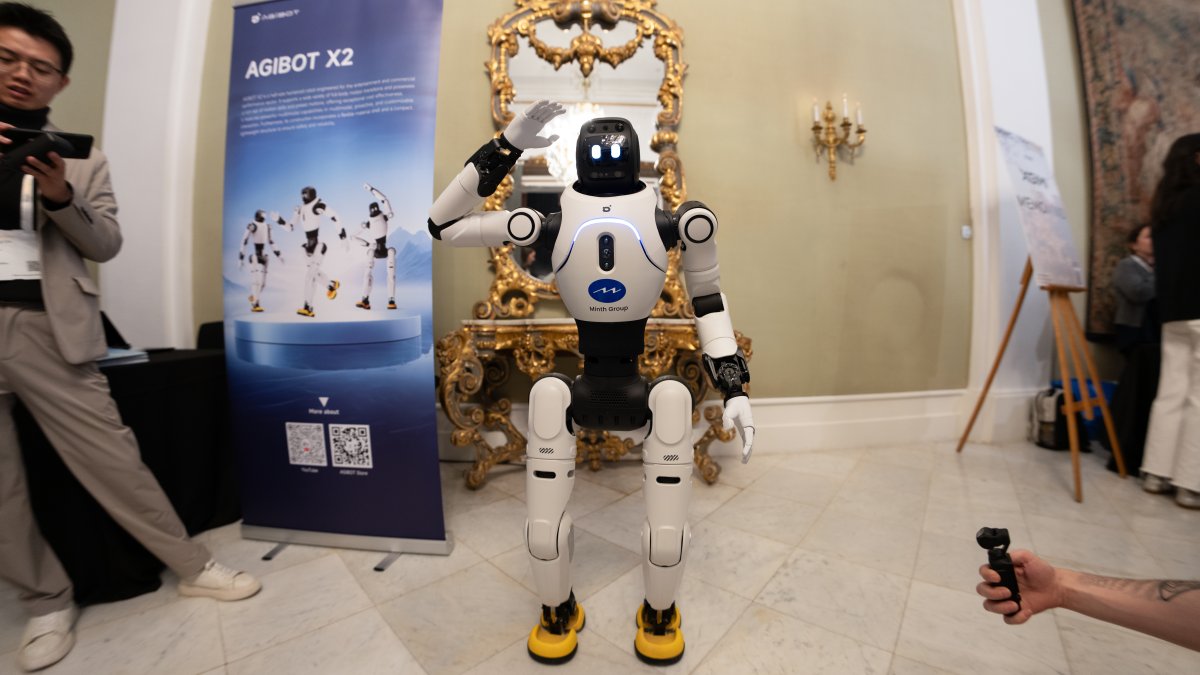
The commercial evidence is thin but concrete. Huixi says its R1 platform went into AgiBot's Genie G2 humanoid in 2025, moving from validation to volume. In June 2026, it says, several G2 units ran a six-day continuous production livestream and completed 17,625 tasks with a 99.99 percent success rate. Those figures are the company's own, cover one customer and one task mix in one factory, and have not been independently audited.
The team is why investors keep writing cheques. Founder and CEO Xu Ningyi holds bachelor's, master's and doctoral degrees from Tsinghua's electronic engineering department, ran the hardware computing group at Microsoft Research Asia and was chief architect of Baidu's Kunlun AI chip. Co-founder Zhang Jianyong came out of Tsinghua's automotive engineering programme and was an assistant vice president of autonomous driving at NIO, where he helped build the function from scratch. Co-founder He Guanghui is a professor at Shanghai Jiao Tong University working on energy-efficient digital systems. The company says it has more than 200 staff.
The bet is that robot compute will not consolidate the way phone chips did. A humanoid has to fit inference, sensor fusion and deterministic motion control inside one thermal and power envelope, which rewards integration, and Chinese robot makers are shipping in volumes that make a domestic supplier viable. Against that, the segment is crowded: NVIDIA's Jetson line and its Halos safety stack, Horizon Robotics and a queue of Chinese startups are chasing the same sockets, and a design win takes two product cycles to turn into revenue.
What the round actually buys is time to convert one flagship customer into a shipping curve. The 17,625-task number is a good slide. The question investors will ask next year is how many robot models, not how many tasks.
Comments (0)
Log in to join the discussion
Log InNo comments yet