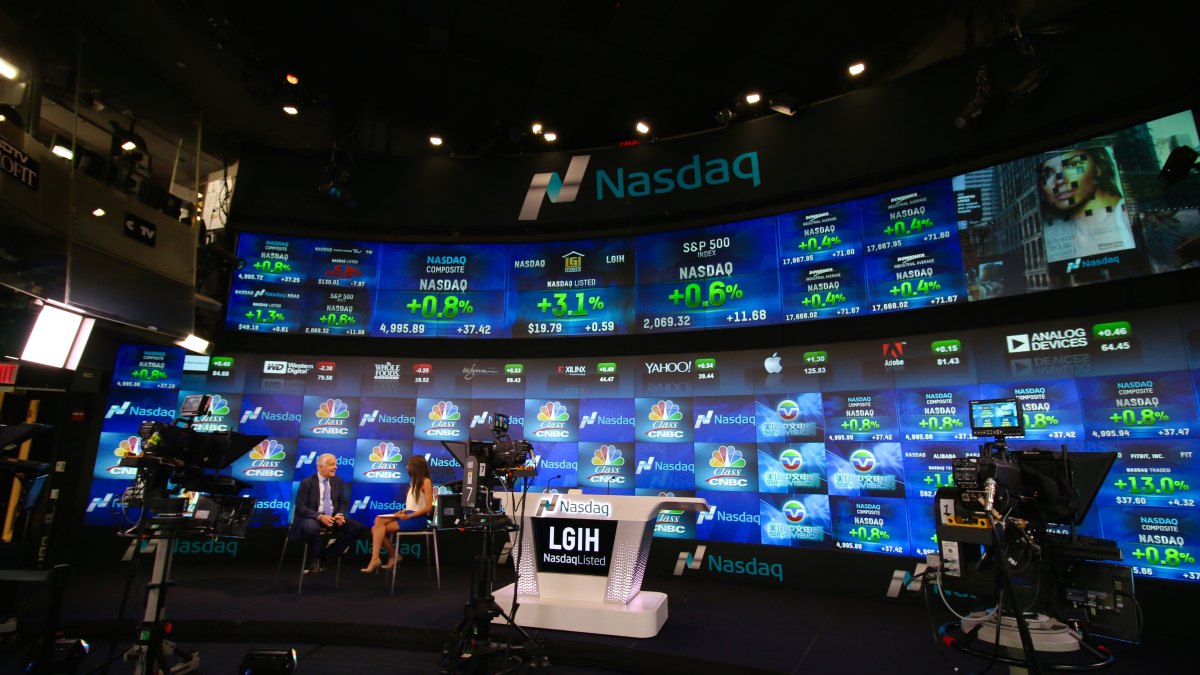
The rally that greeted Jensen Huang's return to Nvidia lasted less than three sessions. On Wednesday, Nov 25, US technology stocks resumed their slide, and by late morning in New York the Nasdaq 100 had fallen as much as 4.7% intraday, putting it 20% below the record it set in early October - the threshold of a technical bear market. More than $8.5 trillion of market value has been erased from the index's constituents during the selloff, and both the Nasdaq Composite and the S&P 500 are on course for their worst November since 2008.
At 9:53am ET the Nasdaq Composite was down 985.93 points, or 4.15%, at 22,747.61; the S&P 500 had shed 205.89 points, or 2.86%, to 6,995.20, breaking below 7,000; and the Dow Jones Industrial Average was off 995.52 points, or 1.99%, at 49,023.18. Losses narrowed later in the morning - by 10:07am ET the S&P 500 was down about 2% at 7,054.78 and the Nasdaq Composite about 3% at 23,012.91 - but the damage was broad: 329 Nasdaq Composite members touched 52-week lows against just 12 new highs, and decliners outnumbered advancers 4.54 to 1 on the Nasdaq and 3.51 to 1 on the NYSE.
Semiconductors led the retreat. Nvidia fell 8.6%, the Philadelphia Semiconductor Index dropped 5.8%, Micron was down as much as 10%, Broadcom 6.3%, Oracle more than 6%, Alphabet 5% and Amazon 4.9%; Microsoft lost 3.2% and Apple 1.4%. Ambarella plunged more than 22% after its guidance missed. Dell fell 5.4% even though it had just reported record quarterly revenue of $54.94 billion and an AI server backlog of $132.3 billion - a reminder that in this market, good numbers are no longer enough.
Two forces are doing the damage. October core PCE inflation rose to 3.3% year on year, well above the Federal Reserve's 2% target, and futures now price a 98% probability of a 25-basis-point hike in December. The Trump administration is also preparing a fresh round of Section 301 tariffs on China, the EU and other trading partners. Money fleeing AI equities went into Treasuries instead, pushing the 10-year yield down to about 4.84%, an inversion of the usual growth-scare trade.
The most telling stress is in credit rather than in equities. CoreWeave, the purest listed proxy for rented AI compute, fell 10.6%, and its 2031 bonds are now yielding close to 18%. The September-quarter numbers explain why: a $709 million net loss, $846 million of net interest expense and a $132.5 billion revenue backlog, set against 2026 capital expenditure guidance of $37 billion to $39 billion and projected revenue of just $13 billion to $13.3 billion. Nebius also fell by double digits, while IREN, Applied Digital and Core Scientific lost 6.9% to 10.8%.
Anthropic, which completed a record initial public offering only last week, dropped a further 8.2% to $81.90, below its $83 offer price after closing at that level on Tuesday. For a company that was supposed to reopen the AI IPO window, trading below issue after four sessions is an awkward signal for the queue of labs behind it.
The move is global. South Korea's KOSPI fell 6.2% with SK Hynix down 11%, and Europe's Stoxx 600 slipped 0.3%. Monday's relief rally - Nvidia alone added roughly $950 billion in a single session when the board reinstated Huang - has been fully reversed, and then some.
What this means: the market has stopped pricing AI as a compute-scarcity story and started pricing it as a balance-sheet story. The question is no longer whether demand exists, because the backlogs say it does, but whether debt-financed capacity can be converted into cash before refinancing costs bite. Watch three dates: the December Fed decision, Huang's Senate Banking Committee testimony on Dec 3, and the next round of neocloud bond pricing. If CoreWeave's curve keeps steepening, the equity selloff will look like the symptom rather than the disease.
Comments (0)
Log in to join the discussion
Log InNo comments yet