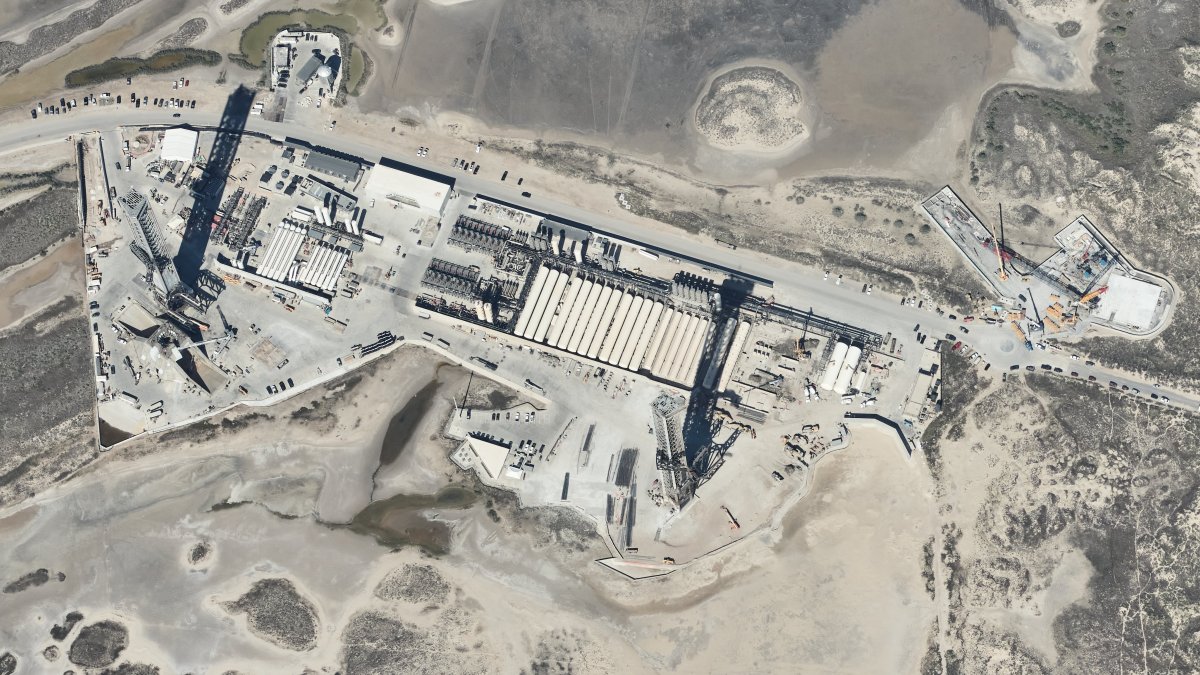
SpaceX plans to spend more than $74 billion building two AI compute campuses, one at its Starbase site in south Texas and one in Cochise County, Arizona, according to a company update titled Building the Future published on Thursday. The disclosure marks how far the company's business has moved from rockets: its AI division contributed more than half of revenue in the third quarter, a fact that has become central to the equity story since SpaceX listed in June.
The Texas project is the smaller of the two at about $24 billion. It sits on roughly 444 acres of SpaceX-owned land in the Rio Grande Valley near the port of Brownsville and the city landfill, and will pair a supercomputing facility with a natural gas plant that SpaceX will build, own and operate. The site will generate its own electricity rather than draw from the public grid. SpaceX says the project has already created more than 3,000 construction jobs and will support more than 500 permanent ones, and it has committed $220 million to expand Brownsville's water and wastewater systems, adding capacity for 20 million gallons a day.
Arizona is the larger commitment at about $50 billion, and the details come from a special use permit application filed with Cochise County. The campus would occupy roughly 747 acres and be built in four phases with as many as nine compute buildings. First-phase demand is about 1.5 gigawatts, rising to roughly 6 gigawatts when complete. The filing describes about $3.6 billion of grid infrastructure investment, $500 million of it in the first phase, with transformers, breakers and gas-insulated switchgear already purchased or ordered, plus a 24 gigawatt-hour battery storage system whose site plan is labeled Megapacks, pointing to Tesla's utility-scale product. SpaceX targets March 2027 for initial construction power, with energization following transmission upgrades. The design uses dry cooling and, the company says, no industrial groundwater.
SpaceX puts the Arizona project at about 5,500 construction jobs and 1,000 permanent positions, and says it is working with local electric cooperatives on terms that could cut members' bills by up to 20 percent. Approval is not assured. The county is due to hold a public hearing in December, and a petition opposing the permit application has gathered about 2,400 signatures. Starbase's city council is scheduled to take up a property tax abatement for the Texas project on December 9.
The framing of the announcement is notable. A large share of the document is devoted to what host communities get: self-generated power instead of grid strain, money for water infrastructure, lower cooperative bills, dry cooling rather than water-intensive evaporative systems. That is a response to a year in which data center projects across the United States have run into local opposition over power prices, water use and noise, and it is now standard practice for operators to publish community benefit terms alongside the capital number.
SpaceX says the campuses will train frontier AI systems and also develop and test technology for compute in space, which is where the rocket business reconnects to the AI business. The company has argued that orbital data centers could eventually sidestep terrestrial power and land constraints, though the economics remain unproven and depend on launch costs falling far below current levels.
What it means: at $74 billion, SpaceX is joining the small group of companies writing nine-figure-monthly checks for AI infrastructure, and it is doing so with an unusual degree of vertical integration, generating its own power, buying Tesla batteries and building on land it already owns. The Arizona filing also shows the new gating factor. The constraint is no longer capital or chips but interconnection queues, county permits and the patience of neighbors, which is why a rocket company now spends paragraphs on water treatment and electricity bills.
Comments (0)
Log in to join the discussion
Log InNo comments yet