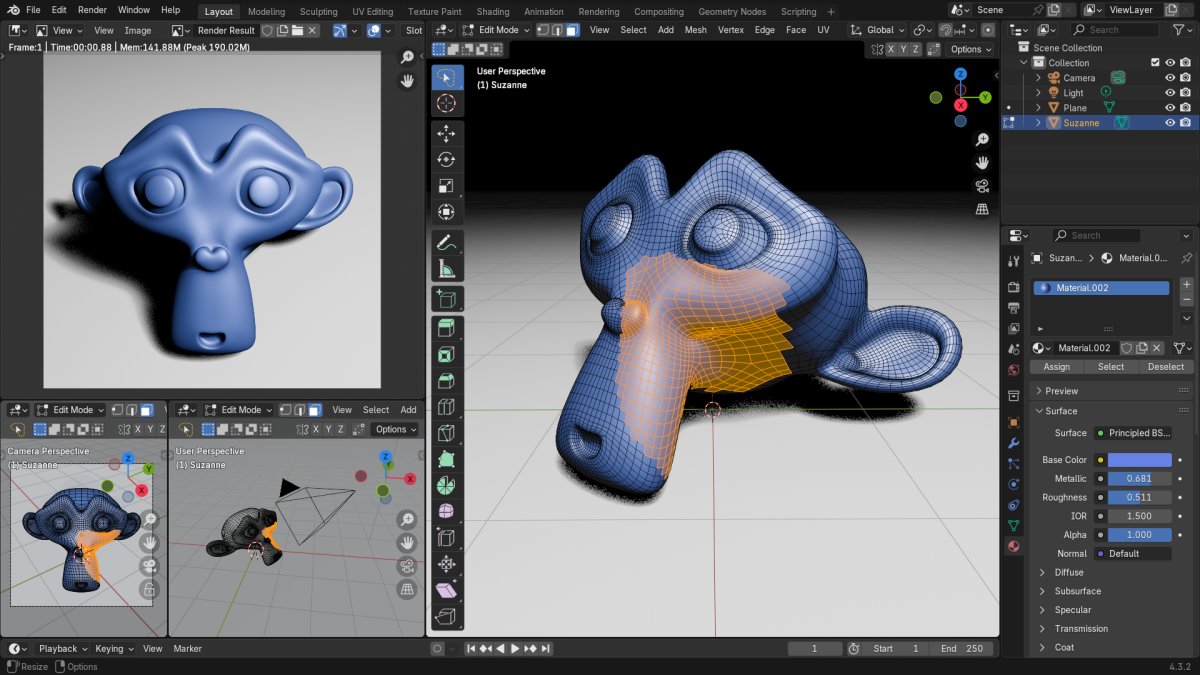
Moonshot AI has productized the part of its Kimi K3.1 Pro launch that drew the most attention among developers: the model's ability to operate professional 3D software. The company announced "Introducing 3D Make in Kimi" on October 30, and the feature is now available on kimi.ai, in the Kimi app, and inside Kimi Work, the company's work agent surface.
The mechanics are agentic rather than generative in the image-model sense. A user supplies a text description, a sketch or a reference image; the model infers shape, proportion and spatial relationships; then it writes and executes scripts for Blender and CAD tools directly, which Moonshot says works without MCP connectors. The result can be previewed and edited online, downloaded as a mesh suitable for 3D printing, or exported as video and Live Photos.
The numbers Moonshot publishes are measured and, notably, not flattering to itself. On BenchCAD, a benchmark that tests 3D reconstruction from multi-view renderings through CAD code generation, the company reports K3.1 Pro scoring 92.7 percent with tools, behind Claude Opus 5.5 at 96.2 percent and GPT-6 Astra at 95.9 percent. Those are Moonshot's own evaluation figures and have not been independently verified. On OfficeQA Pro v2, a finance document benchmark, the company claims 64.4, which it describes as state of the art.
An official tutorial published the same day walks through four concrete workflows: building an oriental palace scene in Unreal Engine, making a lamp that can actually be 3D printed, generating architecture with pure-code Blender calls, and assembling a miniature city with Tripo and Blender. The company's advice to users reads like craft guidance rather than marketing: show images instead of long descriptions, build a gray model first and refine later.
3D Make rides on K3.1 Pro, the 3-trillion-parameter flagship Moonshot released on October 23 with a 1-million-token context window, which the company says was trained with a much larger reinforcement learning budget aimed at long-horizon tool use in coding, 3D creation and financial modeling. The capability claims around game engines are specific: the model is said to work with Unity, Unreal Engine and Godot, combining them with web search and 3D generation to produce complete interactive scenes.
The competitive context matters. Community teams including Nvidia and MIT researchers, fal and FastVideo have spent recent months building on MiniMax's open H3 video model, and design-arena leaderboards now rank open-weight video models. 3D is following the same pattern: a strong base model plus tool-driving agents is turning what used to be a demo reel into a production pipeline, with outputs that land in Blender, Unity or Rhino rather than staying inside a chat window.
What is unproven is quality at the professional end. BenchCAD suggests frontier models still beat Kimi at CAD code generation, and no independent benchmark yet measures whether agent-driven Blender work can survive contact with a working 3D artist's standards. But the direction is clear: the fight is shifting from who renders the prettiest picture to whose agent can operate the software professionals already use, and Moonshot has decided to compete on that ground with a consumer-facing product rather than a paper.
Comments (0)
Log in to join the discussion
Log InNo comments yet