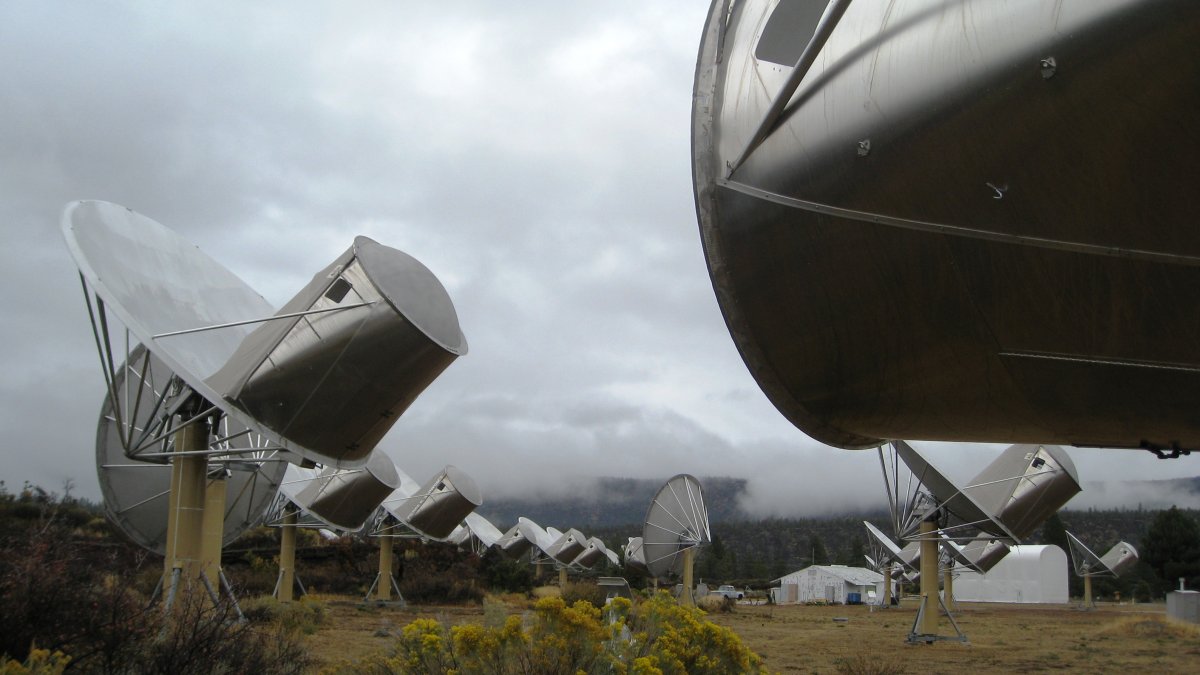
At the Allen Telescope Array in Northern California, the search for extraterrestrial intelligence now accepts instructions in plain language. Breakthrough Listen and the SETI Institute have integrated agentic AI into the observatory's daily operations, in a system described by Nvidia on October 30. From a single natural-language request, agents can steer the instrument, calibrate and focus it, correct errors in the incoming stream, apply models to the data as it arrives, and plot the result.
Getting there required solving a data problem first. Radio telescopes generate enormous volumes of signal, and the traditional workflow is to write it all to disk and analyze it later. At the Allen array, a Holoscan platform library called DAQIRI pulls terabits per second of sensor data straight into GPU memory so observations are processed in flight. CyberEther, a signal-processing framework developed at the SETI Institute, does the mathematics using Nvidia CUDA-X libraries including cuFFT and cuBLAS.
The agent layer sits on top of that plumbing. Nexus, a web-based observatory orchestrator from Stelline, acts as the harness: it gives agents a single source of truth for instrument state, compute resources and pipelines, and lets researchers monitor packet loss, read live spectrograms and even rewrite signal-processing blocks by prompting. The full system handles 2.4 terabits per second on Nvidia RTX PRO 6000 Blackwell GPUs, with inference running on premises, next to the instrument, rather than in a distant cloud.
The payoff is measured in human time. Tasks that would take researchers weeks or years are compressed into hours, because the agent can iterate on the instrument itself rather than waiting for a scheduled observing block and a manual analysis pass. The pipeline has already notched a first: real-time AI detection of a pulsar, the rapidly spinning stellar remnant in the Crab Nebula that pulses like a cosmic lighthouse.
Andrew Siemion, holder of the Bernard M. Oliver chair for SETI at the SETI Institute and principal investigator of Breakthrough Listen, put the philosophical stakes precisely. "As our new agentic observatories reach out into the universe, what they find may have much more in common with themselves than with the humans who created them," he said. "But this isn't something to fear. Rather, it's a breakthrough in translation." The remark is more than poetry. If some extraterrestrial civilisations are billions of years older than humanity, the argument goes, the most durable thing they would leave behind is not biology but machinery, and the machinery most likely to be listening is our own.
The team is already looking past terrestrial infrastructure. It is evaluating open models, Nvidia's Nemotron among them, for cases where data locality and turnaround time dominate, and for observatories that may one day run offline on the far side of the moon, where a round trip to Earth is a latency problem rather than a bandwidth one.
Read as an AI story rather than an astronomy story, this is a template. The instrument is not a chatbot and the agent is not answering questions; it is operating a physical scientific apparatus, closing a loop between measurement, analysis and the next measurement. The hard part is no longer building the loop. It is deciding how much authority to hand to a system that can retune a telescope overnight, and how a researcher verifies a result that no human set up. Astronomy, with its clean signals and reproducible observations, is an unusually forgiving place to work that out before the same pattern arrives in laboratories, factories and power grids.
Comments (0)
Log in to join the discussion
Log InNo comments yet