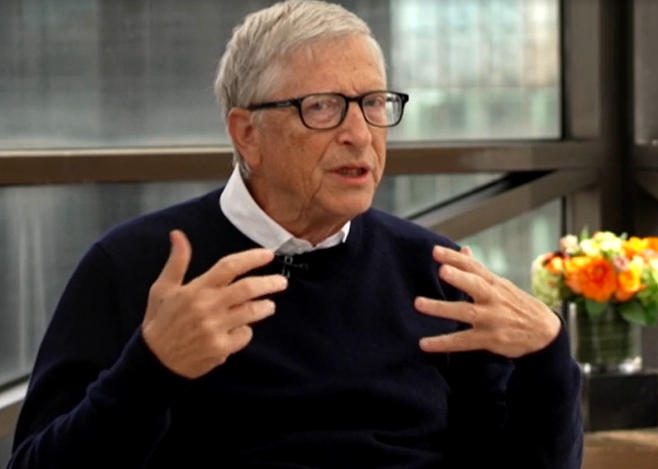
Microsoft co-founder Bill Gates has delivered a striking public warning: in the worst case, uncontrolled AI development could lead to a catastrophic event causing a billion deaths, according to a report by MyDrivers (Kuai Keji).
In a dedicated interview segment on NBC, Gates made no attempt to blur the potential risks of AI. He stated plainly that today's AI, which is iterating faster and faster, has already become powerful enough to trigger an extreme black swan event with a potential death toll of as many as one billion people.
Human civilization, he explained, has never faced such a dangerous combination. If malicious extremists get hold of the latest generation of AI tools, it would amount to holding a new type of weapon of mass destruction far more destructive than conventional weapons — with corresponding potential risks that are simply impossible to estimate.
Gates also stated publicly in the interview that dedicated legislation restricting real-world AI applications must be introduced as soon as possible, keeping the boundaries of technological development within a safe and controllable range.
Notably, before Gates made this public statement, Dario Amodei, chief executive of leading AI company Anthropic, had already been the first to issue the call: out of shared safety concerns for all humanity, developers should proactively slow the pace of developing new generations of AI models with larger parameter counts and stronger capabilities, to keep the risks from spiraling completely out of control.
Well-known American billionaire Elon Musk (whose companies include SpaceX and an affiliated AI firm), along with OpenAI chief executive Sam Altman, have both previously stated publicly that they fully endorse that call, arguing that at this stage, safety constraints on AI are a priority no lower than the pace of the technology's iteration itself.
Today, the top practitioners of the global tech industry have collectively sobered up from the carnival of purely chasing AI iteration speed. Technology has never carried any inherent good or evil; whether humanity can establish unified global regulatory rules before the technology completely slips out of control has become the single most central unsolved question facing the AI industry.
Comments (0)
Log in to join the discussion
Log InNo comments yet