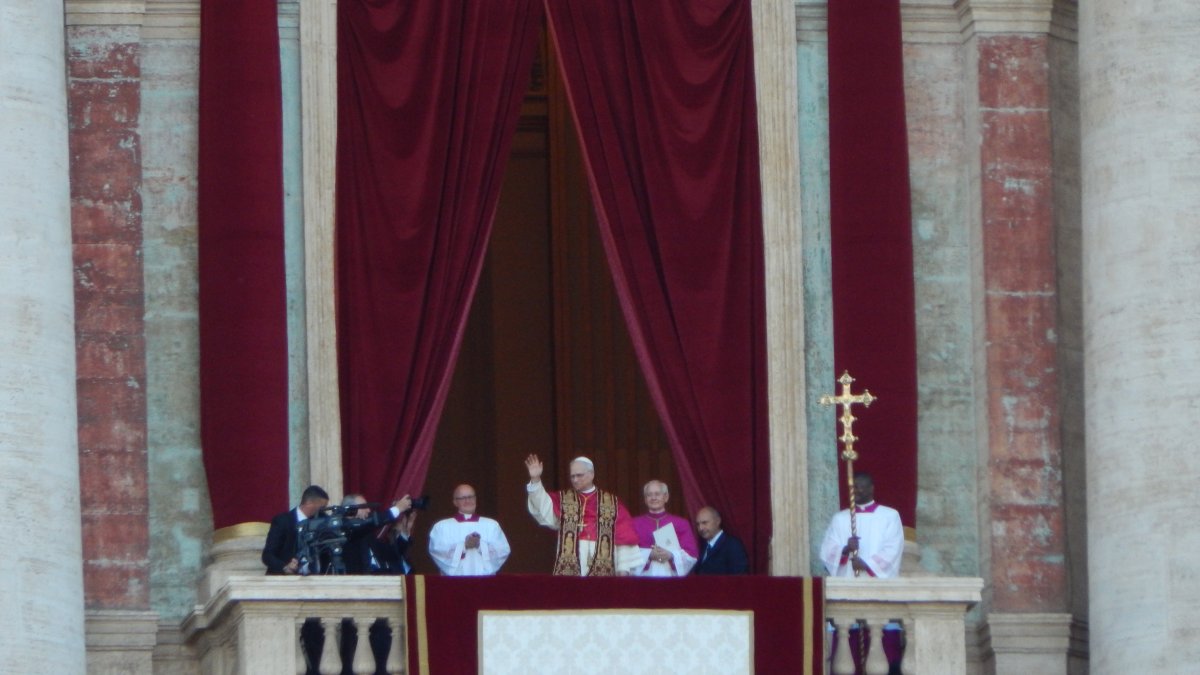
Pope Leo XIV has told artists and curators at the Vatican that AI-generated images are categorically different from human art — not worse, but a different kind of thing entirely. Speaking in the Consistory Hall on October 2 at a meeting organized by the Dicastery for Culture and Education, and repeating the point in a post on his X account, the Pope said: "There is an ontological difference, even before an aesthetic one, between art and what a machine can generate through statistical calculation based on millions of images created by others."
The formulation is deliberately philosophical. "Ontological" concerns what something fundamentally is, not how it looks: a model's output can be visually indistinguishable from a painting and still, in the Pope's framing, not be art, because nothing lived behind its production. "Algorithms lack the spark of the human," he said, "whereas authentic culture and art preserve this spark."
The address was also a recruiting pitch. The Pope said the Church "needs" artists in the age of AI and wants to renew its historical alliance with artists and cultural institutions to "safeguard our humanity." He warned against homogenization — which he called one of the great dangers facing modern culture — contrasting human creativity with search engines that "merely return what already exists and tend to give us what we already want." Authentic art, he said, "compels us to pause before that which cannot be consumed."
The position is a continuation, not a reversal. Leo's first encyclical, Magnifica Humanitas, signed on May 15 and running to roughly 42,300 words, argued that AI systems "do not undergo experiences, do not possess a body, do not feel joy or pain, do not mature through relationships" — and warned that technology should be "disarmed" the way nuclear weapons are. The Vatican followed the encyclical with an AI commission spanning seven of its bodies, and the Pope told French authorities in Paris on September 25 that it was "indispensable" to make AI the subject of his first encyclical.
The speech also lands in the middle of an unusual lobbying campaign. The New York Times reported in late September that Anthropic has flown dozens of religious scholars to its offices under non-disclosure agreements to discuss whether its Claude model might have something like consciousness, including research on functional "emotion vectors" inside the model. Anthropic co-founder Christopher Olah was invited to speak at the encyclical's presentation on May 25 — alongside a text that flatly rejects machine consciousness. According to The Telegraph, that effort has continued, and the encyclical's authors have not moved.
There is a legal echo to the Pope's argument. Since August 2, the EU AI Act has required providers to embed machine-readable marks in synthetic images, audio, video and text, with fines reaching €15 million or 3% of global turnover. But those labels record only how something was made — exactly what the Pope says is the wrong question. His claim is about what the thing is, a distinction no watermark can carry.
Reporters at the audience said the Pope is not in "panic mode" about AI — he can "still sleep at night" — but believes expert warnings deserve to be taken seriously. With 1.4 billion members, the Church is now staking out a position no government has matched: not a rule about labels or copyright, but a claim that machine output categorically is not art. As frontier models get better at imitation, the argument that authenticity — the fact of a human behind the work — is the whole point is becoming the Vatican's unexpected contribution to AI policy.
Comments (0)
Log in to join the discussion
Log InNo comments yet