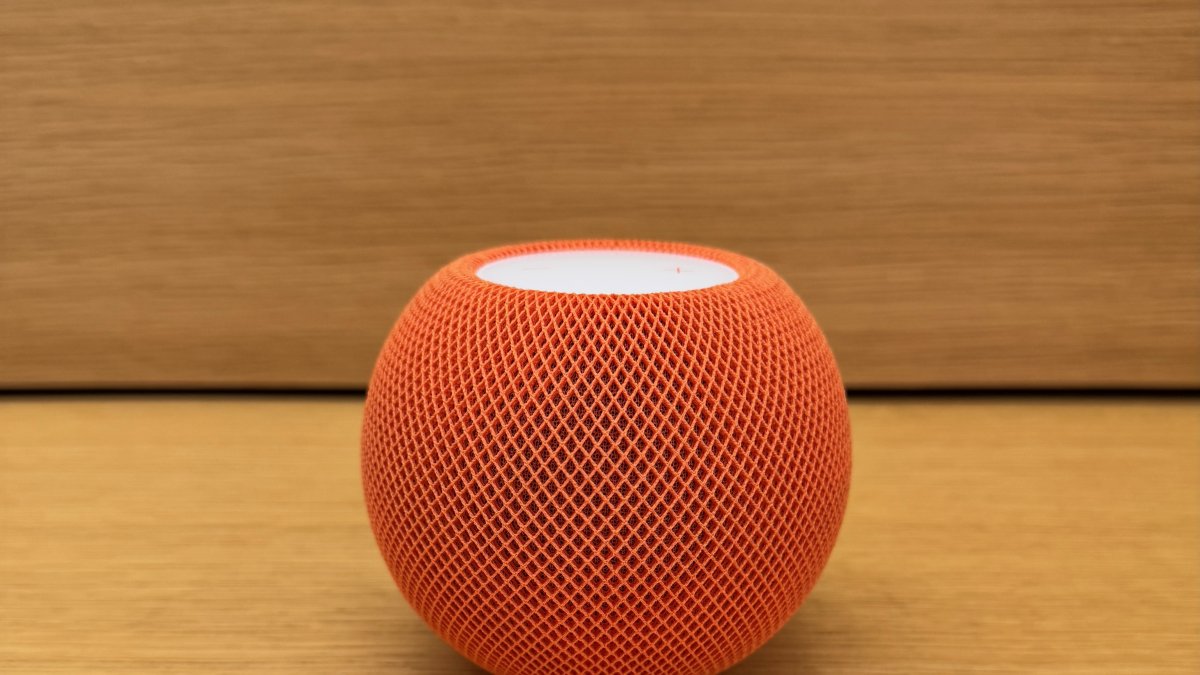
Apple is expected to hold a product announcement on October 13, and the centerpiece is not a phone. According to Bloomberg's Mark Gurman, the company plans to introduce the HomePad — a long-rumored smart home display — alongside a refreshed HomePod mini and a new Apple TV 4K. Apple has not confirmed the HomePad name, the date or the products; everything below is based on reporting, not an official launch.
The hardware, per the reports, comes in two versions. The tabletop model, codenamed J490, pairs a round metal base holding speakers and microphones with a metal arm supporting a tilting 6-inch screen — a design that visibly echoes the 2002 iMac G4. A wall-mount variant, J491, uses a thinner base beneath the display. The panel is about as thick as an iPhone with bezels reminiscent of older iPads, a 1080p front camera handles video calls and face recognition, and there is no internal battery: both versions run on USB-C power, in a grey aluminum finish.
The more consequential half is the software. The device is expected to debut homeOS, a new operating system that blends iOS-style widgets, iPad app layouts and watchOS-inspired icons. The idle screen is built around a clock and photo slideshow in the manner of the iPhone's StandBy mode; swiping up opens an app launcher. Built-in apps reportedly include Music, Podcasts, Photos, Weather, FaceTime, Notes, Calendar, Messages and Reminders. There is no App Store — users can bring in third-party widgets from an iPhone, but that is the extent of third-party software.
That absence is deliberate, because Siri AI is the product. The reported experience leans on voice and on-device processing: the camera recognizes who is standing in front of the screen and swaps in their calendar, music and notes; the interface shifts with proximity, showing room temperature from across the room and the control center up close. Processing is said to run locally on an A-series chip rather than pinging a cloud server for every request, which is both a privacy pitch and a latency argument.
The business logic is the subscription market Apple is choosing not to enter — for now. Google Home Premium runs $10 to $20 a month for its advanced tier, and Ring Protect $5 to $20 depending on coverage; a rival AI tier at $20 a month works out to $720 over three years, excluding hardware. Apple's reports so far describe no subscription fee for Siri AI or homeOS features: the intelligence is bundled into the device price. The refreshed HomePod mini already sits at $129, up from $99 in June 2026, and the HomePad is expected to land above $300, though Apple has confirmed nothing.
The risk profile is unusual for Apple. A hub with no App Store has no manual fallback: if Siri AI misunderstands a request, there is no touch-first alternative path for the core experience, so the category stands or falls on assistant quality. Availability is another constraint — reporting indicates Siri AI has not yet cleared regulatory review in China, limiting the feature on domestically sold hardware regardless of how capable the device is.
If the October 13 reports hold, this becomes Apple's first new hardware category since the Vision Pro and its most serious attempt to give Siri a physical home. It is also a direct bet against the subscription model that Amazon's Alexa+ and Google's Home Premium have normalized: Apple is wagering that buyers will pay more upfront to own the experience outright. Whether on-device Siri AI is good enough to carry that bet is the question the launch will finally answer.
Comments (0)
Log in to join the discussion
Log InNo comments yet