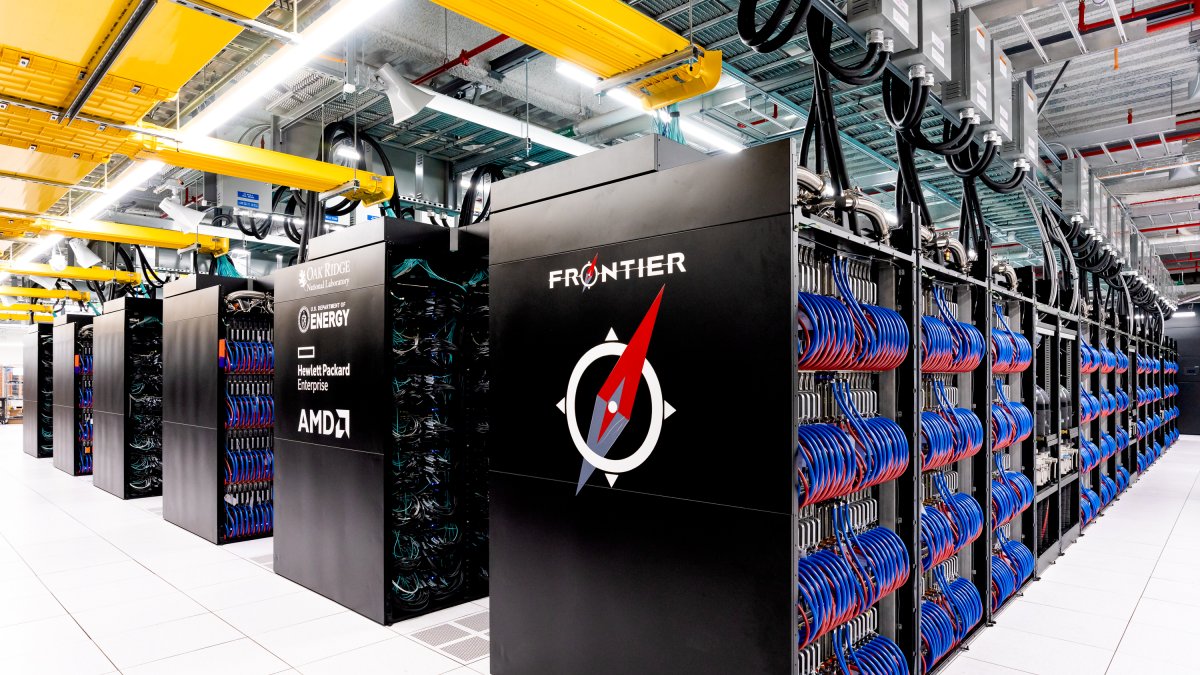
AMD has released HPC Assistant, an open-source AI coding agent aimed at removing the operational friction of running supercomputers, announcing the tool at the SC26 conference in Chicago on November 17. The system is live on LUMI, Finland's flagship supercomputer operated by CSC, and is being deployed on Frontier, the exascale machine at Oak Ridge National Laboratory whose AMD-powered cabinets anchor the US Department of Energy's computing portfolio. The code ships under the MIT license from the silogen/hpc-assistant repository on GitHub.
The problem it targets is familiar to anyone who has used a national-lab system. HPC clusters are nothing like cloud VMs: researchers write Slurm job scripts with exact partition names and GPU counts, manage module environments where mismatched library versions silently break runs, and read system-specific documentation that can run past 200 pages. Most HPC users are domain scientists, not sysadmins, and routinely spend weeks on this overhead before writing a single line of research code. AMD's bet is that an agent holding the cluster's own documentation can absorb that burden rather than just pointing at it.
The tool ships as a set of site-specific skills covering the most time-consuming operations: submitting, monitoring and canceling jobs through sbatch, srun, squeue and scancel issued in natural language; profiling AMD GPUs through rocprofv3 with kernel tracing and performance counters; tracking per-job energy consumption through Omnistat and Grafana; retrieving answers from the cluster's real documentation, including storage policies and project quotas; and launching scientific agents such as OpenFold3 for protein structure prediction without manual environment setup.
The architecture reflects how HPC centers actually work. Login nodes cannot host large language models, so the agent runs on the researcher's own machine and executes remotely over SSH. Under the hood, markdown skill files with YAML frontmatter define permitted operations, MCP servers expose the RAG knowledge base and cluster tools, and a LiteLLM proxy translates between Anthropic- and OpenAI-compatible backends, letting the agent drive Claude Code and OpenCode as clients.
"The HPC Assistant brings something genuinely new to LUMI. It understands the full researcher workflow, from job submission to GPU profiling, energy visibility and launching scientific models without manual environment setup," said Pekka Manninen, Director of Science and Technology at CSC. AMD has not disclosed adoption metrics, and the agent's practical value will depend on how well its skills hold up across the dozens of site-specific configurations that differ from LUMI's.
The release lands mid-week at SC26, where NVIDIA marked CUDA's 20th anniversary and announced Rubin HPC for simulation workloads. AMD's counter-framing is to weaponize openness: while NVIDIA ties researchers to its CUDA stack, AMD is shipping an agent layer that already runs the two most prominent AMD-based supercomputers in the world, and giving the code away to get it into national-lab workflows. Whether agentic tooling becomes a genuine wedge for AMD in HPC procurement — a market NVIDIA has dominated for two decades — is the question the next few procurement cycles will answer.
Comments (0)
Log in to join the discussion
Log InNo comments yet