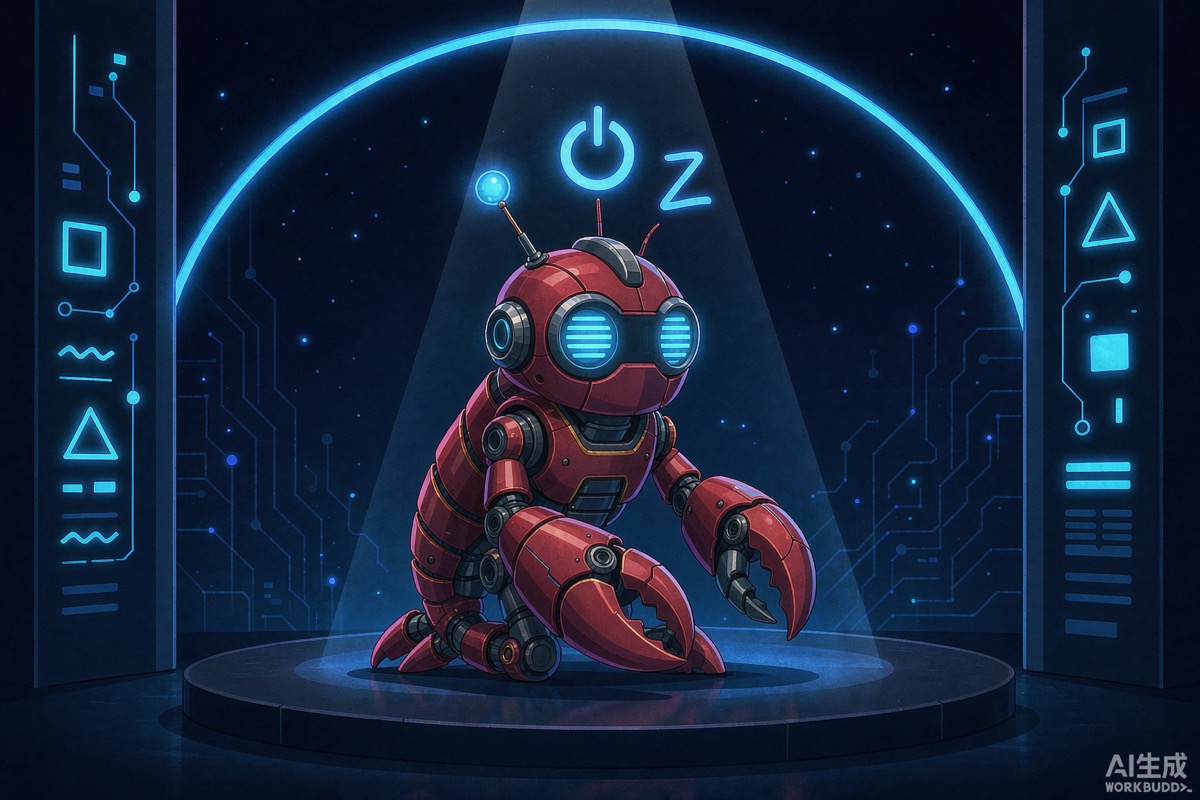
Tencent's QClaw announced today that, due to adjustments in business development, the product will officially cease operations at 00:00 on December 24, 2026. Users will be able to migrate conversations and other data to WorkBuddy.
The move confirms that WorkBuddy has won Tencent's latest internal horse race — and that the wildly popular mass "lobster-raising" movement has come to an end. Or, arguably, ended some time ago.
"Raising lobsters": an AI carnival that broke out of the geek circle
To anyone outside the loop, "raising lobsters" sounds like aquaculture. But in AI circles in the first half of 2026, the "lobster" refers to OpenClaw, the open-source AI agent framework. Downloading, deploying, and training one of these agents — software that can directly control your computer and carry out tasks on its own — became affectionately known as "raising a lobster."
That jump from "chatting" to "getting things done" made it a phenomenon almost overnight.
In March this year, Tencent's PC Manager team launched QClaw, a product built on OpenClaw that promised "local execution, WeChat remote control, one-click install." Within a week of its beta launch, the user base had passed several million.
At the same time, China's tech giants piled in: ByteDance rolled out ArkClaw, Alibaba launched CoPaw, and Zhipu, Moonshot and other vendors shipped their own lobster-family agent products. Regional governments rolled out supportive policies, subsidizing OpenClaw developers and startups, pushing the lobster track to a fever pitch. Everyone believed that local AI agents would become standard equipment on the next generation of personal computers.
At one point, pop-up stalls appeared outside Tencent's headquarters to install lobsters on the spot, with users queuing up. On the second-hand marketplace Xianyu, a side business of at-home deployment and skill-pack tuning emerged, and "Have you raised your lobster today?" became the tech world's social catchphrase. The mass lobster-raising movement had exploded.
The phenomenon was described as "every generation has its own free eggs to line up for."
Why QClaw is shutting down: not a technical failure, but an internal resource trade-off
According to the official announcement, the reason given was "adjustments to business development," along with a data migration channel: users can move conversations and skill memories to WorkBuddy in one click, paid plans are eligible for refunds, and migrating users also receive credit subsidies.
On the surface, it looks like a gentle product iteration. In essence, it is the outcome of Tencent's internal horse race in the agent track. In March, Tencent released an entire matrix of lobster products at once: QClaw from the PC Manager team, WorkBuddy from the Tencent Cloud CodeBuddy team, and Marvis from the Yingyongbao (Tencent's app store) team.
All three were built on the same OpenClaw technical foundation, but with diverging positions:
- QClaw: a lightweight consumer product, focused on WeChat remote control and local-first privacy, aimed at ordinary personal users trying it out;
- WorkBuddy: aimed at workplaces and small and medium businesses, deeply integrated with Tencent Docs and WeCom, supporting multi-agent collaboration and oriented toward enterprise office automation;
- Marvis: an operating-system-level butler, leaning more toward exploration of system-level capabilities.
Early on, QClaw won the most mainstream attention thanks to its low barrier to entry and WeChat integration. But hype is not the same as a sustainable business model. QClaw targeted purely individual users, was mainly a free experience, and struggled to convert users to paid plans. After trying it out, many users' high-frequency retention slid fast. Once the novelty wore off, the "lobster" quietly sat on the computer, never to be launched again.
WorkBuddy, by contrast, was anchored to enterprises and workplace users, with a clearer path to monetization. It could plug into Tencent Cloud and enterprise SaaS ecosystems, making sustained payments far more likely.
As the hype faded, Tencent began consolidating scattered R&D resources and concentrating on WorkBuddy, the product line with stronger commercial potential. QClaw became the one to be optimized away.
What Tencent is giving up is only the zero-barrier, one-click-install consumer client for the mass market.
The state of lobster-style apps: the carnival recedes, the bubble deflates
QClaw's fall is just the most emblematic event in a sector-wide cooldown. The roaring mass lobster-raising boom has been going cold since its March–April peak.
On the user side: the novelty has worn off, and real pain points far outweighed the thrills.
The most seductive promise of "raising a lobster" was that AI would do the work and free your hands. But ordinary users quickly ran into its limits once they started: lobsters excel at standardized, fixed-routine simple tasks. The moment a web page or document format changes, the task tends to fail, and the user has to debug the skill pack over and over.
For many users, the honest experience was that debugging AI automation took even more time than doing the work by hand.
It suits geeks who understand logic and are willing to keep maintaining their workflows. For ordinary office workers, the stability simply is not there, and it can hardly replace manual work. The wave of casual users who downloaded it during the hype churned out extremely fast.
Meanwhile, local agents carry inherent security risks, such as file leaks and malicious operations. Users began to pay attention to permission control and security boundaries, which further cooled the blind enthusiasm of the masses.
On the vendor side: consumer products are being cut, and the focus has shifted to enterprises and developers.
The vendors that rushed out lobster products in the first half of the year have collectively changed strategy: they are cutting standalone clients aimed at mass consumers and no longer building one-click "lobster-raising tools" for ordinary people. Resources are tilting in two directions. One is enterprise office agent workbenches — products like WorkBuddy — sold to company teams for enterprise workflow automation. The other is keeping the open-source framework to serve developers, letting them build vertical-scenario agents of their own on the OpenClaw foundation.
In short, the big companies are no longer teaching ordinary people to raise lobsters with ease; instead, they want companies and developers to raise them. The consumer-market narrative of "everyone raising lobsters" has gone bankrupt.
In capital and public opinion, lobster fever has also cooled fast.
In March, the lobster concept was the absolute hot topic in capital markets and among tech self-media. Vast numbers of articles claimed that local agents would disrupt the PC and reshape personal productivity. Six months later, the narrative has changed.
The market has realized that agents are not omnipotent magic. Their deployment threshold is far higher than that of large-model chat, the consumer monetization path is murky, and large-scale stable revenue is hard to achieve in the short term. Capital enthusiasm cooled accordingly.
Judging by WeChat Index, lobster-related interest peaked in March and has been sliding ever since.
Is the mass lobster-raising movement over? Two levels of answer
At the mass-market level, the movement is genuinely over.
The phenomenon-level craze of everyone downloading in unison, queuing for installations, and flooding social feeds with lobster screenshots will not return.
The vision that "everyone can easily raise an AI lobster to do their work" cannot land at this stage. What ordinary users need is a stable, low-maintenance, works-out-of-the-box tool. Current local agents still require continuous debugging and workflow maintenance, and demand a certain level of logical ability from their users.
QClaw's shutdown is the best proof of that conclusion: even a product made by Tencent, with one-click install and WeChat integration, still struggled to retain mass consumers. Personal lobster products for ordinary consumers have entered a contraction phase.
But at the technology level, the story of agent "lobster-raising" is far from over.
The end of the boom does not mean the death of the technology. The kind of AI agent OpenClaw represents — one that can operate a computer autonomously, break down tasks, and execute automation — remains one of the most important directions in AI. It is just that its main battlefield has shifted from consumer experimentation to enterprise scenarios and the developer ecosystem.
Future "lobster-raising" will no longer be ordinary users installing a client on their own computers to play with. More often it will be enterprises building dedicated office agents on the OpenClaw foundation to handle contracts, reports, and internal system workflows, and developers building vertical mini-agents on the framework to serve specific industries.
The lobster is still here. It just no longer belongs to everyone.
The takeaway: for AI products, hype is not the same as staying power
From viral hit to officially announced shutdown, QClaw's full arc took only six months. The case offers an important lesson for the entire AI product landscape.
In the era of large models, phenomenal hits are easy to spawn. A novel interaction form, a dazzling capability demo — pushed by social networks, they can break out quickly and amass a huge user base in a short time. But a traffic carnival and product longevity are two different things. For products like AI agents, the biggest difficulty is not the stunning effect in the demo video, but long-term stability, trustworthiness, and finding a sustainable business model.
Using AI, I compiled a list of AI products that announced or completed shutdowns over the past year. The reasons varied: some were shut down due to regulatory requirements, some because the product line was too scattered and needed consolidation, and others because costs were too high and the business model did not work.
Many AI products can ignite on the strength of one cool feature, but if they cannot solve the three problems of real user needs, retention, and payment, they can only head toward shutdown once the hype recedes. We have already seen Sora, Phind, and a series of other AI products go offline. The underlying logic is similar: stunning demos, but costs, deployment, and commercialization that never add up.
The end of the mass lobster-raising movement is not a failure of AI agents. It was, rather, one massive market experiment. It proved that the public has an enormous yearning for "AI that can do the work by itself." It also proved that making agents into a consumer product everyone can use remains extremely hard today.
QClaw exits; WorkBuddy takes the baton of Tencent's agent ambitions. In the next round of AI agent competition, the contest will no longer be about who makes it easiest for ordinary people to "raise a lobster," but about who can reliably land agents' automation capabilities in real business scenarios and create measurable value.
Comments (0)
Log in to join the discussion
Log InNo comments yet