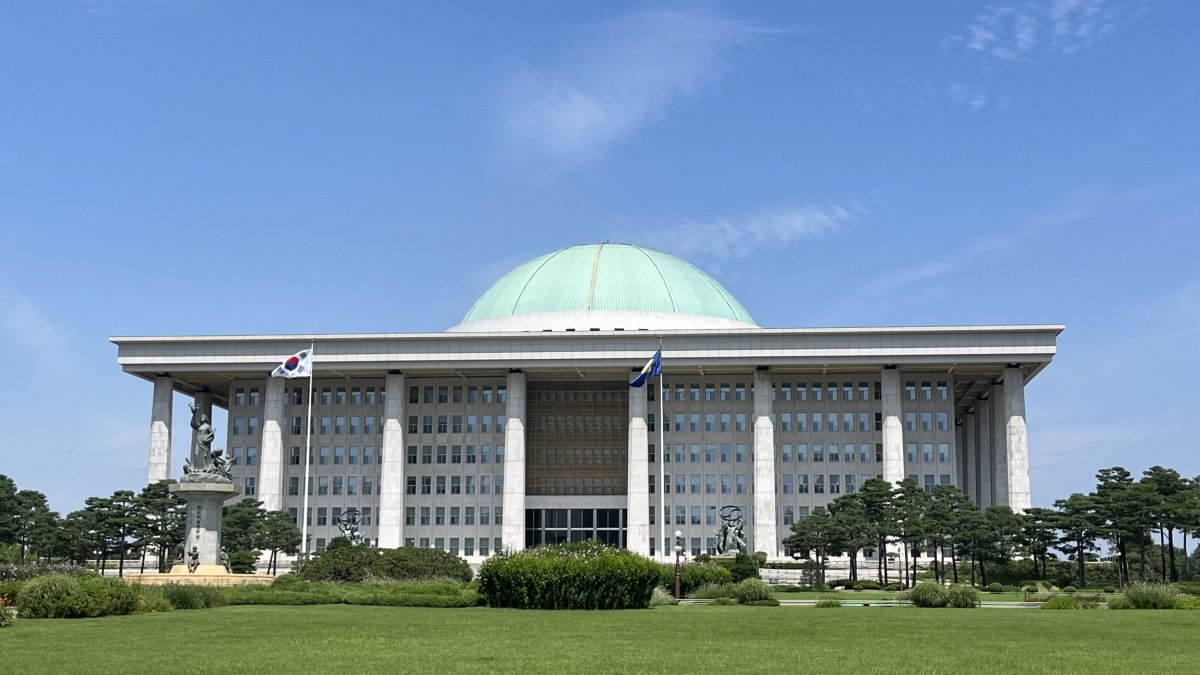
South Korean President Lee Jae Myung told the National Assembly on Monday that the government's 2027 budget will raise total spending by a record 12.8% to 820.9 trillion won (about $610 billion), with 21.3 trillion won ($15.97 billion) — nearly double this year's level — earmarked for what the administration calls its three megaprojects: semiconductors, physical AI, and AI data centers.
A separate 4.7 trillion won ($3.5 billion) line funds frontier AI development, with the stated aim of achieving "world-leading performance for our own AI model, a national strategic asset." The science ministry had already sketched that program in October: a lead developer chosen by open tender starting in March 2027, once parliament passes the budget. The new headline number is the envelope around it — 21.3 trillion won across the three megaprojects, up from roughly half that in 2026.
The record spending comes with unusual fiscal framing. Lee said next year's deficit narrows to 0.1% of GDP — the lowest in two decades, down from 3.9% this year — while the debt-to-GDP ratio falls to 48.3% from 51.6%. A 162.3 trillion won "Future Response Fund," financed largely by additional tax revenue from the semiconductor boom, is meant to buffer future revenue shortfalls. Citi economist Kim Jin-wook wrote on Monday that cumulative funding sources for the fund could reach 215 trillion won across 2026-2027, and that the strategy could support a Fitch upgrade of South Korea's rating from AA- toward AA.
The budget also invests in people. Seoul plans to train 2,000 specialists to lead semiconductor design and the regional chip industry, expand AI education for students, job seekers and existing workers, and scale up the university "contract departments" where students enroll in company-linked degree tracks with hiring pathways at Samsung Electronics and SK Hynix before graduation.
The private-sector backdrop makes the public money look almost modest. Lee is simultaneously pursuing an 800 trillion won chip buildout in the country's southwest, led by Samsung and SK Hynix. The export data explain why both sides are spending: October shipments surged 93.7% year on year to a record $115.3 billion, and the first ten months of 2026 reached $930 billion, topping the $900 billion mark for the first time. Lee said annual exports of $1 trillion are now within reach. The IMF forecasts 3.3% growth for 2026, the fastest since the post-pandemic rebound.
Defense spending rises 8.2% to 73.3 trillion won, with Lee framing the modernization in AI terms: "We will rapidly transform into a smart, elite, and powerful military by establishing a hybrid manned and unmanned system based on AI, robots, and drones."
The structural story is the flywheel. Memory-chip windfalls generate tax revenue, the revenue funds AI and chip infrastructure, and the infrastructure sustains the chip demand. Seoul is joining the sovereign-AI spending race — Saudi Arabia's HUMAIN, France's Mistral, and others — with one advantage none of them have: it already sits at the bottom of the AI supply chain. The budget still needs parliamentary approval, where Lee's Democratic Party holds a majority.
Comments (0)
Log in to join the discussion
Log InNo comments yet