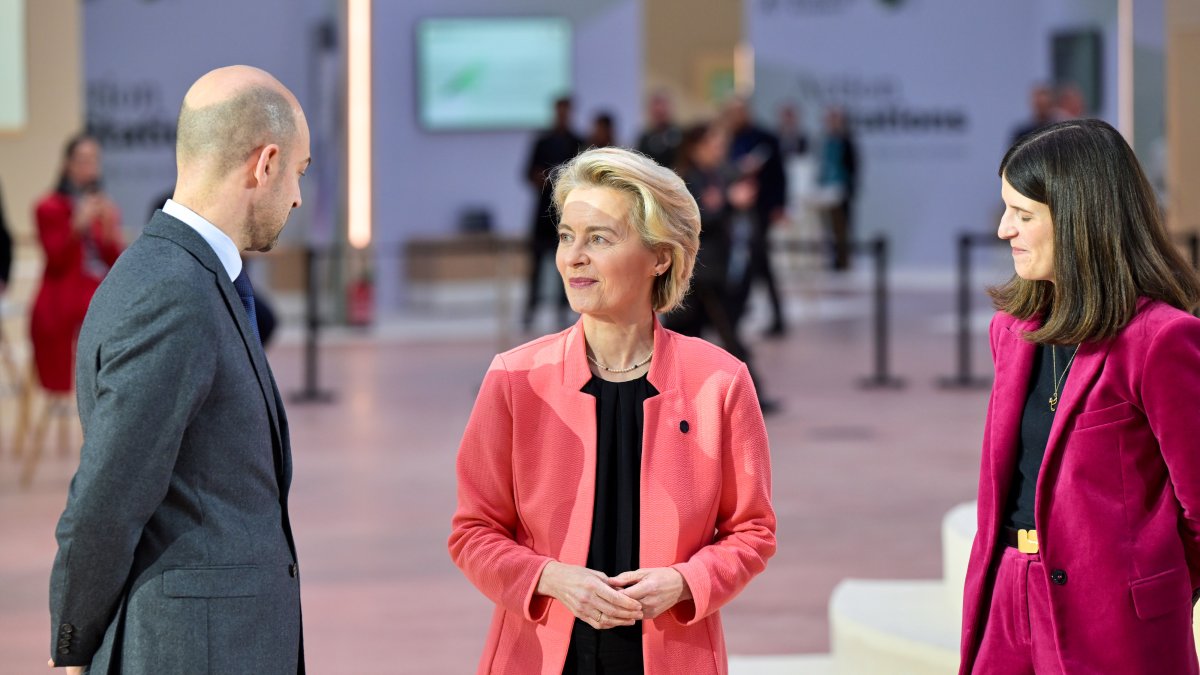
The first European summit dedicated to artificial intelligence ended in Dublin on Friday with a familiar pattern: big numbers, little new money. Commission President Ursula von der Leyen told leaders that Europe needs at least €500 billion in investment to advance its technological ambitions, and outlined a plan for seven AI gigafactories expected to mobilize around €30 billion. No binding financing commitments followed.
The gap between ambition and execution was the real story. The gigafactory plan, which would put advanced AI processors, software, cloud capacity and data centers under one roof at seven sites, has been struggling to get fully underway because member states disagree over competitiveness spending in the EU next long-term budget for 2028-2034. Le Monde reported on Saturday that the plan remains stalled, with its future tied directly to those budget negotiations.
The European Chips Act is not helping the mood. Three years after implementation, the program looks likely to miss its goal of doubling the bloc's share of the global chip market to 20 percent by 2030 and attracting advanced manufacturing to Europe. A study by the Brussels-based CEPS found that many planned AI facilities sit outside established research and innovation centers, and that heavy reliance on foreign chip suppliers risks swapping one technological dependency for another.
Leaders did get the briefings they asked for. Mistral AI chief executive Arthur Mensch and Nobel laureate Geoffrey Hinton addressed the room, an unusual pairing that captured the two moods in the building: commercial urgency about Europe falling behind the United States and China, and scientific unease about where frontier systems are heading. French President Emmanuel Macron called for faster decisions and greater investment, arguing that Europe has the talent, the energy and the technology to compete but must act jointly.
Macron also announced the next step: he and Dutch Prime Minister Rob Jetten will convene a meeting of European technology leaders, dubbed Tech Creators, in Paris on December 2. His framing was blunt. European companies that develop leading AI models should be able to find the compute to train them, the capital to scale them and the customers to deploy them inside Europe, because independence, in his words, cannot be outsourced.
Von der Leyen said the Commission is building a vision around the five sectors where AI can create the most value, with the first results due within two weeks, and that the Commission will bring forward proposals on financing technological autonomy. Council President Antonio Costa said leaders would revisit AI in February 2027, leaving the largest investment and policy decisions to future meetings.
The productivity math behind all of this is sobering. The Financial Times noted that Europe is already receiving AI-related investment, yet its productivity gains remain modest. The Stanford AI Index counted 59 notable models from the United States and 35 from China in 2025, against 2 from Europe, while Europe holds under 5 percent of global AI compute capacity. Against that backdrop, €500 billion is less a funding plan than a measure of the distance still to cover.
Comments (0)
Log in to join the discussion
Log InNo comments yet