Warp Sciences came out of stealth on Thursday with 215 million dollars in funding, led by Lightspeed Venture Partners, at a reported 865 million dollar valuation including the new money. IVP, Mayfield, Lux Capital, Premji Invest and Menlo Ventures participated, alongside individual investors including OpenAI chief financial officer Sarah Friar, Coinbase chief executive Brian Armstrong and LinkedIn co-founder Reid Hoffman.
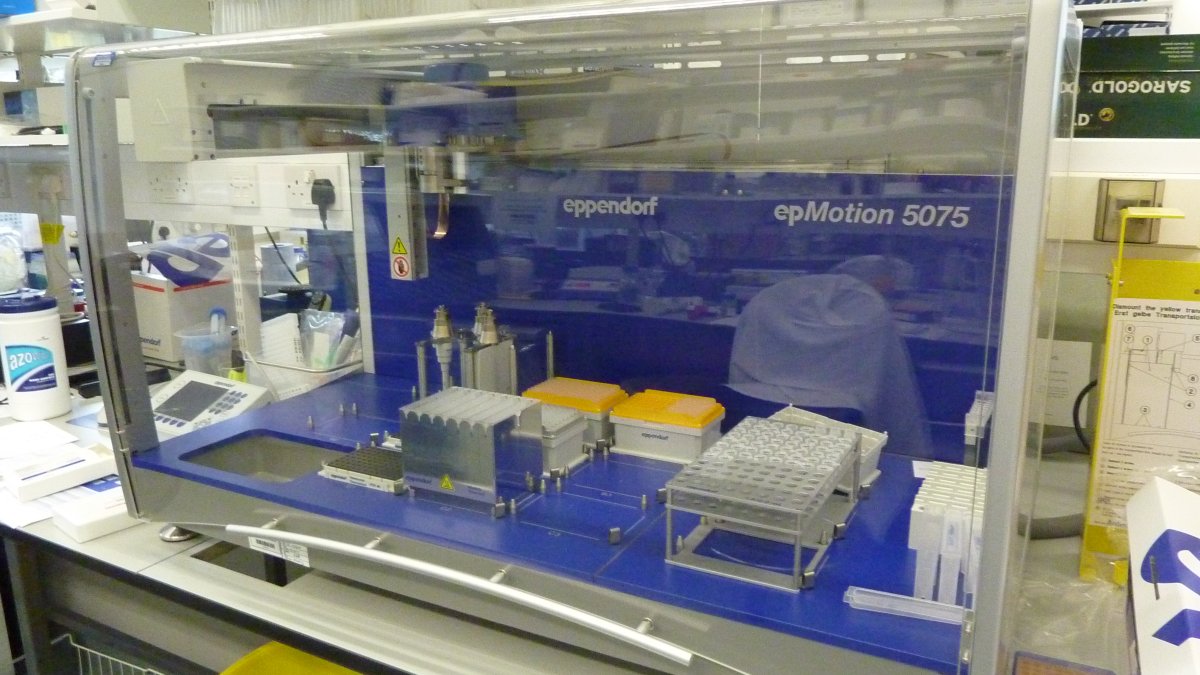
The company is not another model lab. It is building a chemistry contract research organization on American soil, staffed by expert chemists and increasingly by robots, and selling synthesis and testing as a service. Its first offering is lead optimization analog synthesis, the grind of making variations of a promising molecule so that researchers can compare properties and decide what to pursue next. Warp says customers choose the molecules and keep control of their programs, and that it will not develop a drug pipeline of its own.
The training loop is the mechanism worth watching. Chemists wear cameras and sensor-equipped gloves while performing experiments, and that demonstration data teaches robots to take over the physical work. Each automated run then produces data that improves the models, which in turn shapes the next round of experiments. Manohar Paluri, a founding member of Meta FAIR and now Warp chief technology officer, described the goal as making every experiment improve the next one, with software, AI and robotics designed alongside the lab rather than bolted onto it.
The founding team is unusually credentialed for a company this young. Kevin Weil was chief product officer and vice president of science at OpenAI. Solomon Reisberg, now chief scientific officer, held medicinal chemistry leadership roles at Terremoto Biosciences. DJ Patil, now chief operating officer, was a founding executive at Devoted Health and the first US chief data scientist. Early hires brought robotics experience from Genesis, Skild AI and 1X, and science backgrounds from Genentech and Lawrence Livermore National Laboratory.
The commercial thesis is partly geopolitical. In a 2024 survey by the Biotechnology Innovation Organization, 74 percent of respondents reported contracts with Chinese companies for preclinical and clinical services. The BIOSECURE Act, signed in December 2025, established a framework for restricting federal procurement and funding involving designated biotechnology companies of concern. Warp is explicitly selling an onshore alternative to the overseas partners that have absorbed this work for two decades, and Reisberg argues it can do so without the price premium US boutique CROs currently command.
Weil framed the scientific argument in terms of where AI has and has not landed. AI has dramatically accelerated software engineering and mathematics, he said, but has yet to make the same impact in the physical sciences, because chemistry and biology advance when something is made, tested and learned from. More capable models for science, in that view, require generating real-world experimental data at scale, and someone has to build the labs that generate it.
Skepticism is warranted on two counts. Automation depth and throughput are claims about a factory that is still being built, and no customer names, capacity figures or turnaround times have been disclosed. The valuation also prices a services business like a platform: at 865 million dollars, Warp is worth more than many clinical-stage biotechs with assets in trials, on the strength of a thesis about data flywheels rather than delivered experiments.
Still, the direction of travel is notable. The scarce input for AI in biology is not compute or model weights but clean, reproducible physical experiments, and the firms that own that capacity own the training data. Warp is betting that the cheapest way to own it is to buy a robot fleet, hire medicinal chemists, and sell the output as a service while keeping the byproduct, which is a defensible if capital-hungry position.
Comments (0)
Log in to join the discussion
Log InNo comments yet