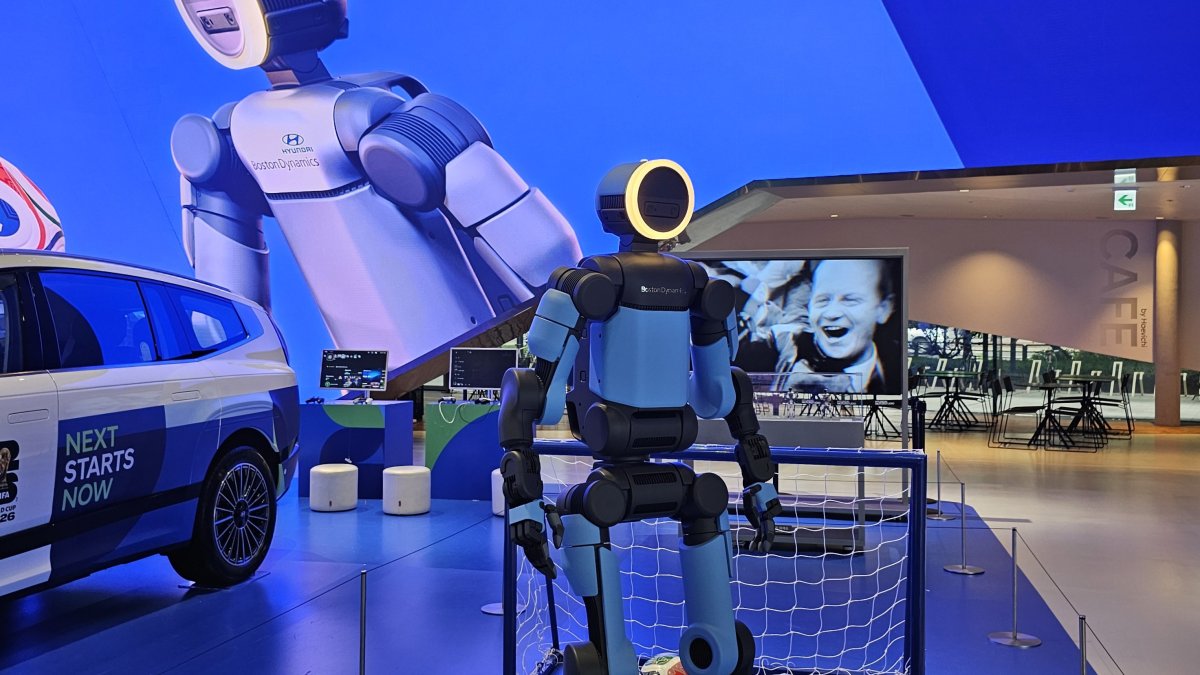
Hyundai Motor has closed the last gap in its ownership of Boston Dynamics. The Korean automaker paid SoftBank Group $325 million for the remaining 9.65 percent of the Waltham, Massachusetts robot maker, taking its stake to 100 percent, according to a Hyundai press release. SoftBank exercised a put option it had held since 2020, ending a nine-year involvement that began when it bought the company from Alphabet in 2017.
The price is the interesting part. Hyundai acquired 80 percent of Boston Dynamics in 2021 for $880 million, in a transaction that valued the whole company at $1.1 billion. Paying $325 million for 9.65 percent implies a valuation of roughly $3.4 billion, about three times the 2021 mark, for a company whose commercial revenue has historically lagged its viral videos.
SoftBank is not leaving robotics so much as repricing it. The Japanese group has committed about $41 billion to OpenAI and has been selling assets to fund that position; it now plans to use robots through a separate vehicle, Roze AI, for infrastructure construction including data centers, rather than through a hardware manufacturer it controls.
For Hyundai, full ownership converts Boston Dynamics from an affiliate with a minority partner into an internal supplier. The stated plan is to put the Atlas humanoid to work sorting and assembling parts at Hyundai's US plants between 2028 and 2030, while Hyundai Mobis manufactures the actuator systems that drive it. That vertical integration matters: actuators are among the most expensive and least substitutable parts of a humanoid, and keeping them in-house gives Hyundai a cost lever that buyers of Chinese components do not have.
Boston Dynamics has spent a decade trying to turn engineering prestige into a business. The company was spun out of MIT in 1992, bought by Google in 2013, sold to SoftBank in 2017 and finally majority-owned by Hyundai in 2021. Spot, its quadruped, went on commercial sale in 2020; Stretch, a box-handling robot for warehouses and sorting centers, followed. Neither has produced the scale of revenue that a $3.4 billion valuation implies.
The competitive field has also changed. Tesla is promising Optimus production, Figure AI has raised heavily on the premise of humanoids in logistics, and a cluster of Chinese suppliers is pushing hardware prices down fast. Hyundai's answer is to be its own first customer: a captive factory floor generates the operating hours, failure data and maintenance records that outside deployments take years to accumulate.
What to watch is whether Atlas ships on schedule and whether Hyundai discloses anything about cost per unit of work. A humanoid that only exists inside its parent company's plants is a well-funded pilot; a humanoid that Hyundai can sell to other manufacturers, with Mobis actuators inside, is a business. The $325 million check buys the right to attempt the second one without asking SoftBank for permission.
Comments (0)
Log in to join the discussion
Log InNo comments yet