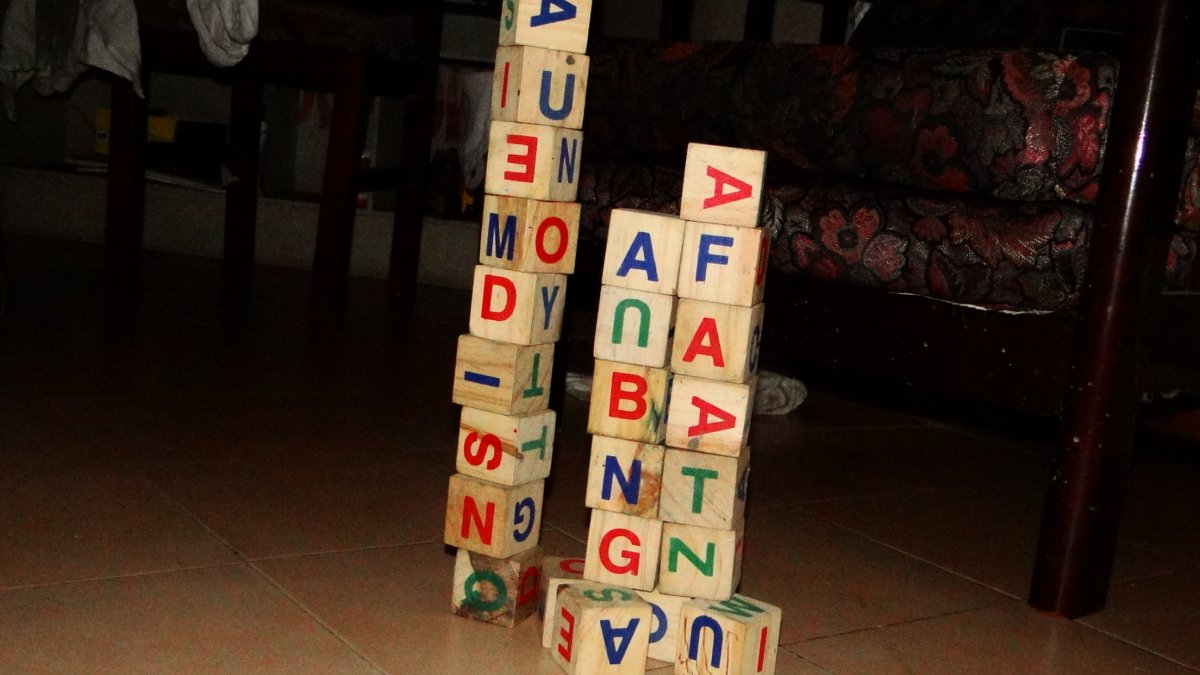
The Allen Institute for Artificial Intelligence (Ai2) has released ToyBlocks, a deliberately simple simulated world where a robot arm pushes lettered blocks around a table — and a first stress test suggesting that some of the most heavily pretrained robot policies still fail at basic changes in position and stack height. The release, published on the Hugging Face blog on November 6, is the first entry in what Ai2 calls FoundationWorlds: a framework of controlled environments paired with automatic task generators, demonstration generators and behavior metrics.
The setup is intentionally modest. A Franka arm manipulates alphabet blocks in NVIDIA's Isaac Lab simulator, with short-horizon skills such as pushing, flipping and rotating trained through reinforcement learning and motion planning. A task-and-motion planner then composes those skills into long-horizon demonstrations — no human teleoperation involved. Ai2 says hundreds of plans can run in parallel on a single GPU at up to 24 times real-time speed, which is how the initial dataset reached 85,336 long-horizon demonstrations, roughly 1,600 hours of robot execution data and 144 million frames.
What makes ToyBlocks different from static trajectory datasets such as Open X-Embodiment or DROID is the scoring. Every episode is checked against a PDDL-based planner, so the benchmark can separate high-level planning errors from low-level motor-execution errors — a diagnostic Ai2 argues is missing from datasets that only record what happened. The baseline difficulty on complex stacking is deliberately set near 55 percent to avoid the shortcut-solvability that let trivial probes top older benchmarks like LIBERO.
The initial results are pointed. Ai2 reports that pi0.5, ManiFlow and MolmoAct 2 — policies backed by large-scale pretraining — generalize poorly across four tasks (Stack, Unstack, Flip, Rotate) when workspace positions or stack heights move outside their training distribution. ManiFlow, trained entirely in simulation, still scored 80.0 percent on atomic skills in sim and 81.1 percent on a physical Franka FR3 arm, though Ai2 notes those conditions involved roughly ten episodes each. A hierarchy pairing the Molmo 2 vision-language model as planner with ManiFlow as executor completed 55.5 percent of simulated and 50.0 percent — 15 of 30 — real three-block spelling tasks.
The agentic experiments add a twist. When Claude Opus 5.5 drove ToyBlocks skills through an MCP server, seeing the scene only through camera images, it solved all 30 classical stacking tasks. More striking: skill descriptions the agent wrote after running its own experiments lifted success from 24 percent with default descriptions to 63 percent — beating the 36 percent achieved with descriptions written by a human expert. Among the world models tested, Wan 2.2, Alibaba's open video world model, was the best predictor of block motion and outcomes.
Everything in the release is Ai2's own reporting: the benchmark, the baselines and the sim-to-real numbers have not been independently verified, and the authors themselves caution that action model generalization remains far from solved. The institute is releasing the simulation assets, the task and demonstration generators, the full dataset and two trained models, so other labs can rerun and extend the experiments.
The timing is not accidental. OpenAI shipped BioBasicsBench, a 100-task wet-lab benchmark, earlier this week, and METR's contested audit of Anthropic has kept attention on how — and whether — AI progress claims can be independently checked. ToyBlocks addresses the same trust problem for embodied AI: if a robot policy scores well on a leaderboard, a controlled world is one of the few places researchers can trace exactly which layer of the stack failed.
For the robotics industry, the bet behind FoundationWorlds is that cheap, reproducible failure analysis will matter more than another sprawling real-world dataset. If Ai2 is right, the next round of robot foundation models will be tuned not just on more hours of video, but on the specific generalization gaps that environments like ToyBlocks are built to expose.
Comments (0)
Log in to join the discussion
Log InNo comments yet