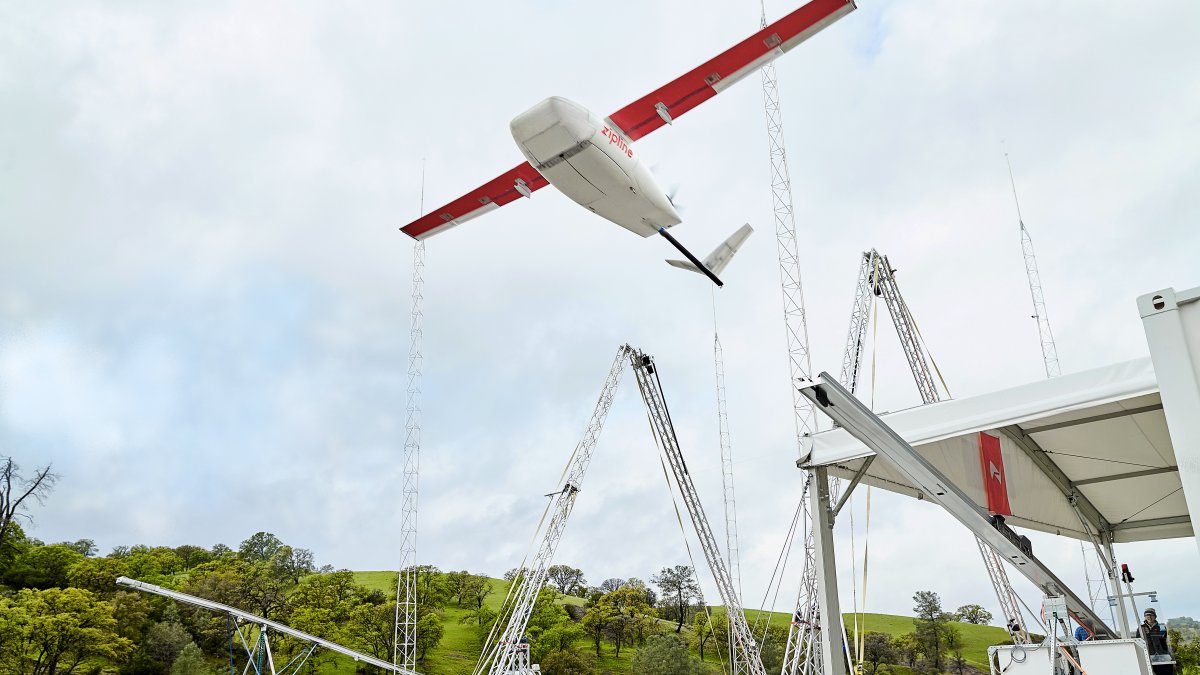
Zipline just made the strongest case yet that drone delivery has moved from demo to infrastructure. The autonomous delivery operator announced Thursday a $1.5 billion funding round at a $21.5 billion post-money valuation, nearly triple the $7.6 billion valuation it reached in January when it raised more than $600 million. The Wall Street Journal and Bloomberg both reported the raise, which the company confirmed.
The round was led by Paradigm, WCM Investment Management and Layer Global, with participation from Valor Equity Partners, Fidelity, Uber, Tiger Global, JPMorgan, ARK Invest and Salesforce Ventures. Notably, several of the investors are also customers whose orders are expected to fill the network. The capital is earmarked for expanding US manufacturing facilities and hiring as the company scales toward a nationwide delivery footprint.
The commercial engine behind the valuation is Walmart. The retailer signed a national multi-year agreement on the same day to add 300 new Zipline drone delivery sites, a sharp step up from the 21 active sites the two companies operate together today. In Texas alone, Zipline says it completed more than one million deliveries in the Dallas-Fort Worth area this year, and the median order in October arrived 19 minutes after checkout, figures the company reported itself.
Uber, which took a strategic stake when the two companies partnered in August, is targeting one million Uber Eats drone deliveries a day with Zipline by the end of 2029, with Houston and Dallas launches planned before the end of the year. Restaurant chains are scaling in parallel: Little Caesars is expanding from five Zipline locations to 65, and Marc Lore's Wonder plans more than 100 Texas locations starting in January, most expected to offer drone delivery. Zipline also says its share of restaurant delivery revenue rose from 10.8 percent in March to 34.9 percent in October, a company-reported metric that, if it holds, reframes drones from marketing gimmick to meaningful delivery channel.
The operating record is the substance under the numbers. Zipline says it has flown more than 150 million commercial autonomous miles without a safety incident, a company-reported claim that no competitor approaches at scale. The record is not spotless: two of its drones made parachute-assisted landings in Texas this summer, one in Greenville in July and another on a Houston-area highway in September, with no injuries. The company operates today under FAA Part 135 approvals granted case by case, and the industry is still waiting on the FAA's Part 108 rule for routine beyond-visual-line-of-sight flights, which reached the White House regulatory office in July and remains pending.
The raise lands in a market that has turned hostile to AI valuations. The Nasdaq dropped 6 percent the same week and Anthropic's mega-IPO is facing investor pushback, yet Zipline nearly tripled its valuation in ten months. The difference is revenue anchored in physical deliveries and customers like Walmart and Uber who are also investors, effectively pre-committing demand. The test ahead is execution at a scale no drone company has attempted: 300 Walmart sites, a million Uber deliveries a day and a nationwide manufacturing build-out, all of which have to land while regulators finish the rules that would let drones fly routinely beyond the sight of their operators.
Comments (0)
Log in to join the discussion
Log InNo comments yet