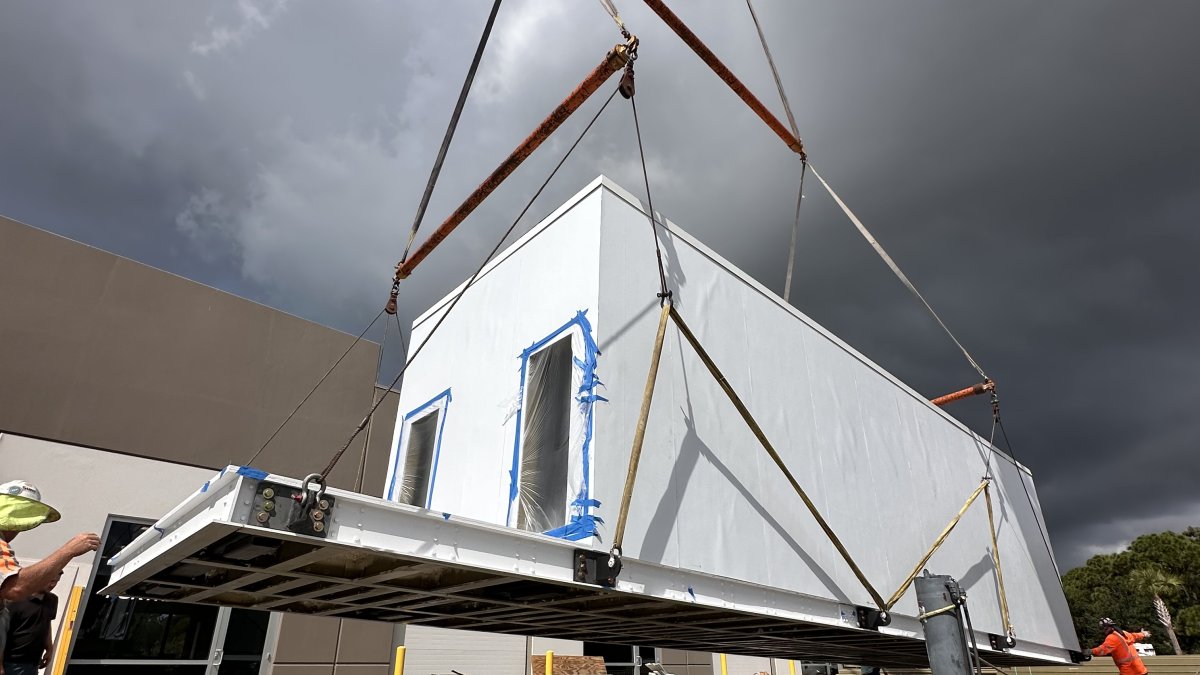
Mavria came out of stealth on Monday with $130 million raised across its pre-seed and seed rounds and a valuation of about $1 billion, on a proposition that is less about chips than about how the buildings around them get made. The Houston-area company wants data centers built as standardized products on an assembly line rather than as one-off construction projects on a field.
The latest round was led by Paradigm, with AMP PBC, Liquid 2, Critical Frontier and Dream Ventures participating; the company disclosed a cumulative raise rather than the size of the newest round, which the Wall Street Journal reported at $100 million. Mavria is headquartered in The Woodlands, Texas, north of Houston, and has 35 employees. It was founded by Adam Blake, who built a commercial solar business and sold a software company to Vista Equity Partners; Nick Poradek, who sold an energy equipment business to Liberty Energy; and Seth Cohen, a former Kirkland & Ellis lawyer who worked on restarting American nuclear power.
The first product is Terrain, a 5-megawatt data center delivered as a single integrated module. Each unit ships with power distribution, direct liquid cooling, automation controls and standardized IT racks already installed, and is sized to travel by truck. The proposition is that a customer orders capacity the way it would order industrial equipment, with a specification and a lead time, instead of assembling transformers, switchgear, chillers and trades on a site that has to be permitted first.
Manufacturing has started. Terrain 01 is in production at the company's Houston facility, with testing scheduled for early 2027 and assembly lines expected to scale output by the middle of that year. Mavria has not disclosed any customers, which is the gap in the story that matters most: a $1 billion valuation is being assigned before a single unit has been delivered to a buyer.
The company also makes a grid claim that is central to its pitch. Mavria says its modules can connect directly into local distribution lines to absorb excess capacity, letting a buyer side-step the interconnection queues that now stretch years in parts of Texas, Virginia and the Midwest. Whether that works at scale depends on utility practice and on how much spare capacity actually exists at the voltages a 5-megawatt block needs, and no third party has verified it.
The diagnosis behind the bet is hard to argue with. Compute build-outs are currently limited less by accelerators than by transformers, switchgear, power and skilled labor, and nearly every site is still a custom project with its own engineering. Turning that into a repeatable product is how solar and liquefied natural gas drove their costs down, and a handful of other companies are chasing the same idea from the cooling and enclosure side.
What it means: the interesting part of this round is who is paying for it. Paradigm is a crypto-native fund, and its lead position in a physical infrastructure deal says something about where AI capital has moved now that software bets look crowded. The risk is equally clear. Factory-built modules shift the hard problems to logistics, utility approvals and service, none of which get easier because the box was built indoors. Mavria's first delivered and running unit will be the only number that settles the argument.
Comments (0)
Log in to join the discussion
Log InNo comments yet