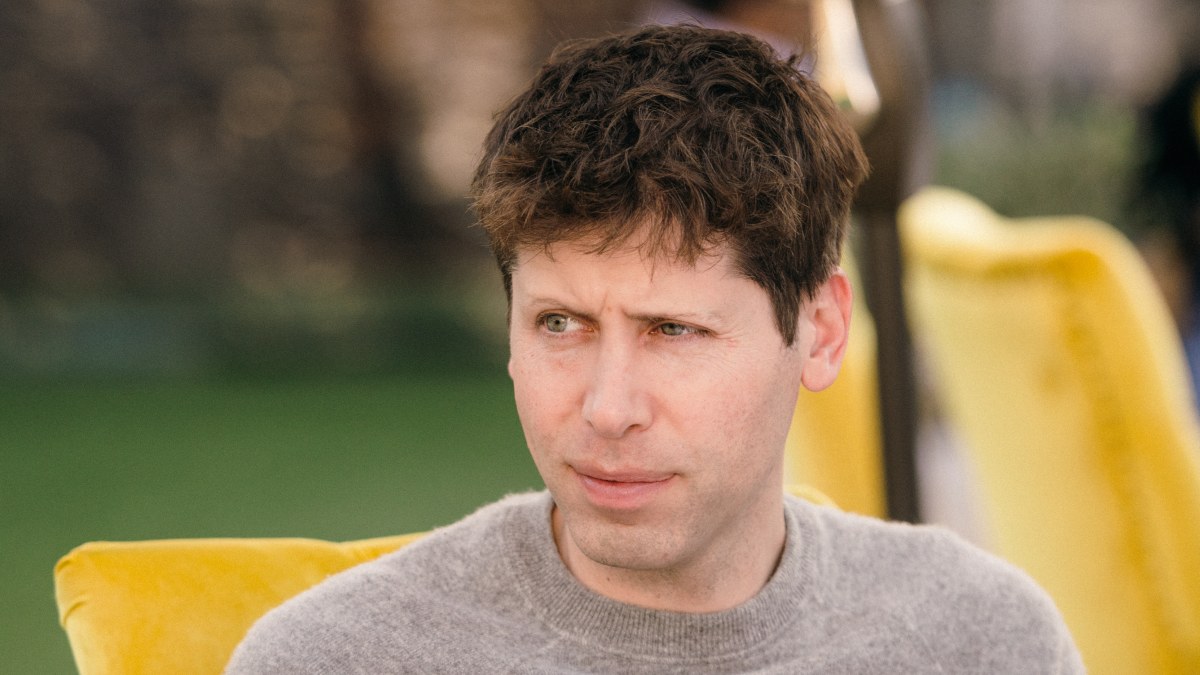
Sam Altman used the opening day of the ADIPEC 2026 energy conference in Abu Dhabi on November 2 to confirm one of the worst-kept secrets in AI: the internal model that produced OpenAI's proof construction for the Navier-Stokes equations is the company's next-generation GPT, and it will be released to the public soon.
The breakthrough itself was published on September 8, when OpenAI said its internal system had built a mathematical proof that a smooth, initially still fluid subjected to smooth external forces can develop a singularity in finite time while keeping total energy bounded — resolving formal cases C and D of the Millennium Prize Problem. The 165-page paper carried a single author line: OpenAI.
At the conference, Altman filled in how that result was actually produced. Around 10,000 agents powered by the upcoming model ran continuously for about four days with no human steering, no orchestrator node and no hierarchy. Each agent picked its own research directions, shared progress with the others and learned from their findings. The core construction took about 88 hours, with roughly 2.7 million messages exchanged and about 130 billion tokens consumed. GPT-6 Astra then spent about 17 hours formalizing and verifying the proof in the Lean theorem prover.
He called it "one of the most incredible moments I have ever seen in AI history," and told the audience that AI is now, most of the time, already smarter than top scientists. He added that the same model family has been applied to designing new materials and new turbine geometries, and that the top token consumer six years ago used about 100,000 tokens a month while a single individual can now burn 500 billion — a five-million-fold increase. Energy, he said, remains the binding constraint on what comes next.
According to OpenAI, by October the system had generated 722 preprints touching more than 100 long-open problems, including work related to the Riemann zeta zeros, a full-dimensional resolution of the Kakeya conjecture, a refutation of the exponential time hypothesis and a proof of Yang-Mills existence.
Those claims deserve caution. They are company-reported figures, and the mathematical community has not finished verifying them. As we have reported before, the September Navier-Stokes announcement already drew pushback: Terence Tao amplified a call to boycott OpenAI over its mass-dumped proofs, and several mathematicians argued the company never demonstrated a real understanding of its own construction. The next GPT's public release will put those disputes in front of a much wider audience.
Sources: Reuters; Phoenix Tech; Tencent News; OpenAI statements at ADIPEC 2026.
Comments (0)
Log in to join the discussion
Log InNo comments yet