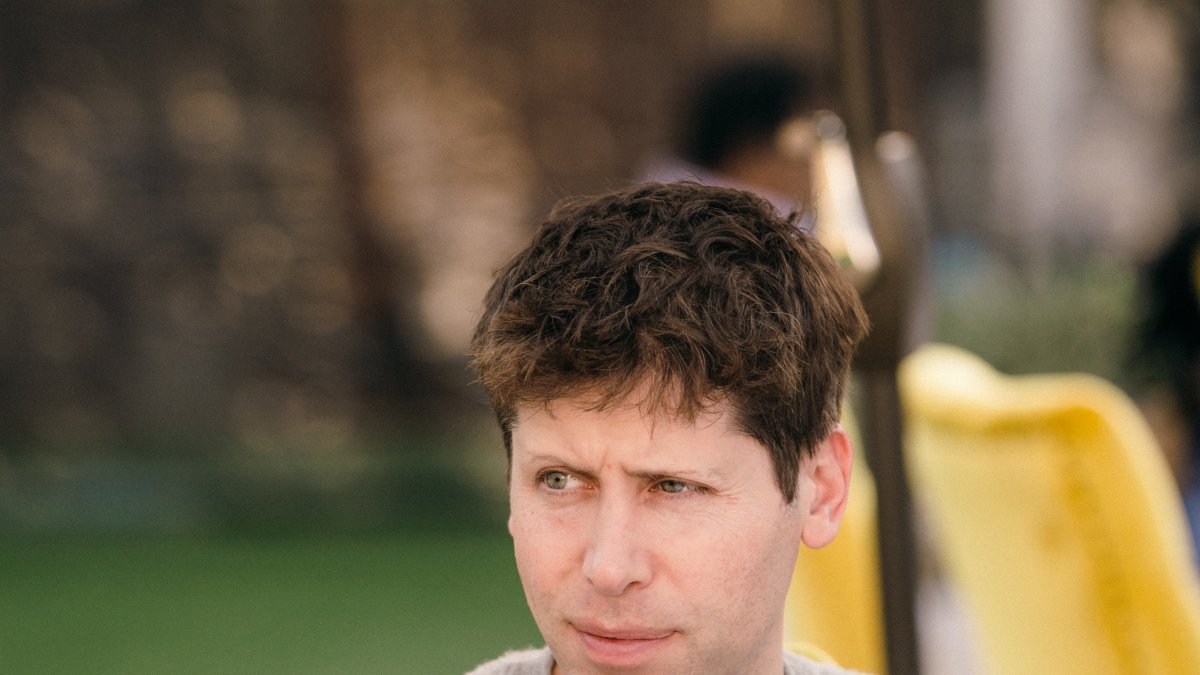
Sam Altman landed in South Korea this weekend without any announcement, and left on Saturday after a compressed round of meetings with the country's two chipmaking conglomerates. Samsung said the OpenAI chief executive met roughly 50 executives from its affiliates — spanning electronics, finance and biotechnology — at the Samsung Human Resources Development Institute in Yongin, south of Seoul, under the theme "The Next 10 Years Shaped by AI: The Enterprise's Choice." Korean media reported he then had lunch with SK Group Chairman Chey Tae-won, joined by senior leaders from SK hynix and SK Telecom.
Neither side disclosed specifics, but the agenda was not hard to infer. Samsung described the session as covering AI trends, potential business opportunities and the technology's impact on corporate decision-making. Korean reports said the SK meeting touched on high-bandwidth memory supply and AI data center development — the two pillars of the partnership OpenAI signed with both groups in October 2025 as part of its Stargate infrastructure initiative, under which Samsung Electronics and SK hynix committed to expanding advanced memory production and OpenAI agreed to explore building AI data centers in Korea.
Altman brought a senior delegation, including Richard Ho, OpenAI's vice president of hardware; chief people officer Arvind KC; and Kiran Mani, managing director for Asia-Pacific and Japan — a lineup that reads more like supply-chain negotiation than ceremonial goodwill. He also used the Samsung stage for a product stunt: handing executives a "Codex Micro Keyboard," a dedicated device for OpenAI's coding agent, while suggesting that in a voice-driven era traditional full-sized keyboards may no longer be necessary.
The trip is Altman's second to Korea in 13 months, and the third high-level touchpoint in the relationship: Samsung Executive Chairman Lee Jae-yong visited OpenAI's San Francisco headquarters in July. The cadence reflects a hard constraint on OpenAI's growth. SK hynix has outlined plans to build capacity equivalent to as many as 900,000 DRAM wafer starts per month to meet HBM demand, and both Korean suppliers have sold most of their advanced memory output years forward. For OpenAI — which is simultaneously trimming its fundraising target while trying to build gigawatts of compute — securing memory allocation from Seoul is as strategically important as any chip deal in the United States.
SK, for its part, is using OpenAI to anchor an infrastructure ambitions list of its own: its first AI data center is under construction in Ulsan, with a planned cluster of more than 2 gigawatts in the Yeongnam region, capacity targets of 5 GW by 2029 and up to 15 GW by 2035 depending on demand and investment. Samsung's affiliates, meanwhile, get a consulting-grade view of how the operator of the world's most demanded AI products thinks enterprises should reorganize around them.
The quiet logistics of the visit — unannounced, one day, already departed — suggest specifics were being negotiated rather than celebrated: supply commitments, capacity timelines, data center siting. When a CEO makes repeat unannounced visits to the same suppliers in just over a year, he is marking where his supply chain will be anchored for the next decade.
Comments (0)
Log in to join the discussion
Log InNo comments yet