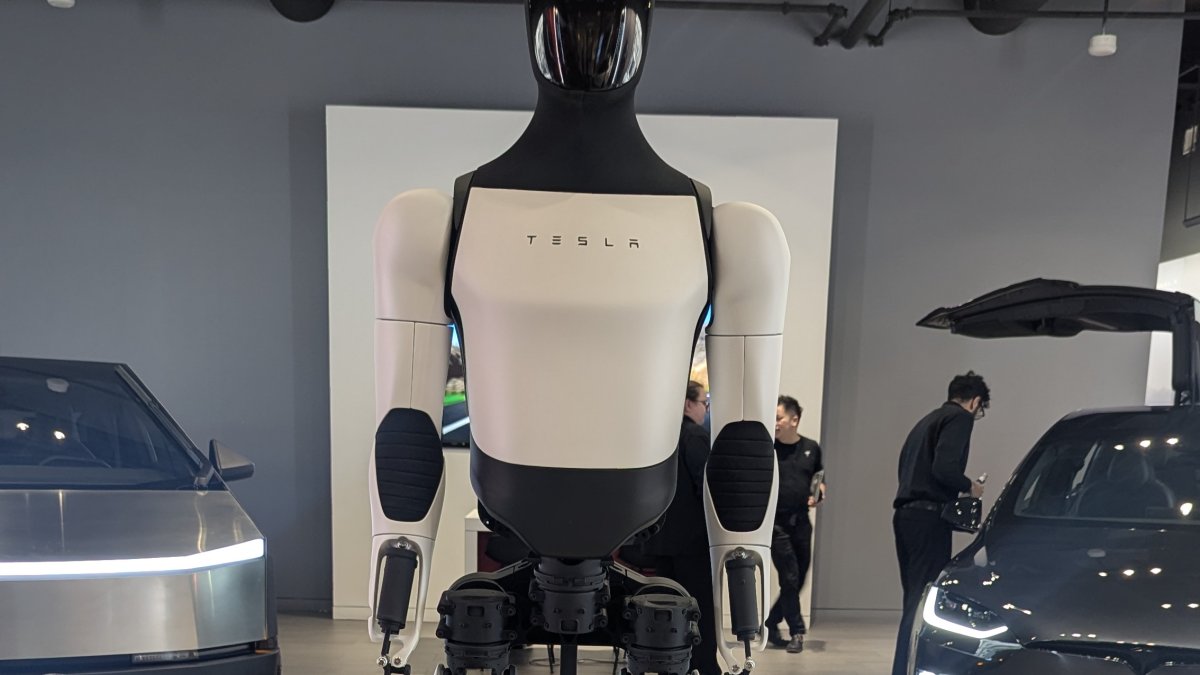
Tesla is leaning toward renting out its Optimus humanoid robot instead of selling it, according to comments Elon Musk made at the 33rd Baron Investment Conference in New York this week. Musk said he thinks the company would "probably" rent the machines rather than put them up for sale, with the rental price and the kinds of work they would perform still to be worked out, according to reporting from the conference picked up by Not a Tesla App and Chinese outlets including IT Home.
The cost picture Musk sketched is concrete by his standards. He put the initial manufacturing cost of an Optimus unit at around $30,000 — roughly what it costs Tesla to build a car — and said he expects that figure to fall to about $20,000 over time. On output, he described five times the productivity of an average human worker as the conservative floor for a mature unit, and argued that somewhere between 20 million and 30 million Optimus robots could match the entire output of American goods and services.
Those numbers are Musk's own projections, not independently verified figures, and his track record on Optimus timelines has run long before. But the business-model shift he described is the more consequential part: renting rather than selling turns a one-time hardware purchase into recurring revenue, in the same direction Tesla has already pushed with FSD subscriptions and its robotaxi plans. It also keeps ownership — and the liability for a robot that malfunctions in a factory — on Tesla's side of the table while the hardware is still young.
The production story is moving in parallel. Tesla started early Optimus production at its Fremont factory in October, using lines freed up when Model S and Model X output wound down, and the line is designed for an eventual capacity of one million units a year. Musk cautioned that reaching full-rate production will take at least another year. The delivery sequence runs from Tesla's own factories first, with external enterprise deliveries expected around the end of 2027 and a version carrying the company's AI5 chip targeted for around April 2027.
A leasing model would also explain the caution on timing. A robot that is still working through reliability and dexterity problems is a hard thing to sell into a customer's plant, because every failure becomes the customer's problem. Renting it keeps the iteration loop inside Tesla's own economics: the company eats the downtime, collects the data, and upgrades the fleet the way it updates software. The comparison investors will reach for is heavy-equipment rental, a business that lives or dies on utilization rates and service networks — neither of which a consumer-style product launch would build.
The next fixed date is Tesla's shareholder meeting on December 3, where pricing and leasing terms may firm up. Until then, the five-times-productivity claim and the $30,000 cost figure should be read as targets set by a founder who needs the robot program to justify a very large share of Tesla's valuation — and as a signal that when Optimus does ship in volume, Tesla intends to be paid by the month, not by the unit.
Comments (0)
Log in to join the discussion
Log InNo comments yet