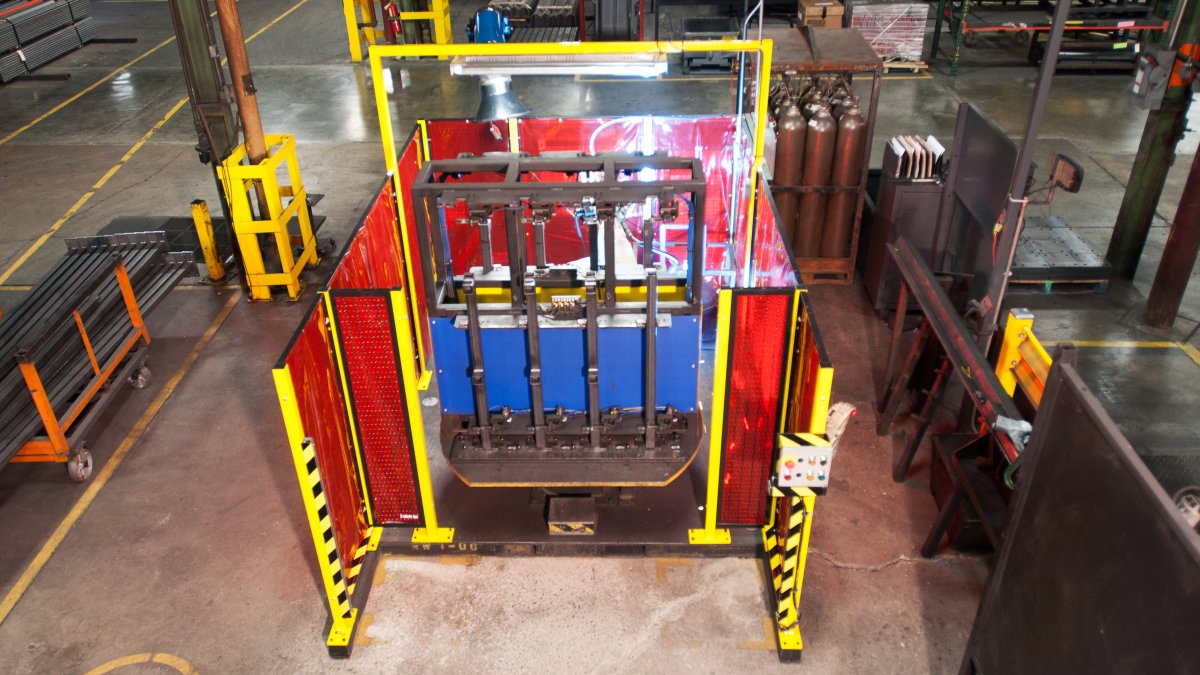
Foundry Robotics said Wednesday it raised a $100 million Series A led by Marlinspike Partners, money it will put into a 130,000-square-foot autonomous assembly plant in Emeryville, California. Khosla Ventures and Red Glass Ventures returned, joined by SE Ventures, Wing VC and Axiom Ventures, with Hanabi and Zero Shot Fund also participating. The company says the facility represents a twentyfold increase in manufacturing footprint.
The unusual part is what Foundry sells. It does not sell robots for a customer to integrate into its own plant. It owns and operates the factory and sells finished hardware with the required quality and traceability. Customers bring a design, among them drones, autonomous-vehicle subassemblies, wire harnesses, underwater vehicles, telecom and data-center infrastructure, ground robots, rugged computers and satellites, and Foundry takes it to production.
The production system is a grid of robotic cells trained on assembly primitives and coordinated by FoundryOS, which the company describes as a single agentic system linking robots, factory systems and cloud infrastructure. Every production run feeds back into the models, so a cell that assembles a drone today can be retrained on a satellite component tomorrow. Foundry also sells design for robotic assembly, simplifying fastening and cabling steps so a product is buildable by a machine rather than by a pair of hands.
The pitch lands on a real bottleneck. Traditional assembly lines are built around a single product, take months to deploy and are expensive to reconfigure, which is why defense and industrial customers that iterate designs faster than they can build them end up queueing. Duane Fotheringham, president of HII Unmanned Systems, framed it in the announcement: "Production capacity is a national constraint on getting unmanned systems to the fleet."
The founders' backgrounds explain the investor list. Adarsh Kulkarni was employee number four at Ghost Robotics, building legged robots for the U.S. military, then Scale AI's inaugural head of robotics, where he built data partnerships with Generalist AI and Physical Intelligence. Emmanuel Lamacchia was the single-threaded owner of Tesla's Model Y program, responsible for manufacturing roughly 1.5 million cars a year. The leadership team also includes former Tesla software lead Anup Karmakar and manufacturing veterans from Raytheon and Northrop Grumman.
Two claims need watching. Foundry says customers move from design to production in weeks, and it describes itself as America's first autonomous factory for assembly. Neither has an external benchmark, and the release discloses no production volumes by product category. Autonomous here does not mean unattended: robotic cells work alongside experienced manufacturing teams, and hiring across robotics research, engineering and factory operations is listed as a use of proceeds.
The bet is that factory design, not robot dexterity, is the binding constraint. Retrofitting automation into a plant built around human hands runs into awkward connections and flexible parts. Foundry's answer is to orient the building, the tooling and the product design around machines from the start, which shifts the unit of manufacturing organization from the product line to the skill-based cell and, if it holds, makes capacity reusable across customers and therefore financeable.
What to watch next is throughput: sustained output, first-pass quality and the time needed to onboard a second product. Capital is no longer the constraint at this stage. Repeatable production is.
Comments (0)
Log in to join the discussion
Log InNo comments yet