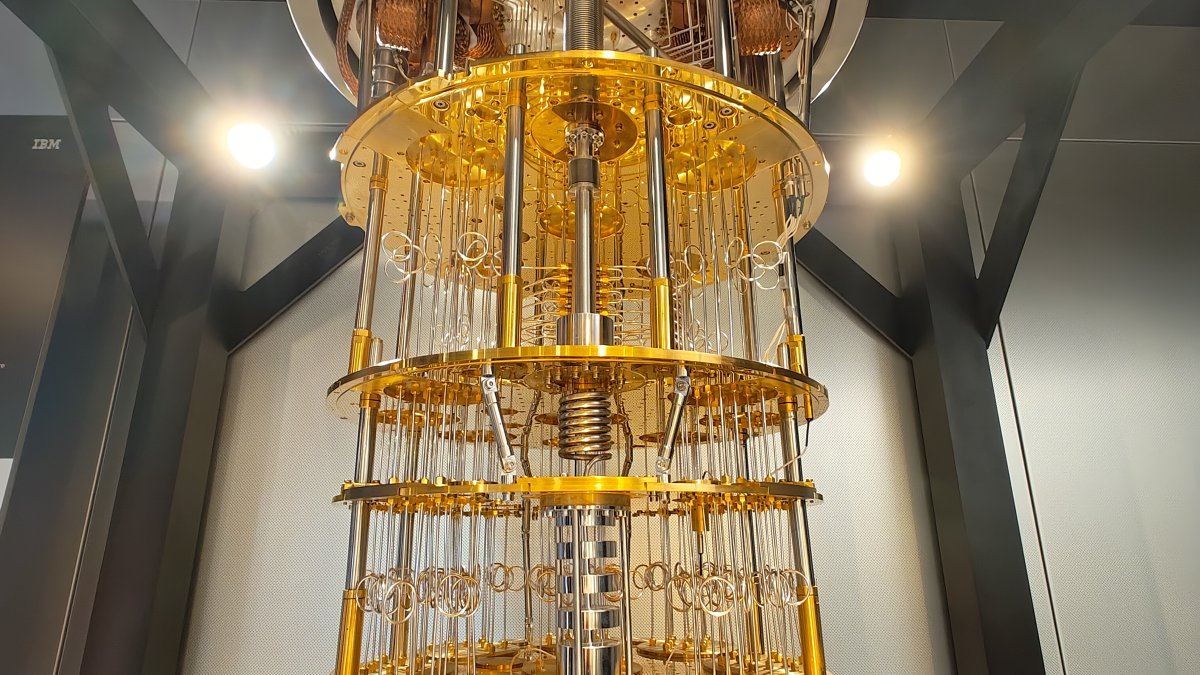
IBM said Tuesday that its next-generation quantum processor, Nighthawk r3, will be built to accurately execute 10,000 quantum operations across 520 programmable qubits, while maintaining the speed and quality of the current generation. The company also confirmed plans to connect two r3 processors into a single 1,040-qubit system in 2027.
The baseline matters. Nighthawk r2, introduced in September, delivers accurate computations with more than 7,500 quantum operations on 120 qubits and up to 100,000 samples per second. Its key trick is high-speed qubit reset: rather than waiting hundreds of milliseconds for qubits to return to their ground state between circuits, IBM dedicates extra physical qubit devices to draining energy from the programmable ones, cutting reset time from roughly 200 milliseconds to about 25 nanoseconds without disturbing neighboring qubits. IBM has credited the architecture with accelerating some operations by up to 19x, and r3 extends the same design to a much larger die.
The 2027 system represents a quiet roadmap rewrite. IBM's earlier plan promised a 1,080-qubit machine by chaining nine 120-qubit Nighthawk chips; the new plan gets to 1,040 qubits with just two chips, each carrying roughly ten times the earlier qubit count. The enabling technology is chip-to-chip coupling: IBM says four L-couplers joined two Nighthawk r1 processors in the same refrigerator with state-transfer fidelities up to 99.4%, close to its 99.9% long-term target, and that interconnect speed is comparable to on-chip qubit connections.
Speed is the frame IBM is pushing. Jay Gambetta, who leads IBM Research, argues that valuable quantum computing needs accuracy and speed together: industry-relevant applications demand circuits with thousands of operations on 100 or more qubits, generating millions to billions of samples, and a machine that answers accurately but slowly cannot solve real problems at reasonable cost.
The path beyond r3 is error correction, and the arithmetic is sobering. IBM's long-term design hosts a block of 12 logical qubits on roughly 300 hardware qubits, which means one or two logical blocks per chip at best; reaching the 100-plus logical qubits where genuinely useful algorithms become possible requires both bigger chips and five or more linked together. Ars Technica also notes a slippage IBM did not highlight: a 2026 plan to link three chips into a 360-qubit machine never materialized, with r2 shipping as a single chip instead.
For AI and optimization workloads, the announcement is less about a headline qubit count than about throughput: samples per second and operations per circuit are what determine whether quantum can act as a co-processor for materials simulation, chemistry and large-scale search rather than a demonstration machine. IBM's competitors in the superconducting camp and the trapped-ion camp are chasing the same milestone from different directions, and 2027's two-chip system will be the first real test of whether modular scaling holds.
Comments (0)
Log in to join the discussion
Log InNo comments yet