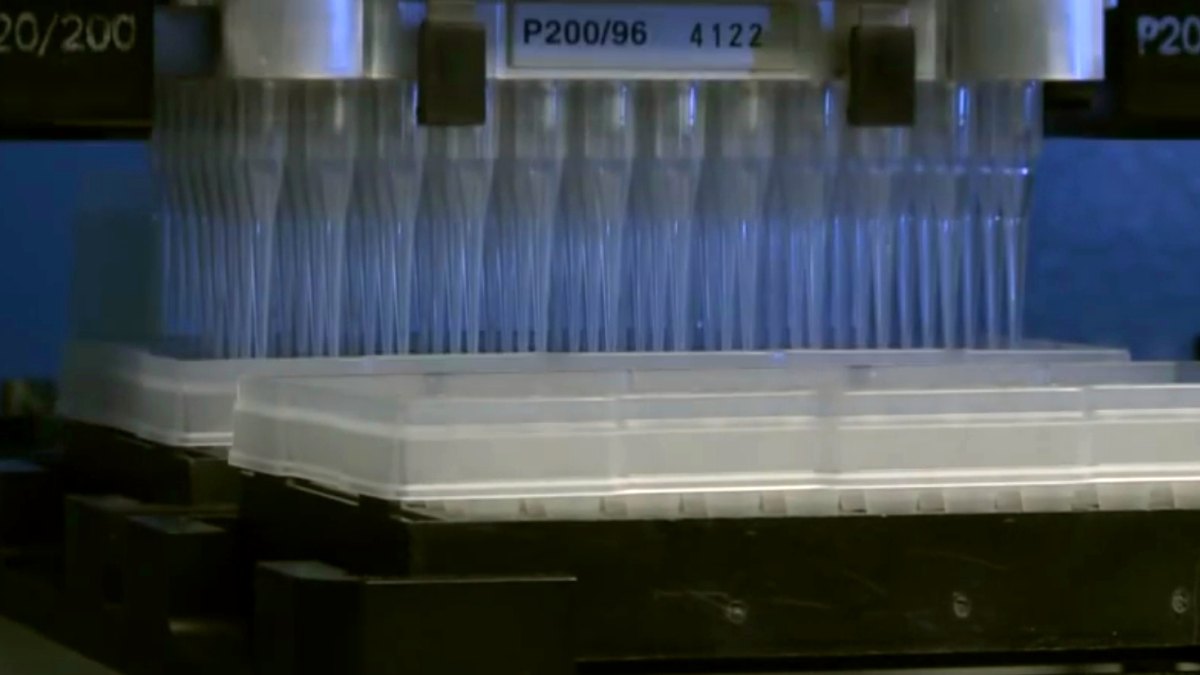
Google Research published a post on October 16 titled "Grounding AI agents in biological reality: Building blocks for autonomous wet labs," laying out three linked efforts to move AI agents out of chat windows and onto laboratory benches: VERID, a control layer for lab robots; an aptamer design sandbox; and a de novo protein binder pipeline. The unifying idea is a closed loop in which a model proposes molecules, robots test them, and the measurements flow back to improve the next round of designs.
VERID, short for VERified Infrastructure for Discovery Laboratories, is built on the open-source PyLabRobot framework and maintains what Google calls a semantic digital twin of the workcell: a live, stateful 3D entity tree tracking robotic geometry, well volumes, reagent identities and pipette tip inventory. Agents rehearse protocols in simulation before anything touches a reagent, hardware safety checks intercept invalid commands, and synchronized video and action logs preserve every run for debugging. The simulator is already catching physical mistakes that code review would miss; in one example an eight-channel pipetting span of at least 72 millimeters was blocked from a 71.2-millimeter trough before the robot attempted an impossible motion.
The most instructive results come from failure. In a blinded dye-mixture reconstruction task, an agent running repeated robot experiments against overhead camera images learned to identify its own optical and fluidic artifacts, improving accuracy more than fivefold, with Google reporting the average error metric falling from about 307 to 58 across the campaign. Video plus action logs also let the system diagnose dye stratification caused by dispensing too close to a well bottom, and the digital twin's retained state allowed work to resume after a plate reader failed mid-run without repeating the pipetting.
The aptamer sandbox turns the loop into chemistry. A complete design-test-analyze cycle takes 7 to 10 days, because DNA libraries can be synthesized in pools and read out directly by sequencing. Targeting thrombin, the first round produced zero confirmed binders, which Google attributes to fixed primer overhangs disrupting folding in 48 percent of sequences; adding stabilizing flanking stems lifted the hit rate to 26.0 percent, and diversifying designs in round three reached 42.1 percent at 98.5 percent specificity. The myoglobin run is the cautionary tale: agents chasing affinity alone produced sticky G-quadruplex structures that bound everything in sight, collapsing specificity from 75.0 to 19.1 percent, before the agents revised their own design rules and recovered to 72.4 percent specificity with a ninefold rise in on-target hits to 33.5 percent.
The third report pushes the same workflow at protein design. Applied to fibroblast activation protein alpha, a receptor overexpressed in solid tumors, a few experimental rounds yielded binders with single-digit nanomolar affinity by the company's own measurements, screened via yeast surface display. Restricting structure prediction to the local binding pocket, an approach Google calls epitope excision, accelerated each cycle more than eightfold, with the blog figure citing 8.6 times, and human-agent collaboration nearly doubled the in-silico hit rate of a scientist working alone at equal compute.
The caveats matter as much as the headline numbers. Everything above is self-published by Google, not peer-reviewed; the binder molecules are research reagents, not drug candidates; robot-executed wet-lab validation so far used dye and water rather than real biological assays; and the three tracks are not yet connected into one system. Humans still authorize every sequence, verify protocols and supervise robot runs, and Google says the testbeds deliberately avoid gain-of-function risk. Still, the direction is clear: the industry's recursive self-improvement loop, until now confined to code and text, is being wired to physical instruments, and the first returns suggest that empirical feedback is exactly what pure in-silico molecular design has been missing.
Comments (0)
Log in to join the discussion
Log InNo comments yet